The Decalogue was intended primarily for government leaders
In my last article I introduced my next few series of blogs regarding the Ten Commandments the way they were understood by the government leaders of Israel (i.e. the Elders). The primary purpose of the Decalogue is misunderstood by most Christians (and even most pastors), because virtually all Bible commentaries and catechisms approach them from a religious perspective and explain them for personal holiness. All of that is well and good, but it is not why they were given. As they say today, pronouns matter.
The Hebrew word dabar is translated in KJV as “word” over 800 times in the Old Testament but only 3 times as “commandment” (Ex 34:28; Deut 4:13 & 10:4). The term Ten Commandments is better understood as Ten Words, meaning ten big ideas or transcendent values for governance of a nation.
The Ten Words are the preamble of the “Book of the Covenant” (Ex 20-23). The term covenant was itself not automatically used only in a religious sense. Covenant first appeared in Gen 9 when God gave to humans (i.e. Noah) the responsibility for punishing crime and upholding justice in a sinful fallen world. Humans, for the first time in world history, were responsible to put murderers to death (Gen 9:6), and likely to bring justice for every lesser crime as well.
The term covenant appeared a second time when God told Abraham to start a new nation (Gen 12). The term “nation” first appears in the Bible in Gen 10, immediately after civil government began (“nation” in the Bible is therefore more than just an ethnic group). So, when God gave Abraham instructions for starting a new nation, the word covenant is used. Again, it is associated with governance and law, not religion. Abraham was a prince in charge of Israel’s government, not a priest (same for Isaac and Jacob).
So also, when God gives Moses the “Book of the Covenant” and instructs him to present it to the government leaders (i.e. Elders), its main purpose is clear: national governance, not personal piety. To the leaders of Israel covenant was the equivalent of what we in modern times call a constitution. Today people usually think of a constitution as a document for structuring good governance of a nation and do not think of it is a private religious way. That is how Moses and the Elders of Israel understood it.
God gave Noah and Abraham oral constitutions, but to Moses it is a written one; hence a “book” of the covenant (Ex 24:7). The Book of the Covenant included four chapters of laws in Ex 20-23, and the Ten Words was simply the preamble that stated the major goals for Israel’s government. The ten transcendent values for a good society had to have specific laws written and implemented in order to be practical, therefore the Ten Words is followed by the case laws of Ex 20-23.
When Moses came down from the mountain it says in Ex 19:7,8 that he “called for the elders of the people, and laid before them all these words. And all the people answered together…” This shows that Moses presented the constitution to the government leaders and they apparently presented it to the citizens under them in their tribes. It was a process that resulted (probably taking some time for deliberation) in the consent of the citizenry (“we will”).
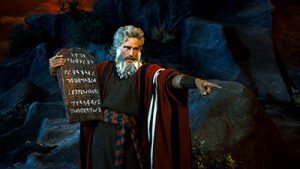
The Decalogue begins with the pronoun “Thou” (or “You” in modern English). Since it was a statement of ten big ideas for good governance of the nation, it is important to grasp who is the intended audience. The general people did not have official governing authority, but their Elders did. So, even though the general citizens needed to understand this constitution and consent to it, each statement was primarily addressed to those holding governing responsibility. It was mainly saying that the government leaders of the nation are empowered and responsible for this constitution to be implemented, but the general citizens are responsible for holding them accountable to do it. So, the primary way they understood “You shall not steal” was that their government leaders shall not steal. [So the picture of Moses above would be understood as him pointing to the government, not the citizens!] It was setting standards for good governance in major contrast to pagan states of that time. Of course, citizens also should not steal, but that was not the primary focus of the Ten Words. Citizen restrictions were stated later in their constitution (ch 20-23).
In subsequent blogs I will be explaining in detail what I summarize below. The ideal model of government that God set up in Israel was a state that:
did not recognize contrary sources of law
did not use or misuse religion & marketplace
did not violate life, marriage, property, justice
did not infringe citizen liberty in all other matters
And the ideal state would positively:
empower schools & families
In the extra paid section below I provide an excerpt from Shearer’s 1910 work: Hebrew Institutions Social and Civil. Subscribe below.
The content below was originally paywalled.
Hebrew Institutions Social and Civil by J. B. Shearer, 1910
H e b r e w C o d es. [excerpts from chapters 15 & 16 of the book]
Law is a comprehensive term. It defines man’s rights and duties, whether toward God or man or self. It is enacted by competent authority, and recognized authority. It is enforced by a variety of sanctions. So-called unwritten law is custom recognized as having the authority of law. Some laws are permissive, some are requirable, and some are prohibitory. Some set up and define permanent institutions such as we have been discussing, and some are intended to regulate personal conduct. None of these distinctions, however, suggest satisfactory lines of cleavage for scientific classification.
A code is an “orderly collection, system or digest of laws.” It is scientific in so far as it is systematic and based on accurate analysis. We speak of the Ten Commandments as the moral code. We speak of the Theodocian Code and the Justinian Code which were collected and promulgated by their authors. We do not speak of the Mosaic Code because the laws promulgated by Moses are not presented in systematic form. We speak of a Criminal Code because it includes a certain class of laws.
The laws of Moses as found in the Pentateuch and as modified by later competent legislation are a composite whole. They embrace social, civil, moral, ceremonial, religious, criminal and institutional laws as a concrete unit with slight trace of logical order or coherency. Modern critics profess to discover various and sundry codes— ‘the Priestly Code,” “the Deuteronomic Code,” “Levitical Codes,” and others—which were promulgated as the centuries passed, and bunglingly combined with a small modicum of Mosaic laws, by unknown redactors.
It would be easy to understand how such codes, if ever discovered, might have been constructed out of Mosaic legislation by analysis, and by a more systematic arrangement. But it is hard to discover on what principle such codes, if promulgated, were combined by those redactors into their present form.
It may not be out of place here to re-emphasize the fundamental principles with which we set out in this discussion. Moses was not the lawgiver, nor the author of the institutions named for him, nor was any law based on his authority; but it all originated with God himself in the person of the Son, the Theocratic head of the commonwealth. It was all as righteous, just and holy as the author himself. The nineteenth Psalm is most positive on this point; “The law of the Lord is perfect, etc.” The 119th Psalm re-inforces this doctrine in every possible form of statement throughout the 176 verses. Paul says, “The law is holy and the commandment holy, just and good.” Rom. vii. 12.
How then do modern condescending critics say that these institutions and laws were relatively perfect—better than surrounding Pagan institutions, and therefore worthy of all pride and praise? They say that they are the best that could be done in that semi-barbaric age, but are far short of the standards of the present day. Per contra, we hold that all that is good in present standards originated from the Scriptures, and is good only as far as it conforms to them. The divine lawgiver made no compromises with evil.
While this is our attitude in all these discussions, we enter upon no wholesale defense of Mosaic institutions except to brush away misconceptions and misrepresentations. The best vindication of them is careful analysis and accurate definition, just as in other fields of truth. It often happens that error in doctrine or practice is best refuted by stating the truth in contrast. We have already discussed the leading institutions in this way. We come in this chapter to analyze and classify their laws as distinguished from their institutions.
It may not be out of place here to inquire why such a variety of laws are so intermingled in the record without any apparent law of classification. One would say it was due to Eastern modes of thought which still deals with the concrete rather than the abstract. Another might say that the social, the civil, the ceremonial and the religious are so intertwined and overlapping that none of the groupings are really illogical. Both these answers are no doubt true. Besides, some of the groupings evidently grew out of environment and historic conditions. These speculations are, however, immaterial.
It would be easy by analysis of Mosaic laws to construct several codes or systematic groups of laws more or less extensive according to the principles of classification which may be adopted.
I. We might easily construct a Levitical code. We might subdivide this into a Ceremonial and a Priestly code. We pass over these codes because they do not come within the purview of this discussion.
II. We can easily construct an Ethical code in the same way, starting with the Decalogue. But we pass over this also for the same reason, except as so many social and civil laws are based on moral distinctions. Indeed, it is said of them all that they are holy, just and good.
III. It would not be difficult to construct a social code out of abundant material outside the family which we have already discussed. The fundamental idea of such a code would be the second table of the law which is summed up in the words, “Thou shalt love thy neighbor as thyself.” All of the provisions of such a code would come under one or more of the six commandments of the second table, so far as they are based on moral distinctions. They are re-inforced to us by the prophets and then by Christ in the Sermon on the Mount and everywhere in his teachings and example.
IV. We might also construct a civil code. This would embrace causes to be tried before the civil magistrate in order to determine disputed claims and rights which do constantly arise among men. This would include collection of debts, divisions of inheritances, settling of disputes, divorce proceedings and such like. Such civil proceedings, both in law and equity are substantially the same in all good government. We find nothing exceptional or calling for special mention in the Hebrew civil code.
V. We might also construct a commercial code.
a. Just weights and measures
b. Usury
c. Creditor’s rights
VI. We come now to consider the criminal code, more properly called the Penal code. It is here that modern rationalistic critics get in their most plausible charges of cruelty and semi-barbarism. We may consider several of their penal statutes.
a. Capital punishment for murder.
b. Capital punishment for rape and adultery.
c. Capital punishment for a son who cursed or smote his father or his mother, or was stubborn and rebellious, “a drunkard and a glutton.”
d. The same punishment was meted out to the man stealer and the kidnapper.
e. the death penalty for idolatry and false prophesy.
f. The law of stripes.
g. The punishment of theft.
h. The Lex talionis.
i. The martial code.