Part 10 of a Political Narrative of the New Testament
In the previous post we examined the main political principles and ideas in Paul’s letter to Roman citizen assemblies. We saw Paul teach about law, judgement, overcoming evil with good leaders in government, conditional submission to the state, and his news of Erastus now holding elected office in the Corinthian city government.
[Note: This series of posts does not assert that politics is primary in the New Testament, however, there are often overlooked principles and ideas that are worthy of attention. For context we paraphrase certain Bible terms by how it was understood at the time. We ask ourselves: ‘What did this word or phrase mean to those first-century hearers or readers? Then we paraphrase the scripture to reflect that understanding. A simple example is the word ekklesia which today is translated church and means a religious meeting to most people, but in New Testament times it was understood by everyone to be a citizen assembly focused on solving community problems. Modern readers of Scripture focus only on the religious activities and teachings in Acts and the Epistles. But Christians were active in politics from the beginning. Failure to understand this and to believe Christianity only belongs in the religious sphere leads some people today to wrongly judge Christian social activism as seeking improper religious imposition of beliefs using state coercion, i.e. ‘Christian Nationalism’ or Theocracy or Dominionism. Christian activism historically is mostly in the context of democratic pluralism.]
After Paul’s time in Corinth where he penned his letter to the Romans, he began his return journey to Israel in 57AD. His ship stopped in Miletus on the coast of Turkey.
Final Address to the Senior Statesmen of the Ephesus Council
Acts 20 says: “From Miletus he sent to Ephesus and called for the senior statesmen of the citizen council…” It’s important to note that he did not gather pastors of religious groups, but civic leaders of the ekklesia of the city.
In this light, He reminds them of that his central theme when previously with them was: “…the government of God,…[therefore] I am innocent of the blood of all men. For I have not shunned to declare to you the whole counsel of God.” This idea of being innocent of the blood of all men was the mentality of the old testament social strategists. Ezekiel 33:1-9 described this role of being a watchman of the city and nation. Prophets were not pastors and the context of Paul’s message was about protecting and serving all citizens, not pastoral advice for a church group.
Paul then exhorts the senior statesmen to “…shepherd the citizen council of God which He purchased with His own blood’…” This idea of being a shepherd again was not historically understood as a pastoral role for a religious group, but often used for the responsibility of the national civic leaders (i.e. Elders) in Israel. But here Paul applies it to the elders (senior statesmen) of the citizen council of God in Ephesus. As with his earlier journeys, Paul’s priority is not a narrow religious goal, but the larger Great Commission to disciple nations (Mt 28).
Paul Consults Social Strategists in Caesarea
When Paul continues his journey and lands in Israel it says in Acts 21 that he met with Philip who was one of the first ministers and evangelists elected in Acts 6. The scripture then tells us that he had four virgin daughters who “prophesied.” Recall in our earlier post on Paul’s letter to the Corinthian citizen assembly, that he explained that women were also able to “prophesy.” Our paraphrase of this means to “see strategic insights for society.”
But to have understanding of (i.e. “see”) God’s worldview of various things does not automatically mean that the same person must be the spokesperson of such insight in the public citizen assembly (Paul advised against women doing the speaking of it because it violated Greek law and could undermine Christian influence in the citizen assemblies). Again, this has nothing to do with women preaching in church as we think of it today. But clearly God gives women strategic insight about society. In fact in the Old Testament female social strategists such as Deborah, Huldah, Noadiah and Miriam were honored for their role serving the nation.
While Paul was there in Caesarea another social strategist from earlier in Acts appeared again – Agabus. Remember that his previous strategic insight for society was in regard to a famine and it caused the citizen assemblies to organize social strategic emergency relief plans. Now in Acts 21 the text says that Philip warned that the Paul would be arrested by the Jews in Jerusalem and “…deliver him into the hands of the Gentiles.” Sometimes Paul had fled such danger, and other times he faced arrest and trial. Agabus did not say what Paul’s response should be, but Paul said he “was ready” to stand trial and resist tyranny if need be.
But this insight into real politics of the time had to be discussed. We learned in the earlier post on the letter to the Corinthian citizen assembly that the gift of prophesy should be paired with the gift of interpretation. So Acts says: “On the following day Paul went in with us to James, and all the senior statesmen…And they said to him, “The citizen council must certainly meet…[to discuss Agabus’ strategic insight].” James, as we saw earlier in Acts, was the President of the citizen assembly in Jerusalem, but these sage leaders felt they should hear from the larger citizen council.
What were they to discuss? It was likely to decide their plan. Jesus had taught (Mt 10; Lk 10) that there are two main ways to resist government tyranny and injustice: peaceful protest or separation from the reach of the authorities (i.e. flee). The Apostles had done both previously, as did Paul. It seems that they sensed it was not time for Paul to escape, but rather it was time for peaceful protest.
As with the church leadership in Antioch (see previous post), we see here a beautiful healthy model of a team of social strategists working with senior statesmen and emissaries and the entire citizen council to find the best strategy for the moment. Modern churches that fail to bring prophets (social strategists) and elders (senior statesmen) into the inner circle with the pastors and teachers become largely irrelevant and impotent in the culture.
Paul’s Arrest and Legal Defense in Jerusalem
Then the scripture says that “…the people…seized Paul …seeking to kill him….And when they saw the commander and the soldiers, they stopped beating Paul….[Then] Paul said, “…I implore you, permit me to speak to the people.” In Paul’s speech he recounted his conversion and what Ananias had told him: “The God of our fathers has elected you that you should know His will, and see the Just One….” Here again is democratic language Paul uses of God’s vote for him, and of the title for Jesus being a political term: the one who is Just. Real justice is found in Jesus. The “Savior” or “Redeemer” would not be titles for such a message regarding Paul’s mission. Paul needed to know that the “Just One” was directing him.
After Paul’s speech in Acts 22 the crowd demanded Paul be executed but the Roman officer planned only to scourge him. But even that was a violation of his rights. So instead of accepting that abuse, Paul asked the soldier: “…Is it lawful for you to scourge a man who is a Roman, and uncondemned? …I was born a citizen.” Paul was strategic to use the Roman law and his rights as a citizen for this situation, and it indeed prevented the scourging. But really this time Paul would not be released. The necessity would be for Paul to endure many trials for the next several years in order to defend his rights through the legal system.
In Acts 23 Paul was on trial before the Sanhedrin. This was not the same as a citizen assembly or ekklesia. It was a legal body in Israel that consisted of priests, scribes and elders operating under Roman oversight, and the high priest presided over it. The scripture says that “…the high priest Ananias commanded [that they strike Paul]. Then Paul said to him, “God will strike you, you whitewashed wall! For you sit to govern me according to the law, and do you command me to be struck contrary to the law?” Paul was properly protesting a violation of law.
But the Scripture then says: “And those who stood by said, “Do you revile God’s high priest?” Then Paul said, “I did not know, brethren, that he was the high priest; for it is written, ‘You shall not speak evil of a ruler of your people.’”. Paul quotes from Exodus 22 and humbles himself when he realized that he had shown disrespect for the leader. God’s people are required to resist tyranny but to do so with respect to the positional authority of the state that was ordained by God. We can respectfully resist unjust and corrupt actions and policies of government leaders, but if we do not do it honorably it crosses the line into rebellion and anarchy which is condemned by God.
Paul then shifts his strategy of resistance to tyranny. The text says “….he cried out in the Sanhedrin, ‘…concerning the hope and resurrection of the dead I am being governed!’ And when he had said this, a dissension arose between the Pharisees and the Sadducees…” Paul used ideas to bring disruption. They were not lies, but certainly not the real reason the trial began. To be effective in transforming culture we have to be masters of ideas and language. Here Paul had a language strategy that worked. It shifted the debate and a riot ensured so the solders took Paul into safety.
Scripture then says that “The following night the Sovereign stood by him and said, “Be of good cheer, Paul; for…you must also bear witness at Rome.” This does not say to preach the Gospel of salvation necessarily, but could mean to faithfully speak up for real justice and good law (in alignment with the Gospel of the Government of God and the Great Commission to Disciple Nations). Paul needed this extraordinary encouragement because he would soon learn of a serious plot to assassinate him.
New Trials before Governors and King Agrippa, AD 58-59
Paul’s case was moved to the jurisdiction of Governor Felix. In Acts 24 it shows false allegations in the trial to which “Paul…answered: ‘…they [cannot] prove the things of which they now accuse me,…I…believ[e] all things which are written in the Law and in the Social strategists. I have hope in…a resurrection of the dead, both of the just and the unjust….’” Governor Felix would set up times to hear more from Paul and it is interesting that Paul’s message to him was about “…self-government, and the policy decisions to come.” This was great exposure to a Biblical worldview of jurisdictional governance but the reality is that Felix had mixed motives, for he “also hoped that money would be given him by Paul…” Corrupt state officers seek bribes (Ex 23:8].
But after two more years Porcius Festus succeeded Felix as governor and another trial was held. In Acts 25 it says that Paul argued: “Neither against the law of the Jews, nor against the temple, nor against Caesar have I offended in anything….I stand at Caesar’s policy decisions seat, where I ought to be governed….I appeal to Caesar.” Then Festus,…answered, “…To Caesar you shall go!” Paul was not just trying to preach the Gospel to more leaders; he was seeking justice and pushing for better governance using the legal system.
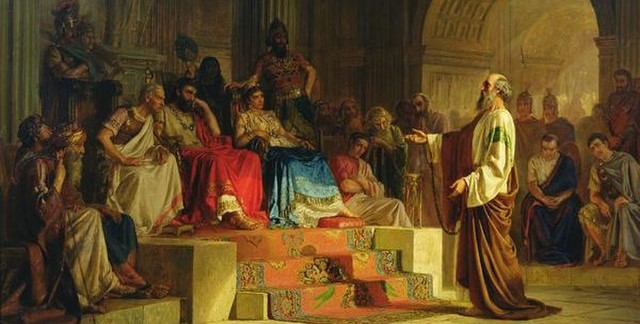
In Acts 26 it says the trial continued before King Agrippa and Bernice [see pic above of Paul on trial] and there Paul testified that before his conversion: “…I cast my vote against…” Stephen and the Jesus followers [Acts 8]. Paul admits that he had previously supported and participated in (voted for) the corrupt political system in Jerusalem. But now he declares that he is not “disobedient to the highest strategic social insight…saying no other things than those which the Social strategists and Moses said.” Then he directly asks: “King Agrippa, do you believe the Social strategists?” Notice the central emphasis of Paul on the social strategists for all he is doing. His mission is not just about evangelization and planting churches – it’s about changing society as the prophets of the Bible tried to do. Paul was not preaching about salvation here.
This kind of message is effective for the government sphere. The text says: “Then Agrippa said to Paul, ‘You almost persuade me to become an agent of the pre-chosen Ruler (i.e. a Christian. See previous post).” In other words, he was seriously thinking about switching allegiance to the coming Ruler over all. Paul’s message about government (i.e. Kingdom) of God was having an effect.
“….Then Agrippa said to Festus, “This man might have been set free if he had not appealed to Caesar.” This is a crucial fact. The king was saying the evidence does not warrant Paul being under arrest any further and he could be released. Paul understood this but wanted more than just his personal freedom. Like in Acts 16 when the magistrates in Philippi said he could go free, Paul refused to leave the prison and protested the violation of his rights.
Paul’s appeal to Caesar was a determination to fight for transformation of government – for justice – through the legal system. This was just as important to the Apostle as was winning souls for heaven. Many modern pastors and Christians would tend to think Paul’s choice to remain in the legal fight instead of doing more church-planting was a mistake. They do not see the value of Paul giving these crucial years being in prison and in courts seeking for justice.
In the next post we will find Paul in Rome and examine his prison letters.