Christian ideology in Paine’s Famous Common Sense, January 1776
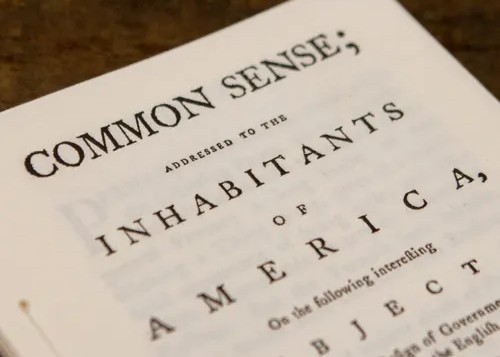
We have recently focused on Biblical ideas of governance back in Europe that were read by American’s Founders and contributed to emerging movement toward independence. 250 years ago at this winter and early spring a shift occurred in public opinion among the American colonies and their colonial legislatures.
Now we will start to examine various writings in the American colonies. First, let’s look at a timeline:
Chronology of Events in early 1776
January 9, Common Sense published by Thomas Paine
January, Proclamation by John Adams of MA (and in April his Thoughts on Government)
February 13, Essay on Legal Right to form a government by James Wilson of PA
March 17, Report of Capture of Boston by George Washington
March 20, Continental Congress proclaims a Day of Prayer (for May 17)
Jan-Apr, Mass, S.C., and Georgia shifted to support common good
April, Jefferson and others sense strong support in their communities for independence
April 12, N.C. is first colony to explicitly approve independence and foreign alliances
May 4, R.I. gave implicit support
Let us examine the influential pamphlet by Thomas Paine.
The title of our blog today is intentionally provacative. Was Thomas Paine a Christian Nationalist? Most people today do not even believe he was a Christian, much less a Christian Nationalist. But Thomas Paine’s Common Sense (January 1776) was heavily shaped by the Bible and broader Christian religious traditions.
Paine later harshly criticized organized Christianity and the Bible in The Age of Reason (1794–1795), but in this revolutionary pamphlet he drew extensively on scriptural references and Protestant-style argumentation to appeal to the overwhelmingly Christian (mostly Protestant) colonists.
Common Sense (1776) by Thomas Paine was not a theological work, yet it was deeply shaped by biblical language, Protestant religious assumptions, and Christian political ideas familiar to colonial Americans. Paine deliberately framed his political argument in religious terms so ordinary readers—many shaped by Scripture—would see independence as morally and even biblically justified. Paine explicitly treats scripture as authoritative for his audience.
His pamphlet made abstract ideas of liberty and equality feel familiar, moral, and divinely sanctioned—countering the British “divine right of kings” doctrine while framing independence as a righteous cause.
Primary Example: Biblical Case Against Monarchy (the pamphlet’s core political argument).
In the long section “Of Monarchy and Hereditary Succession,” Paine devotes several pages to showing that kingship is not God’s will but a sinful human invention copied from pagans (”Heathens”). He argues that early humanity (per “scripture chronology”) had no kings and thus no wars, and that monarchy invades “the prerogative of Heaven” through “idolatrous homage.”
Gideon refuses kingship (Judges 8:22–23): After God gives victory over the Midianites, the Israelites offer Gideon hereditary rule: “Rule thou over us, thou and thy son, and thy son’s son.” Gideon replies: “I will not rule over you, neither shall my son rule over you. THE LORD SHALL RULE OVER YOU.” Paine calls this a direct prophetic rejection: Gideon “denieth their right to give it” and charges the people with “disaffection to their proper Sovereign, the King of Heaven.” This establishes God Himself as the only legitimate king.
Israel demands a king from Samuel (1 Samuel 8): About 130 years later, the people clamor for a king “like all the other nations” because Samuel’s sons are corrupt. God tells Samuel: “they have not rejected thee, but they have rejected me, THAT I SHOULD NOT REIGN OVER THEM.” Paine quotes God’s warning at length— the future king will conscript sons for chariots and war, take daughters as servants, seize land and a tenth of produce/seed, and make the people “his servants.” When the people insist, God sends thunder and rain as a sign; they confess, “WE HAVE ADDED UNTO OUR SINS THIS EVIL, TO ASK A KING.” Paine concludes: “Monarchy is ranked in scripture as one of the sins of the Jews, for which a curse in reserve is denounced against them… That the Almighty hath here entered his protest against monarchical government is true, or the scripture is false.” He applies this directly to Britain: monarchy and hereditary succession have “laid… the world in blood and ashes” and “the word of God bears testimony against” it.
“Render unto Caesar” (Matthew 22:21): Paine dismisses this as support for monarchy, noting the Jews at the time had no king and were vassals to Rome—so it applies to courts/taxes, not divine endorsement of kings.
Paine also parallels hereditary succession with “original sin” (all men lost privileges in Adam, just as they do in the first “electors” who accept a king), reinforcing a Christian worldview of fallen human nature while arguing for republican government under law (echoing ideas like Lex Rex—”the law is king”—from earlier Protestant thinkers).
Other Examples:
1. Equality Before God
Equality and creation: Paine opens by stating “MANKIND being originally equals in the order of creation,” tying natural rights to a biblical view of humanity (implicitly Genesis) while rejecting artificial hierarchies like kingship as against both nature and scripture. Colonial America was heavily shaped by Protestant Christianity, which emphasized:
Spiritual equality before God
Individual moral responsibility
Suspicion of hierarchical authority
Paine echoed these ideas by arguing:
No family has a God-given right to rule others.
Hereditary succession is irrational and unjust.
This mirrors Christian teaching that: All men stand equal before God (Galatians 3:28 conceptually), and thus political equality flowed naturally from religious belief.
2. Covenant Theology and the Idea of a Chosen People
Many American colonists viewed society through biblical covenant thinking derived from Puritan theology. Paine tapped into this mindset by portraying America as:
A people with a historical mission
Providentially separated from corruption in Europe
Called to establish a new political order
He said America was prepared by Providence for independence. Example themes:
America as a refuge from tyranny
A new beginning similar to Israel leaving Egypt
This resonated strongly with biblically literate readers.
3. Divine Providence in History
Paine repeatedly refers to Providence guiding events. He argues that:
The discovery of America,
Its distance from Britain,
And unfolding events
all indicate divine intention. This reflects a common Christian historical belief: God directs nations and historical outcomes, and Independence therefore appeared not merely practical—but morally ordained.
Summary of Paine’s Ideas
The Bible shaped Common Sense by:
Providing arguments against monarchy (1 Samuel 8)
Supporting political equality
Encouraging covenant and providential interpretations of America
Framing independence as a moral and almost sacred duty
Without the colonists’ biblical worldview, Common Sense would likely not have had the same explosive influence on the American Revolution.
By grounding the call for independence in the colonists’ shared Bible (the most widely read book), Paine made revolution feel like a return to God’s original plan for Israel (a judge/elder republic without a king) rather than rebellion against divine order. This helped Common Sense sell ~100,000–150,000 copies rapidly and become (after the Bible itself) one of the most widely read works in the Western world at the time.
In short, while Paine’s philosophy later was anti-Christian, at this time the Bible provided the moral authority, historical precedents, and rhetorical power that made Common Sense explosively effective. Without these Christian elements, the pamphlet would likely have had far less impact on a religious populace. (Paine’s later anti-Bible writings ironically alienated many of the same founders who had praised Common Sense.)
Important Irony
Today, the modern attacks on “Christian Nationalism” by secular media and pundits (even some that are religious but lack a Biblical worldview), would likely include Thomas Paine as a dangerous Christian Nationalist, even though he was among the minority in America’s revolutionary times who lacked evidence of personal faith.
Other January-February 1776 Documents of Note:
About the same time Paine’s pamphlet was published another document was adopted by the Massachusetts government and spread widely. Written primarily by John Adams, the Proclamation expressed the Christian worldview and values that governments in all the colonies shared in common.
In it the government urged “…the good People of this Colony, that they lead sober, religious and peaceable Lives, avoiding all Blasphemies, Contempt of the holy Scriptures and of the Lords Day, …and all Immoralities whatever: and that they decently and reverently attend the public Worship of God at all Times, acknowledging with Gratitude his merciful Interposition in their Behalf, devoutly confiding in Him, as the God of Armies…”
[Adam’s Proclamation is printed in full in the subscriber section below. Subscribe now to get all of these valuable primary source documents from 1776 in the coming months. See button below.]
A few weeks or so later in February 1776 another document was written primarily by James Wilson, a Scottish-born Pennsylvania lawyer and future signer of both the Declaration of Independence and the U.S. Constitution, who was active in the Continental Congress during early 1776.
An “Address to the Inhabitants of the Colonies” presented to the Continental Congress sought to explain colonial grievances while still affirming loyalty to the Crown and hoping for reconciliation—rather than pushing for full independence or new government formation. It argued against Parliament’s authority over the colonies but stopped short of declaring a right to form entirely new governments.
This address reflects Wilson’s broader political philosophy, which he developed more fully in later writings, including his famous Lectures on Law (delivered 1790–1791, published posthumously). In those lectures and related works, Wilson explicitly tied his views on government, rights, and popular sovereignty to Christian principles and the Bible.
Wilson’s Address to the Colonies centered on popular sovereignty—the idea that all legitimate government authority derives from the consent of the people, not from kings, parliaments, or divine right of rulers. This was radical for rejecting parliamentary supremacy and hereditary monarchy, while still grounding authority in moral and natural law.
The people as the source of power: Government exists by the people’s will and can be altered or abolished when it becomes destructive.
Natural rights and consent: Colonists, like all people, possess inherent rights that no distant legislature can override without representation.
Limited, accountable government: Power must be checked to prevent tyranny, with structures ensuring representation and protection of liberties.
Subscribe now to read the Massachusetts Proclamation primarily drafted by Adams.
The content below was originally paywalled.
By the Great and General Court of the Colony of Massachusetts-Bay. A Proclamation. (January 1776)
The Frailty of human Nature, the Wants of Individuals, and the numerous Dangers which Surround them, through the Course of Life, have in all Ages, and in every Country, impell’d Mankind to form Societies, and establish Governments, as the happy means of Security, and the only Means of avoiding the misery which results from Anarchy and Confusion. As the Happiness of the People is the sole End of Government, so the Consent of the People is the only Foundation of it, in Reason, Morality, and the natural fitness of Things: and therefore, every Act of Government, every Exercise of Sovereignty, against or without that Consent, is Injustice, Usurpation and Tyranny.
It is a Maxim, that the People ought to choose whom they will have to rule over them: and it is most certain that they ought to have this Power in the greatest Degree possible, consistent with the Ends of Government. The Great Creator having never given to Men a Right to vest others with Authority over them, unlimited, either in its Duration, or its Extent, the Exercise of unlimited Power, is therefore, in every Instance, an Encroachment upon the great Law of Nature, and a Violation of the most sacred Rights of Mankind.
Government, thus founded on the Principles of natural Justice, and the common Rights of Mankind, is a divine Institution, and Magistrates are the Ministers of God, ordained for the good of Men. It is the indispensable Duty of all Ranks of People, to promote the Happiness of Society, by a due Subordination to lawful Authority, and by a ready and cheerful Obedience to the Laws.
Where the Form of Government is derived from the People, and Magistrates hold their Offices during their good Behaviour, or for limited Terms, and are responsible to the People, or their Representatives, for the faithful Discharge of their Trusts, there is the greatest Security for the Rights and Liberties of the People. But when the Powers of Government are assumed by, or delegated to, Persons who hold them independent of the People, without Responsibility to them, or without Limitation of Time, there is Reason to fear that those Powers will be abused to the Oppression of the People.
The Parliament of Great-Britain, claiming Authority to make Laws for the internal Government of the Colonies, in all Cases whatsoever, without the Consent of the People of the Colonies, or their Representatives, have exercised that Authority in various Instances, by Acts imposing Taxes, and other Acts, subversive of the Constitution of this Colony, and destructive of the Rights and Liberties of the People. The Attempts of the Parliament, by Force of Arms, to carry these Acts into Execution, have involved this Colony, and the other United American Colonies, in a most unhappy and unnatural War.
In this distressing Situation, the great and general Court have been constrained to assume the Exercise of Powers, which, in ordinary Times, would be vested in other Hands: but Necessity obliges them to exert all the Powers of Government for the Preservation of the People, and the Defence of their Rights. No reasonable Prospect remains of a speedy Reconciliation with Great-Britain: the Sword is drawn, and the Army of Great-Britain is actually employed in the Destruction of the Lives, Liberties and Properties of the good People of this Colony.
Thirteen Colonies are now firmly united in the Conduct of this most just and necessary War, under the wise Councils of their Congress. It is the Will of Providence, for wise, righteous, and gracious Ends, that this Colony should have been singled out, by the Enemies of America, as the first Object of their Fury and Revenge. In this Conflict, Success depends upon the Smiles of Heaven, and the Blessing of Almighty God.
That Piety and Virtue, which alone can secure the Freedom of any People, may be encouraged, and Vice and Immorality suppress’d, the great and general Court have thought fit to issue this Proclamation, commending and enjoining it upon the good People of this Colony, that they lead sober, religious and peaceable Lives, avoiding all Blasphemies, Contempt of the holy Scriptures and of the Lords Day, and all other Crimes and Misdemeanors, all Debauchery, Prophaneness, Corruption, Venality, all riotous and tumultuous Proceedings, and all Immoralities whatever: and that they decently and reverently attend the public Worship of God at all Times, acknowledging with Gratitude his merciful Interposition in their Behalf, devoutly confiding in Him, as the God of Armies, by whose Favour and Protection alone they may hope for Success, in their present Conflict.
And all Magistrates and others whom it may concern, are hereby enjoined and directed to take effectual Care, that this Proclamation be duly observed.