250 years ago this week Jefferson made initial draft of the Declaration of Independence while George Mason drafted the Virginia Declaration of Rights. Deism and Enlightenment were largely irrelevant.
In last blog we discussed why the Declaration of Independence, being remembered in this 250th anniversary year, was important for the world. For the last 18 months we have looked at the development of Biblical ideology of government in Europe and in the American colonies in the 17th and 18th centuries. Later we will discuss why Enlightenment and Deism were largely irrelevant to the Declaration of Independence. But first, some timeline notes.
This week 250 years ago
On June 7, 1776 a resolution was moved in the Second Continental Congress by Richard Henry Lee of Virginia for independence from Great Britain. The majority supported it and therefore approved that a committee be formed to draft the declaration. That committee was created on June 11th 250 years ago.
On the Committee of Five (or Declaration Committee) was Thomas Jefferson of Virginia, John Adams of Massachusetts, Benjamin Franklin of Pennsylvania, Robert Livingston of New York, and Roger Shermon of Connecticut. They were representative of different regions. Because Jefferson was already respected for his writing (e.g., A Summary View of the Rights of British America), it fell to him to do the initial draft. He shared his initial work with Adams and Franklin by late June. The full committee reviewed it shortly thereafter and they submitted to Congress for debate.
The final Declaration contains several words and phrases not originally Jefferson’s, but the answer must be qualified: some changes were written into the rough draft in Jefferson’s own hand, so historians cannot always tell whether Jefferson himself devised them or whether he copied suggestions from Adams, Franklin, Sherman, Livingston, or Congress. Princeton’s Jefferson Papers says this is a real difficulty because Jefferson marked many stages of revision on the same manuscript, and some changes in Jefferson’s hand may reflect committee suggestions.
For instance, Jefferson calls our rights “sacred and indeniable” originally but it was changed to “inherent and inalienable” before the draft was submitted to Congress, who then changed it to “certain unalienable” rights. Adams contributed a few identifiable words; Franklin contributed several very memorable improvements; but Congress made the largest final revisions, as stated above regarding rights, but also the additional religious sentiments near the end with addition of the phrases: “Supreme Judge of the World,” and “Protection of divine Providence.”
George Mason and the Virginia Declaration of Rights
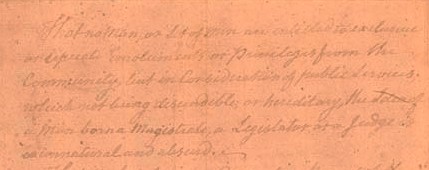
A day after the committee was appointed, another declaration was adopted by the Fifth Virginia Revolutionary Convention meeting in Williamsburg. The Declaration of Rights was primarily drafted by George Mason. The committee was larger, around thirty or so delegates. Mason wrote most of the initial draft [see pic above] in late May and Thomas Ludwell Lee added some key phrases as did James Madison and Robert Carter Nicholas.
George Mason was one of the most influential Christian Founding Fathers that is relatively unknown to most Americans today, mainly because he never became a President or held national office that made him more famous. But this is his work:
Drafted the Virginia Declaration of Rights, which strongly influenced Thomas Jefferson’s Declaration of Independence and later became the foundation for the U.S. Bill of Rights.
Helped write Virginia’s first state constitution.
Served as a delegate to the 1787 Constitutional Convention but refused to sign the final U.S. Constitution, primarily because it lacked a bill of rights.
The Virginia Declaration was the first comprehensive state bill of rights in the Revolutionary era. It’s contents were known the committee and delegates in Philadelphia. It is below with relevant phrases in bold that were similar to words in the Declaration of Independence.
Key portions of the Virginia Declaration of Rights
A DECLARATION OF RIGHTS made by the representatives of the good people of Virginia, assembled in full and free Convention; which rights do pertain to them and their posterity, as the basis and foundation of government.
I. That all men are by nature equally free and independent, and have certain inherent rights, ….namely, the enjoyment of life and liberty, with the means of acquiring and possessing property, and pursuing and obtaining happiness and safety.
II. That all power is vested in, and consequently derived from, the people; ….
III. That government is, or ought to be, instituted for the common benefit, protection, and security of the people, nation or community; ….and that, whenever any government shall be found inadequate or contrary to these purposes, a majority of the community hath an indubitable, unalienable, and indefeasible right to reform, alter or abolish it…
IV. ….
V. That the legislative and executive powers of the state should be separate and distinct from the judicative; and, that the members of the two first may be restrained ….by frequent, certain, and regular elections…
VI. ….That all men,…have the right of suffrage and cannot be taxed or deprived of their property for public uses without their own consent or that of their representatives,…
VII. ….
VIII. That in all capital or criminal prosecutions a man hath a right to demand the cause and nature of his accusation to be confronted with the accusers and witnesses, to call for evidence in his favor, and to a speedy trial by an impartial jury of his vicinage, without whose unanimous consent he cannot be found guilty, ….
IX. That excessive bail ought not to be required, nor excessive fines imposed; nor cruel and unusual punishments inflicted.
X. ….
XI. That in controversies respecting property and in suits between man and man, the ancient trial by jury is preferable to any other and ought to be held sacred.
XII. That the freedom of the press is one of the greatest bulwarks of liberty and can never be restrained but by despotic governments.
XIII. That a well regulated militia, composed of the body of the people, trained to arms, is the proper, natural, and safe defense of a free state; that standing armies, in time of peace, should be avoided as dangerous to liberty; and that, in all cases, the military should be under strict subordination to, and be governed by, the civil power.
XIV. ….
XV. That no free government, or the blessings of liberty, can be preserved to any people but by a firm adherence to justice, moderation, temperance, frugality, and virtue and by frequent recurrence to fundamental principles.
XVI. That religion, or the duty which we owe to our Creator and the manner of discharging it, can be directed by reason and conviction, not by force or violence; and therefore, all men are equally entitled to the free exercise of religion, according to the dictates of conscience; and that it is the mutual duty of all to practice Christian forbearance, love, and charity towards each other.
It like, the Declaration of Independence, also expresses overt Christian language not only in the citing the duty “we owe to our Creator” but in the “duty of all to practice Christian” virtues. The presupposition was Christianity as the personal faith of all citizens or at least recognized at the worldview principles of the culture and institutions they shared.
[Modern historians and commentators try to redefine our Declaration and the Founding principles as primarily an expression of non-Christian Englightenment or Deism. For today’s extra content for paid subscribers is an excerpt from the introduction of a book I publish but is written by my friend professor Gary Amos. Defending the Declaration: How the Bible and Christianity Influenced the Writing of the Declaration of Independence. You can order a copy here. Footnotes are not included below, but footnotes alone of amazing primary sources are worth the purchase!]
The content below was originally paywalled.
[The following is a slightly modified excerpt from the introduction of the book by Gary Amos, Defending the Declaration.]
The Flaws of Modern Historians’ Views of the Declaration
What you have probably read about the American Enlightenment and the influence of Deism may sound convincing, parts of it may even be familiar. In general, it is the overall view of early America as is taught in American colleges and universities. This view from the experts is severely flawed. What follows is a brief synopsis of the problems with this interpretation.
First, the most basic flaw is this: Writers who hold this view have almost universally ignored the Bible itself, particularly the writings of the Apostle Paul, when building their case for rationalism and the Enlightenment. They have not asked whether Aquinas, Hooker, Ames, Owen, Baxter, Locke, Wise, Mather, or Tindal tried to follow the Bible in their views of the relationships among God, man, nature, and law. Neither have they admitted that most of these men openly claimed to be following the Bible. Nor have they shown that any of them failed to follow the Bible when trying to do so. References to Romans 1 and 2 and to other passages of Scripture abound in the original sources but go unnoticed by these historians. Every historian of the period who takes this view has committed the error of question-begging, guaranteeing a particular conclusion by assuming a wrong definition of Christianity.
Second, the error of question-begging takes several different forms. Writers assume that ideas are deistic by definition. They do not start by explaining the differences between Christianity and deism nor show into which category an idea fits. Also, since they routinely ignore what the Bible and Christianity teach, they are unaware when an idea is Christian. Thus, they call many Christian and Biblical ideas deistic, capturing Christianity for paganism. Also, they assume that Christians can be influenced by nonChristian ideas, but for the most part do not admit that nonChristians can be influenced by Christian ideas. So a double standard exists.
Third, most of the writers with this view of history wrongly assume that the New Testament and true Christianity separate faith and reason. The “faith versus reason” dichotomy is a strawman argument. It does not accurately represent the Bible’s teaching on the human mind and its role in human life and service to God. The New Testament uses nearly forty different Greek words to describe reason, mind, and intellect. These occur in more than 1,500 different places in the New Testament. A number of these are used in highly technical ways in the Scriptures. In Romans 12:13, for example, the Apostle Paul uses seven different Greek words for the mind and intellect to explain how Christians are to live and serve God. He also links reason and faith in verse 3. If Paul and the New Testament were measured by the standards used against Hooker, Wise, and Mather, the Apostle and his writings would have to be dismissed as rationalistic and tending toward deism. Now for the real shock. Roger L. Emerson, writing in the Dictionary of the History of Ideas attributes deistic tendencies even to the Apostle Paul, saying: “Elements of the deistic position are as ancient as critical religious thought itself. . . . Saint Paul’s statements concerning the law of the Gentiles (Romans 2:1315) yield the base for a natural religion.” If even Paul had deistic tendencies, the historians are right to find Mather and Wise to be deistic, since they accepted implicitly the writings of Paul as divinely inspired. The same is true of Jonathan Edwards and John Witherspoon, the great colonial preachers whom historians have dismissed as Enlightenment men. If the colonial preachers and even Paul are to be considered deistic, no wonder historians think that the founders in general were deists. How could they conclude otherwise?
Fourth, besides failing to understand the Bible and Biblical epistemology, these writers often misrepresent what certain people believed or said. Catholics such as Aquinas are routinely misrepresented, as are many later Protestants. For example, John Calvin did not try to make God or the universe a mystery so as to make Christianity a riddle. There was no dichotomy between Calvin and William Ames. Saying Ames revised Calvin to make Calvinism rational, setting up the Puritans as targets for the Enlightenment, is simply false.
Fifth, modern writers also make the Puritans humanistic syncretists for studying the classics of the Greeks and Romans. One gets the impression that true Christianity requires Christians to be uneducated morons. Such a view fails to account for what the Bible and Christian theology have to say about the image of God in man. Although men are fallen and corrupted by sin, they still retain something of the image of God. To the extent that their words and works reflect that image, Christians are to use and benefit from them. It is wrong to say that Puritan education was unchristian because it respected the value of classical learning.
Sixth, the modern writers greatly misstate the impact of Newtonian cosmology and its relationship to the Bible and Christianity. We are given the impression that before Newton published the Principia in 1687, Christians did not really believe that the universe worked according to fixed laws. Rather, Christians viewed the universe as a magical or mystical organism, miraculously vitalized by angelic powers according to the unpredictable whim of its Creator. Thus, anyone who lived after the time of Newton and who believed in a reasonably ordered universe according to fixed law would not be thinking in Biblical or Christian terms. Much of this writing attributes to preNewtonian Christians a view of God and the universe they did not hold. The Bible talks repeatedly about fixed natural laws in the cosmos The importance of fixed natural laws was a part of Christianity long before Newton ever wrote. By misrepresenting the impact of Newton, these writers have set up a false dichotomy between those Christians who lived later than Newton and those who came earlier. By the same token, all the talk about the impact of Newton on Wise and Mather to turn them into Enlightenment men is simply incredible. Both Wise and Mather held the same view of the laws of nature and of the relationship of reason and revelation, as had most of the preNewtonian Puritans. And their views were consistent with the Apostle Paul in the New Testament.
Finally, there are a number of other problems among modern writers. One is the misreading of John Locke. I am convinced that Locke’s Essay On Human Understanding has been greatly misunderstood by writers of our day. I am not at all convinced that the links between Locke’s epistemology and the New Testament have been adequately traced. Another is that most writers, in calling certain religious language deistic, fail to understand the Biblical Creator/Redeemer distinction or the religious error called the nature/grace dichotomy and often are mistaken in imputing “deistic tendencies” to anyone who uses creation language. Because of the kinds of errors noted above, I suspect that a great deal of the writing about Scottish commonsense philosophy as a form of Enlightenment thought is also defective. A notable exception was Merwyn Johnson’s excellent book on Locke, published in 1978. He shows that, without question, Locke was indeed a Christian who was Trinitarian in doctrine and who believed in the divinity of Christ.
The average person is more likely to discover the wrong view of the Declaration because most of the popular writing goes that way. The bulk of modern writing on the American Enlightenment and the American revolution makes a Pauline view of the world – God, man, law, nature, epistemology, and so forth – a Newtonian concoction brewed and served up by Puritan compromisers. It turns Biblical and Christian ideas into raw material of the Enlightenment. By the alchemy of history and the wave of the historian’s pen, Biblical and Christian ideas are changed into Enlightenment paganism. This makes it impossible for a Christian who takes Romans 1 and 2 seriously not to be called a child of the Enlightenment. And it causes the Christianity of early America to be described in such a way that no Christian influence on the founding could be possible.
The Declaration of Independence was not the bastard offspring of antiChristian deism or Enlightenment rationalism. The ideas in the Declaration are Christian despite the fact that some of the men who wrote them down were not. Those ideas are not opposed to the teachings of the Bible or of mainstream Christianity. The popular notion that the intellectual heritage of the Declaration traces solely to deism, the Enlightenment, the Renaissance, and from there to pagan Rome and Greece is seriously flawed. Indeed, much of what we have been told for years about the Declaration’s intellectual heritage and the meaning of its terms is largely a series of myths.
Most of the key terms and ideas in the Declaration of Independence arose from the JudeoChristian intellectual tradition. I do not deny that there was such a thing as the Enlightenment or deists. But many of the ideas used by deists were borrowed from the Bible and Christianity. Where the Declaration is concerned, its legal and political theories are consistent with Biblical principles and with historical mainstream Christianity, both Catholic and Protestant. It is a mistake to read the Declaration of Independence as an ingenious “secularized” assault on the Bible, Christianity, or the western Christian tradition. The Declaration stands squarely inside that tradition, reflecting how profoundly Biblical principles had influenced the world in which the framers lived and worked.
[This is just a small excerpt. The book proves his arguments with primary sources that draw from a who’s who of Christian thinkers from over a thousand years. Order here.]