Documents that show the Ideas leading to the War for Independence
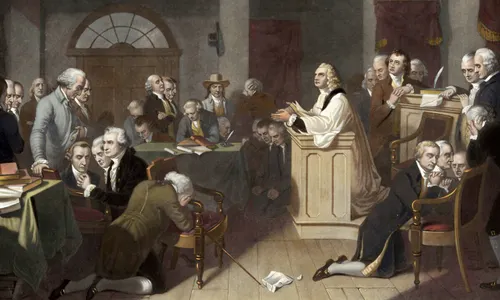
This week PBS broadcast the 6 part (12 hours) documentary of Ken Burns’ The American Revolution. While the production quality is superb, the greatest failure is that there is almost nothing on the religious ideology and motivation. You could easily think after sitting through the 12 hours that it was a secular society. Often modern historians and biographers leave out religious history [such as the first prayer in congress portrayed in the pic above] because religion is not a part of their own lives, and so they think it not valuable to include.
But in American history, to leave out the Christian culture, is not only an inaccurate narrative, it is dramatically misleading. This false portrayal of history could easily cause people to think of America and its Founding Fathers as non-religious, and therefore, when modern Christians get involved in politics or a government offiical makes references to God, it is a new and dangerous “Christian Nationalism” emerging.
This blog is devoting much of this year and the upcomong one leading up to the 250th anniversary of Independence to tell the Christian history of the Revolution. In the previous blog we showed evidence of the how George Washington’s faith was a major part of his work to form and maintain an army. Today we discuss earlier documents in the 1770s that led up to Independence. Two documents today were political pamphlets or orations by men such as Sam Adams or Joseph Warren. Two are sermons. Political sermons were published in the newspapers and circulated for discussion by committees of correspondence. Sermons were both contributions to and expressions of the American mind. [For example, see American Political Writing During the Founding Era, by Hyneman and Lutz].
The Rights of the Colonists as Christians, Samuel Adams (1772)
Samuel Adams’ 1772 work “The Rights of the Colonists as Christians” is part of a larger pamphlet titled “The Report of the Committee of Correspondence to the Boston Town Meeting.” In this section, Adams asserts that the Christian faith is foundational to liberty and civil society. Below is a summary of the main points, including key excerpts and implications.
1. Religious Liberty Is a Natural Right
Adams declares that the rights of the colonists as Christians are grounded in natural law and Scripture:
“The right to freedom being the gift of God Almighty, it is not in the power of man to alienate this gift…”
He argues that civil and religious liberty are both natural rights bestowed by God, not privileges granted by the state or crown.
Implication: Government cannot lawfully restrict religious practice, because such rights are inherent and divine in origin.
2. The Christian Religion Is Rooted in Freedom, Not Force
Adams stresses that true Christianity must not be imposed by coercion:
“Christianity may be supported as of divine revelation, without the aid of law.”
He opposes using state power to enforce religious belief or uniformity, noting that Christ never used force to spread His teachings.
Implication: Establishments of religion (like the Church of England) that use political power to impose conformity are unchristian and tyrannical.
3. Toleration vs. Rights
Adams critiques the idea that religious practice is merely “tolerated”:
“Toleration is not the gift of princes… it is the gift of God.”
By framing liberty of conscience as a right, not a concession from rulers, Adams asserts a theological and philosophical foundation for resistance to religious tyranny.
Implication: The colonists do not need to ask for religious freedom—they already possess it by natural and divine law.
4. Equality Among Christian Denominations
Adams advocates that all Christian denominations should be equally protected, so long as they do not threaten civil peace:
“Every man living in or out of a state of civil society has a right peaceably and quietly to worship God according to the dictates of his conscience.”
Implication: Any laws or policies that elevate one sect above another (such as Anglican dominance in Massachusetts) violate both natural rights and Christian principles.
5. Moral Foundation of Civil Society
Adams believes Christianity is essential to the moral and ethical grounding of society:
“The laws of the eternal God, the moral law, and the laws of the Gospel are the foundation of all good government.”
Implication: Far from being irrelevant to politics, Christian teaching is the basis for justice, liberty, and good governance.
This work helped frame the American resistance to British religious policies and laid a theological foundation for the First Amendment’s protections of religious freedom decades later.
An Oration on the Beauties of Liberty, Rev. John Allen (1772)
Rev. John Allen’s An Oration on the Beauties of Liberty was one of the most widely read patriotic sermons of the American Revolution. Delivered in Boston in 1772, it was reprinted multiple times and resonated deeply with colonial Americans. This bold oration combines religious, moral, and political arguments to defend natural rights, resistance to tyranny, and the interdependence of civil and religious liberty.
Here are the main points, with contextual explanations and key excerpts:
1. Liberty Is a Divine Gift from God
Allen opens with the powerful conviction that liberty—both civil and religious—is bestowed by God, not granted by governments.
“Liberty is the birthright of all men; it is coeval with our existence, and given us by the Author of our being.”
He argues that since liberty is rooted in divine law, any attempt to take it away is a direct offense against God.
2. Government Is Accountable to God and the People
Allen maintains that rulers must govern justly and within the bounds of divine and natural law. Any abuse of power constitutes tyranny and must be resisted:
“A power assumed, not derived from the people, is tyranny.”
Key Point: Legitimate government must reflect the consent of the governed and uphold liberty, not suppress it.
3. The Danger of Standing Armies and Taxation Without Representation
Allen warns about British military presence and unfair taxes in the colonies:
“Standing armies in times of peace are dangerous to liberty… arbitrary taxes are marks of slavery.”
He links these injustices to the erosion of freedoms and draws parallels to historical tyrannies.
Key Critique: Parliament’s actions violated both English constitutional law and divine justice.
4. Civil Liberty and Religious Liberty Are Inseparable
A central theme is that you cannot preserve one liberty while surrendering another. Allen sees civil and religious freedoms as united in purpose:
“Where the Spirit of the Lord is, there is liberty.”
The implication is that obedience to God requires resisting civil authorities who act against conscience and freedom.
5. A Call to Awake and Resist Tyranny
Allen calls the colonists to vigilance and active resistance, using both Scripture and civic principles:
“Rouse, my countrymen, and by all that is dear… resolve to be free!”
This passionate appeal is rooted in both the Protestant Reformation tradition and the legacy of English constitutional liberty.
6. America Has a Providential Role
Allen hints at a theological justification for American independence, suggesting that America might be chosen by God to preserve liberty in the world:
“May America be the asylum of liberty, the seat of virtue, the temple of piety!”
Historical Significance
Allen’s sermon was reprinted seven times, making it one of the most widely circulated pre-Revolutionary works.
It helped shape the moral and theological justification for rebellion against Britain.
His argument that resistance to tyranny is obedience to God influenced later revolutionary figures like Samuel Adams and Patrick Henry.
Oration Delivered at Boston, Joseph Warren (1772)
Here is a detailed summary of the main points of Joseph Warren’s “Oration Delivered at Boston, March 5, 1772”, given on the second anniversary of the Boston Massacre:
1. Commemoration of the Boston Massacre
Warren opens by solemnly remembering the tragic deaths of the colonists in 1770 at the hands of British soldiers.
He emphasizes that the Massacre symbolizes the danger of standing armies in times of peace and unchecked imperial authority.
The loss of innocent lives is framed as a sacrifice for liberty and a warning to future generations.
“The voice of your brethren’s blood cries to you from the ground.”
2. Natural Rights and Liberty
Warren asserts that liberty is a gift from God and cannot be justly taken away by any human authority.
He draws on Lockean ideas of natural rights—life, liberty, and property—and claims that these are inalienable and protected by natural law.
He warns that any power that seeks to infringe upon these rights is tyrannical.
“The law of God and nature hath made us free.”
3. Tyranny of the British Crown
He critiques the British government, especially Parliament, for violating the colonial charter, imposing unjust laws, and stationing troops in Boston.
Warren accuses British officials of corruption, cruelty, and seeking to enslave the colonies.
He attacks taxation without representation and the use of force to suppress dissent.
“Our country is infested with pensioners and placemen… who are ready to swallow up the rights and liberties of the people.”
4. Moral Duty to Resist
Warren teaches that it is not only a right but a moral duty to resist tyranny.
He appeals to Christian and classical republican principles, arguing that passive submission to unjust rulers dishonors the memory of the martyrs.
He encourages civic virtue, unity, and preparedness for sacrifice.
“It is our duty to watch and oppose every encroachment on our civil and religious liberties.”
5. Call to Vigilance and Action
The oration closes with a call to renewed patriotism, urging colonists to remain alert, educate their children in liberty, and take up the mantle of resistance if needed.
He warns against complacency and calls for a collective spirit of resolve and nonviolent but firm opposition to imperial abuses.
“The flame of liberty is burning—it must not be extinguished by the breath of sycophants.”
Themes and Legacy
The oration was influential in galvanizing colonial unity, especially in Massachusetts.
It framed the American cause as both a religious and civic duty, deeply influencing future Revolutionary rhetoric.
Warren later died as a patriot in the Battle of Bunker Hill, further immortalizing his call to action.
An Election Sermon, Simeon Howard (1773)
Demonstrating that an armed war against a tyrant was a Christian’s duty.
Here is a summary of the main points of A Sermon Preached to the Ancient and Honorable Artillery‑Company, in Boston, June 7, 1773 by Simeon Howard (delivered on the anniversary of the election of officers of the Artillery Company).
Summary of Main Points
Definition of True Liberty
Howard begins by defining liberty as “that which is opposed to external force and constraint … everything that is opposed to temporal slavery.”
He argues this liberty is a natural blessing from God, one to which every person has an equal claim.Origin of Government and Limits on Authority
He outlines how, in a “state of nature,” individuals exercise liberty under the law of nature. When some violate that law (by encroaching on others’ liberty), civil society and government emerge to protect liberty.
He emphasizes that rulers’ powers must be limited — if they exceed what the public good demands, the people may refuse obedience.Duty to Defend Liberty
Howard asserts that defending liberty is not merely a right but an obligation. He uses the metaphor of a talent being hidden (from the Gospel) to illustrate that failing to safeguard freedom is a form of unfaithfulness.
He also connects defending one’s liberty to responsibility for future generations: if we surrender our freedom, we leave bondage for our children.Military Readiness and Public Virtue
Given the context (addressing a militia/artillery company), Howard praises military preparedness and the militia’s role. He says a people incapable of defending themselves are in a shameful position.
He argues that virtue, religion, and public spirit strengthen liberty, and that vice weakens it — hence moral character is part of national security.Application to the Occasion
Howard applies his argument to the Artillery Company: The company’s existence and training are seen as honorable means by which liberty may be preserved. He urges its members to maintain moral integrity and readiness.
He also cautions that while peace is desirable, one should not assume perpetual peace or external protection — vigilance and self‑defense remain necessary.
Significance
The sermon combines religious, moral, and political themes: liberty rooted in divine law, responsibility of citizens and soldiers, and the interplay of character and freedom.
It reflects pre‑Revolutionary colonial thought linking natural rights and military preparedness to the defense of liberty.
Delivered to a prominent colonial militia organization, it underscores how civic/military assemblies also functioned as venues for patriotic and theological reflection.
These four documents in 1772 and 1773 are an example of the intersection of the Christian worldview with the current political events of that time. We will continue with more in future blogs.
Announcement:
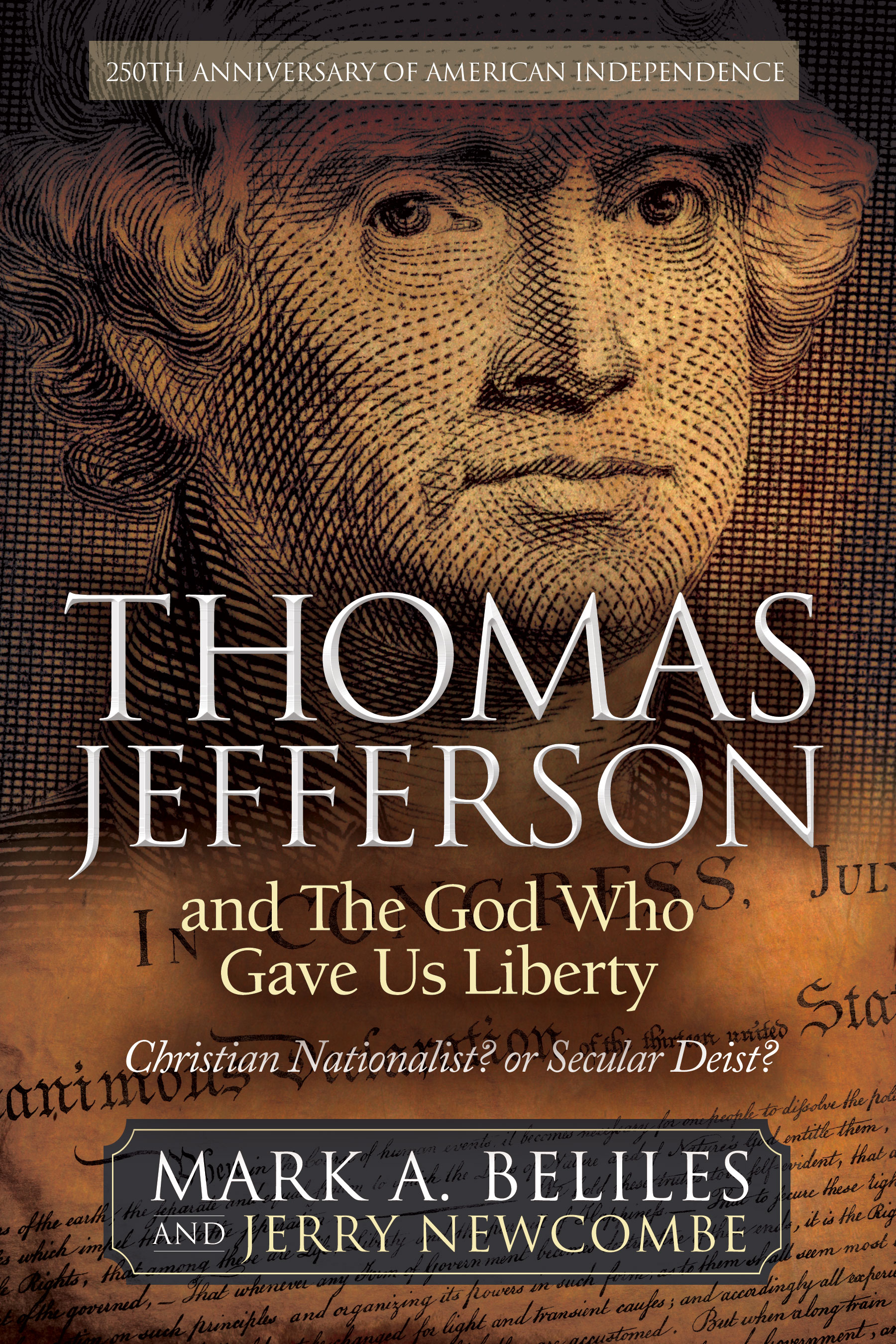
As many of you already know, Jerry Newcombe and Mark Beliles collaborated to write the most comprehensive 520 page study of Thomas Jefferson’s religious life and legacy back in 2015. Now, especially for the 250th Anniversary of the Declaration of Independence we are publishing a shorter more-readible edition that provides all of the main points but also some additional material not known ten years ago. This new book is: Thomas Jefferson and the God Who Gave Us Liberty.
It will be in print within a few months but you can pre-order now with Barnes and Noble and help get this research out to the public. If enough of you pre-order using the Barnes and Noble link, they will stock this book on their shelves once it is in print. And as a gift to you for helping us, I will give you the digital version immediately, plus a huge discount on the full 520 page volume. This new book is available for just $17.76 [to mark the anniversary year!]. The B&N pre-order link should be accessible now but if not, just send me a message below.