Part 11 of a Political Narrative of the New Testament
In the previous post we examined the main political principles and ideas in Acts 20-26. We saw Paul give a final message to Senior Statesmen in Ephesus, then have a consultation with social strategists in Caesarea, followed by his arrest and trials.
[Note: This series of posts does not assert that politics is primary in the New Testament, however, there are often overlooked principles and ideas that are worthy of attention. For context we paraphrase certain Bible terms by how it was understood at the time. We ask ourselves: ‘What did this word or phrase mean to those first-century hearers or readers? Then we paraphrase the scripture to reflect that understanding. A simple example is the word ekklesia which today is translated church and means a religious meeting to most people, but in New Testament times it was understood by everyone to be a citizen assembly focused on solving community problems. Modern readers of Scripture focus only on the religious activities and teachings in Acts and the Epistles. But Christians were active in politics from the beginning. Failure to understand this and to believe Christianity only belongs in the religious sphere leads some people today to wrongly judge Christian social activism as seeking improper religious imposition of beliefs using state coercion, i.e. ‘Christian Nationalism’ or Theocracy or Dominionism. Christian activism historically is mostly in the context of democratic pluralism.]
Paul is taken to Rome to Seek Justice, AD60-62
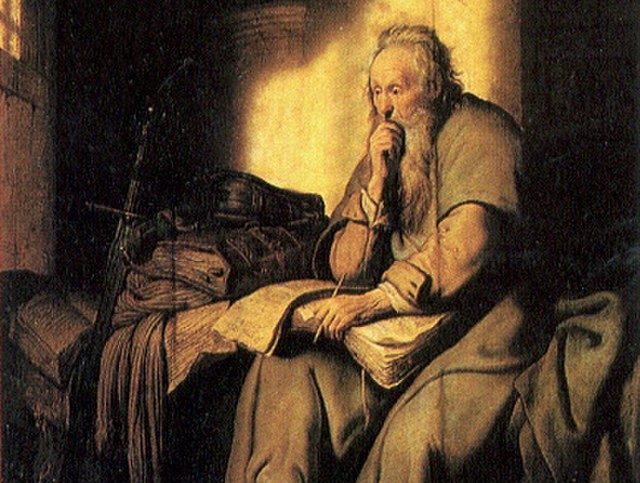
Paul’s appeal for justice caused him to be taken prisoner to Rome. While awaiting trial he was under guard in a house arrest (see pic above by Rembrandt) but was able to meet with others. The text in Acts 28 shows him explaining why he was there: “I was compelled to appeal to Caesar.” And he explained his worldview behind it. He taught of “the government of God, persuading them concerning Jesus from both the Law of Moses and the Social strategists ….”
And he explained the situation by quoting from “Isaiah the Social strategist” [Isa 6] about God’s shift due to the refusal the Jews to turn and be healed. And the final statement in the history of Acts is that Paul continued “preaching the government of God and teaching the things which concern the Sovereign Jesus Supreme Ruler to Come…”
Paul’s Letter to the Citizen Assembly in Colossae & its leader Philemon
Philemon and Consent of the Governed
Paul’s letter to Philemon was really to a “the citizen assembly” that met in his house. This was in the city of Colossae which is today’s Turkey. Likely it was sent to Philemon along with the other letter to the Colossians. But Paul had a personal matter for Philemon.
Paul said: “….I appeal to you for my son Onesimus,….[who] might minister to me in my chains…But without your consent I wanted to do nothing,…[not] by compulsion, as it were, but voluntary….receive him forever, no longer as a slave but…a beloved brother….” This is an example of social transformation by changing individuals one by one. The law permitted Philemon to keep Onesimus as a slave, but Paul used persuasion to help change this social injustice.
Paul’s respect for a citizen’s consent was an important New Testament precedent. The “consent of the governed” (as affirmed in the U.S. Declaration of Independence) was an idea that was established by God in Israel’s constitution about 1500 years earlier. Before the “book of the covenant” became legally enforceable, the citizens of Israel were given three opportunities to affirm or reject it (Exodus 19 & 24). Only after their third consecutive consent (“we will”) did it become binding law. This pattern created a common precedent in modern legislative bodies today where there is three readings and approval of a law before it is adopted.
Colossians and God’s Government over all things
In Paul’s general letter to the rest of the citizen assembly in Colossae, Paul spoke in significant governmental terms. In chapter one it says that God “conveyed us into the government of the Son….For by Him all things were created, [including].…places of governance or dominions or principalities or powers…” There is no basis for viewing this as only meaning spiritual or religious authorities. Jesus’ government is over all thrones and realms of authority.
Paul then addresses the comprehensive scope of Christ’s government and makes clear that it is not just heaven. “He is the head of…the citizen assembly,…that in all things He may have the preeminence ….to reconcile all things to Himself, by Him, whether things on earth or things in heaven …His body…is the citizen assembly…” Paul connects the citizen council (i.e. church) as the vehicle through which all other authorities will be aligned with His purposes. This is not intended to assert a centralization of earthly powers under the church, but that the church is the place where all other political institutions may learn how to do their job rightly in their independent spheres.
In the middle ages, church leaders wrongly merged the jurisdictions of different institutional spheres, and this gives some modern people worry that Christian theocracy or nationalism is the goal today. Biblical metaphors and religious militant terminology (“dominion,” “kingdom,” “warfare,” etc) is often used carelessly by modern church leaders, not realizing how secular ears interpret it. But the opposite problem is also true. Many church leaders today, infected with dualism, limit the ideas Paul speaks for reconciling all things to ONLY the activity of evangelization and religious work. In chapter two of Colossians Paul affirms that Jesus is “the head of all principality and power….[He]disarmed principalities and powers,…triumphing over them…. So let no one govern you in…things which perish…” Again, although it includes spiritual powers, it is also inclusive of earthly ones.
The Earthly Consequence of God’s Government
In chapter three Paul declares the egalitarian impact of God’s reign on earth: “…there is neither Greek nor Jew,…barbarian, Scythian, slave nor free, but Supreme pre-chosen Ruler is all and in all.” Next, Paul again uses the democratic concept of God having voted for us when he says, “Therefore, as the elect of God….let the peace of God rule in your hearts….” God’s government begins with self-government by His Spirit within. The impact of God’s reign moves outward to others spheres of life. “Bondservants, obey in all things your master…he who does wrong will be repaid for what he has done, and there is no partiality.” And then in Chapter four: “Masters, give your bondservants what is just and fair, knowing that you also have a Master above all…”
Then Paul clarifies the ultimate reason why he is was arrested and now imprisoned in Rome. It was not for religious work but rather: “I am…in chains….for the government of God….” He then gives closing greetings to “the citizen assembly that is in his house …(and another) citizen assembly of the Laodiceans.” And he asks them to “Remember my chains.”
Letter to Philippian Citizen assembly (in today’s Greece)
In chapter one Paul says that although he is imprisoned in Rome “….it has become evident to the whole palace guard, and to all the rest, that my chains are in the pre-chosen Ruler….” This is not saying that he preached salvation to them. He said that they recognize that his imprisonment is because of a clash of governments – those on earth verses the coming government of Jesus.
Then in chapter two Paul said that God’s purpose was that “….every tongue should confess that Jesus pre-chosen Ruler is Sovereign….” This meant to bring recognition by all people on earth to Christ’s highest government.
In chapter three Paul says that he formerly kept Israel’s law and in his zeal to do so he mistakenly attacked Christ’s citizen assembly. But now he works for a different standard of authority or rule. Then he says “….our citizenship is in the place above all.” This is not to say that we have no role as citizens on earth, but that we represent the highest government of all, when we do so. And due to this truth of supreme authority now “He is able even to subdue all things to Himself.”
In chapter four Paul emphasizes that their meditations include God’s justice, saying: “….whatever things are just…meditate on these things…” Then Paul spoke of his disappointment while in prison: “no citizen assembly shared with me…” This seems to show that some believers either had a fear of being associated with someone in trouble with government, or a disagreement with what Paul was doing in his legal fight.
But then he shows some of the impact of his stand for justice saying, “All the saints greet you, but especially those…of Caesar’s household…” Although it is not known if Paul directly met Caesar, it was clear that there were believers in the highest places of the empire.
Letter to Ephesian citizen assembly
About that same time Paul’s letter to Ephesians (in what is today Turkey) was also penned. The first couple chapters focused on the big picture.
He declares that Jesus is “…far above all principality and power and might and dominion…in this age…” Note how this is focused on real-world governmental authority here, not just in the future when Christ returns. He goes on and says that God put “…all things under His feet, and gave Him to be head over all things to the citizen assembly…” This is not a religious prayer and worship group (i.e. the modern idea of church), but a governmental council of believers to whom God delegates responsibility.
In chapter two Paul acknowledges that we have to battle. We have to work to enforce the victory of Jesus in the earth. “….the prince of the power of the air…works in the sons of disobedience…” This is opposite of the view many Christians today have. They think Satan rules the world but Jesus rules and works only in the hearts of believers. The reality is opposite. Jesus rules over all and the devil has only a small sphere of influence.
Paul also says that “[you were] aliens from the commonwealth …the constitutions [i.e. covenants]…. that is, the law of transcendent political priorities [i.e. commandments]. He is speaking of the governmental heritage of the Jewish people, not just their religious beliefs. And then Paul says that they are now “…fellow citizens…[with the] Emissaries and Social strategists, Jesus pre-chosen Ruler Himself being the chief corner stone…” By using words such as commonwealth and constitution (i.e. covenant) and law of commandments, Paul shows that it is all about practical governance – not just spiritual or religious affairs of life.
Paul in chapter three brings up his personal situation of being a prisoner under Roman government, to explain God’s plan. He says that such conflict has revealed to “His holy Emissaries and Social strategists ….that now the manifold wisdom of God might be made known by the citizen assembly to the principalities and powers in the highest places, according to the eternal purpose which He accomplished in pre-chosen Ruler Jesus our Sovereign….to Him be glory in the citizen assembly…” In other words, Paul’s appeal in the courts is not just about spiritual realms, not just about bringing the message of salvation. Note the emphasis on the citizen assembly. These governmental councils (not religious worship groups) are the vehicle both to convey God’s purposes for making Jesus the supreme authority and to bring glory to Him.
Duties of Citizens and Officers
Again in chapter four Paul connects his imprisonment to the big picture. He says that “[Jesus] led captivity captive...[Ps 68 and]”….ascended far above all the heavens, that He might fill all things. And He Himself gave some to be Emissaries, some Social strategists….” In other words, an earthly prison is nothing in the big scheme of things. Jesus liberated spiritual captives but also is going to raise all to the highest places; to fill every thing – every institution, every position there is, and this is the purpose of Apostles and Prophets and other officers in the citizen assembly, to be equipping and leading people how to do their mission in this regard.
And Paul then quotes from Zechariah 8 saying “Let each one of you speak truth with his neighbor…Be angry, and do not sin”: do not let the sun go down on your wrath [Ps 4].” This was the command to every self-governing citizen in Israel. Each person was responsible for their neighborhood and communities and cities and nations, to make things function in alignment with God’s transcendent principles and public policies. It’s the job of every citizen in local assemblies. And it’s the various 5-fold officers’ job to train and empower all citizens for their role.
Then in chapter five Paul teaches the standards for citizens. He cites some bad behavior that would prohibit “…any inheritance in the government of pre-chosen Ruler….” Then he frequently mentions the citizen assembly and its relationship with the “Pre-chosen Ruler [who] is head of the citizen assembly….[and the] citizen assembly is subject to pre-chosen Ruler….” But it is not just a legal relationship. He says “Pre-chosen Ruler also loved the citizen assembly and gave Himself for her… that He might present…a glorious citizen assembly….”
Application of Jesus’ government in various spheres
Then Paul speaks of other key spheres of life that are vital in order to represent God’s way of governance. First, the family sphere. A husband is to treat his wife “just as the Sovereign does the citizen assembly….” And he continues more on the family in chapter six speaking of the Old Testament law saying, “…’Honor your father and mother,’ …[which] is the first transcendent political priority with promise: “that it may be well with you….” As explained in an earlier post, this was primarily addressed as a duty of government leaders – to empower and protect parental rights and families, and if they did so, the nation will be stable and prosperous. Paul goes on with the family focus: “fathers…bring them up in the training…of the Sovereign.
Then he shifts to the sphere of business and marketplace. “Bondservants, be obedient to… your masters….whatever good anyone does, he will receive the same from the Sovereign, whether he is a slave or free. And you, masters, do the same…” He shows how in the family and in the workplace, we bring God’s governance by our example.
Finally, he explains that it is a real battle, not just earthly but spiritual governments: We “….wrestle… against principalities, against powers, against the rulers of the darkness of this age, against spiritual armies of wickedness in the heavenly places….I am an ambassador in chains…” Paul says he is in an earthly prison, not because he is a religious preacher, but because he is an ambassador of another higher government. It is mostly a conflict of kingdoms for both spiritual and earthly control.
Execution of James the Just in Jerusalem
About 62AD the full reality of this conflict was shown in the execution of James the Just back in Jerusalem – the president of the citizen council there. Apparently, Paul was released and had opportunity to travel another year or so before his final arrest and execution, along with Peter’s. Persecution was widespread throughout the Roman Empire under Nero. And major shifts were coming in the land of Israel. In the next post we will look at political ideas and principles in the letter to the Hebrews.