Documenting America’s Christian History
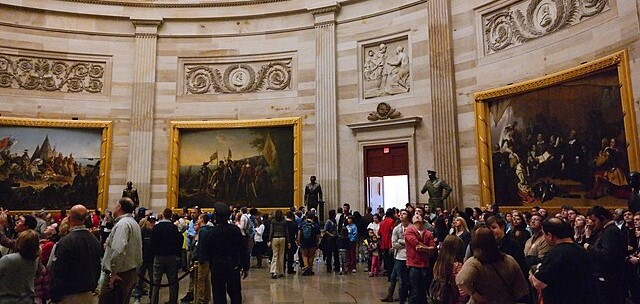
On July 4, 2026 America will celebrate 250 years since it declared independence. This will be one of the most significant opportunities in our lifetime to draw attention among the masses of citizens to our nation’s Founding history. In the new era of “1619 Project” and other distortions of history, it is vital that documentary evidence be disseminated as to the principles and values that shaped our nation.
With this in mind, this blog will be devoting much of this space until the anniversary to publishing documents of America’s Christian history. It does not mean that our nation was perfect, nor does it suggest that only Christians shaped the nation, but our public schools and even many Christian educational institutions no longer teach this aspect of our history at all.
In the recent funeral for former President Carter and the Inauguration of Trump the Rotunda of the U. S. Capitol was featured on national television (see pic above). It highlights important events of our nation’s history including our Christian heritage.
When the Israelites were liberated from slavery in Egypt God gave the newly independent nation a commandment to keep one day a week for a special purpose. Although most think it’s main purpose was to gather for worship, it really was not. Instead of normal work on that day, God commanded families to gather and use the time for education.
In Deuteronomy 5 it said that they were to “…remember that you were a slave in the land of Egypt, and the LORD your God brought you out from there by a mighty hand and by an outstretched arm; therefore the LORD your God commanded you to keep the Sabbath day.” Although worship and church attendance is a good thing, it simply was not mentioned as the activity of their Sabbath day.
Of course other festivals in Israel were also educational and specifically commanded worship and sacrifice, but the weekly Sabbath activity of education in their national history and the reasons for national slavery and national liberty, was really the main way of keeping the day “holy.” Providential history and worldview is THAT important.
America’s citizens and even its Christians have a problem with historical amnesia. We know that there is something in the past that happened and was important but few can actually point to what made America an exceptional and blessed nation. Stephen McDowell and I wrote a book called America’s Providential History long ago (that was revised and updated a few years ago). It can help guide citizens and families in recovering a knowledge of our history and especially evidence of God’s hand in it.
But that book only gives excerpts from various original sources and summarizes the main events. For next year and a half I will present more complete documents to give you an opportunity to read original sources that most people never know exist and even more people would not know how to find the document and read it.
Of course the rise and independence of America did not happen in a vacuum. Really centuries of events and philosophical developments were essential forerunners. Below is a list of things in the 16th century alone that had to have happened for America to come into being:
The Protestant Reformation
The English Bible
The Defeat of the Spanish Armada
Exploration of the territory we now call the United States
But besides the big events of the 16th century there were many documents in that time frame that may be read to understand the time. The following list is provided for your reference:
The Prince, Machiavelli (1513)
On Secular Authority, Luther (1523).
The Bondage of the Will, Luther (1524).
The Act of Supremacy, Henry VIII (1534).
Institutes of the Christian Religion, John Calvin (1540).
Coronado’s Report to Mendoza (1540)
Coronado to the King of Spain (1541)
The Journey of Alvar Nuñez Cabeza De Vaca (1542)
Brief Account of the Devastation of the Indies, Bartolome de la Casas (1542)
On the Revolutions of the Heavenly Bodies, Copernicus (1543).
The Council of Trent (1545)
Spiritual Exercises, Ignatius Loyola (1548).
The Magdeburg Bekenntnis or Magdeburg Confession (1550).
The Genevan Book of Order (1556)
A Short Treatise on Political Power, John Ponet, D.D. (1556).
How Superior Powers Ought to Be Obeyed by Their Subjects, Christopher Goodman (1558).
The First Blast of the Trumpet Against the Monstrous Regiment of Women, John Knox (1558).
Act of Supremacy, Elizabeth I (1559).
Writings and Speeches of Elizabeth I
Foxe’s Book of Martyrs (1563).
Supralapsarian Calvinism, Theodore Beza (1570).
The Scholemaster (1570).
The Thirty-Nine Articles of Religion (1571).
Treasons Act (1571).
The St. Bartholomew’s Day Massacre (1572)
The Right of Magistrates Over Their Subjects, Theodore Beza (1574).
Of the Tabaco and of His Greate Vertues, Nicholas Monardes (1577)
The Works of Sir Walter Raleigh.
De Jure Regni apud Scotos, George Buchanan (1579).
Vindiciae Contra Tyrannos, or, A Vindication Against Tyrants (1579).
The Dutch Declaration of Independence (1581).
A Briefe and True Report of the New Found Land of Virginia, Thomas Hariot.
Discourse of Western Planting, Richard Hakluyt, (1584)
First Voyage To Virginia, Arthur Barlowe (1584)
Adam Winthrop’s Commonplace Book (1586).
The Colony of Roanoke, Ralph Lane (1586).
Return To Roanoake, John White (1590).
An Act Against Papists (1593).
Works of Richard Hooker (1593).
Journey of Coronado (1596)
A Trew Law of Free Monarchs, James I Stuart (1598).
The Dutie of A King, Sir Walter Raleigh (1599).
The Geneva Bible, 1599 (update of the translation of 1560).
In the Rotunda of the U.S. Capitol there are four large paintings. Two of them speak of the time period before English settlements began. One is the landing of Columbus and the other is the Discovery of the Mississippi River by DeSoto. This is important to notice before turning our primary focus in the coming year to excerpts from documents from the 17th and 18th century when the first successful English colonies in America emerged and united to become an independent nation.
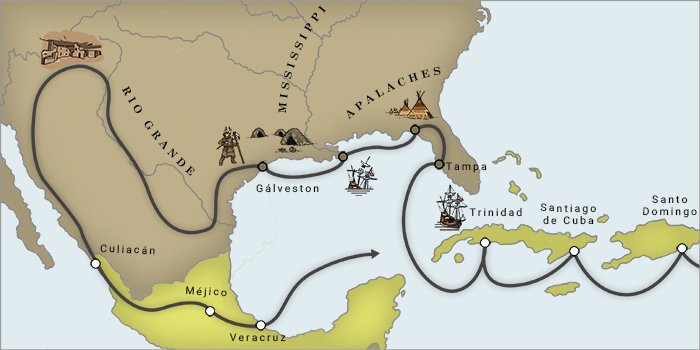
Today in the paid subscriber section below I publish excerpts from a Spanish Catholic explorer of genuine Christian faith who wrote of his travels in what today is Florida and Southwestern United States. Cabeza de Vaca, like the Italian Christopher Columbus, were flawed yet sincere believers whom God used.
The content below was originally paywalled.
Cabeza da Vaca’s account of travels, 1520s-1530s
Prologue: Sacred Caesarian Catholic Majesty:
….Although ambition and love of action are common to all, as to the advantages that each may gain, there are great inequalities of fortune, the result not of conduct, but only accident, nor caused by the fault of any one, but coming in the providence of God and solely by His will. ….As for me, I can say in undertaking the march I made on the main by the royal authority, I firmly trusted that my conduct and services would be as evident and distinguished as were those of my ancestors…. To me, one only duty remains, to present a relation of what was seen and heard in the ten years I wandered lost and in privation through many and remote lands. Not merely a statement of positions and distances, animals and vegetation, but of the diverse customs of the many and very barbarous people with whom I talked and dwelt…. As the narrative is in my opinion of no trivial value to those who in your name go to subdue those countries and bring them to a knowledge of the true faith and true Lord, and under the imperial dominion, I have written this with much exactness; and although in it may be read things very novel and for some persons difficult to believe, nevertheless they may without hesitation credit me as strictly faithful. Better than to exaggerate, I have lessened in all things….
….Two hours after our arrival at Apalachen, the Indians who had fled from there came in peace to us, asking for their women and children, whom we released; but the detention of a cacique by the Governor produced great excitement, in consequence of which they returned for battle…. killing a lord of Tescuco, named Don Pedro, whom the Commissary brought with him, we determined to leave that place and go in quest of the sea, and the town of Ante…
….The Indians we had so far seen in Florida are all archers. They go naked, are large of body, and ap- pear at a distance like giants. They are of admirable proportions, very spare and of great activity and strength. The bows they use are as thick as the arm, of eleven or twelve palms in length, which they will discharge at two hundred paces with so great precision that they miss nothing.
….The journey was extremely arduous. There were not horses enough to carry the sick, who went on increasing in numbers day by day, and we knew of no cure. It was piteous and painful to witness our perplexity and distress. …the people were unable to move forward, the greater part being ill, and those were few who could be on duty. ….but most certain assistance is in God, our Lord, on whom we never failed to place reliance. One thing occurred, more afflicting to us than all the rest, which was, that of the persons mounted, the greater part commenced secretly to plot, hoping to secure a better fate for themselves by abandoning the Governor and the sick…
After the accomplishment of this, the Governor called them all to him, and of each apart he asked advice as to what he should do to get out of a country so miserable, and seek that assistance elsewhere…. and, above all, there -was nothing to eat, while building, for those who should labor…
By the twenty-second of the month of September, the horses had been consumed, one only remaining; and on that day we embarked…the boats were so crowded that we could not move: so much can necessity do, which drove us to hazard our lives in this manner, running into a turbulent sea, not a single one who went, having a knowledge of navigation.
…many natives arrived in canoes who asked us for the two that had remained in the boat. The Governor replied that he would give up the hostages when they should bring the Christians they had taken. With the Indians had come five or six chiefs…. While thus engaged, the wind beginning to freshen, they left us and went back…
Near the shore a wave took us, that knocked the boat out of water…. Finding themselves near the shore, they began to move on hands and feet, crawling to land into some ravines. There we made fire, parched some of the maize we brought, and found rain water.
The Indians, at sight of what had befallen us, and our state of suffering and melancholy destitution, sat down among us, and from the sorrow and pity they felt, they all began to lament so earnestly that they might have been heard at a distance, and continued so doing more than half an hour. It was strange to see these men, wild and untaught, howling like brutes over our misfortunes. It caused in me as in others, an increase of feeling and a livelier sense of our calamity.
That same night of our arrival, some Indians came to Castillo and told him that they had great pain in the head, begging him to cure them. After he made over them the sign of the cross, and commended them to God, they instantly said that all the pain had left… As the report of Castillo’s performances spread, many came to us that night sick, that we should heal them, each bringing a piece of venison, until the quantity became so great we knew not where to dispose of it. We gave many thanks to God, for every day went on increasing his compassion and his gifts. After the sick were attended to, they began to dance and sing, making themselves festive, until sunrise; and because of our arrival, the rejoicing was continued for three days. When these were ended, we asked the Indians about the country farther on, the people we should find in it, and of the subsistence there.
….After walking five days in great hunger, since on the way was no manner of fruit, we came to a river and put up our houses. We then went to seek the product of certain trees….[but] in the dark, I got lost. Thank God I found a burning tree, and in the warmth of it passed the cold of that night. ….I wandered five days…. while walking naked as I was born. ….I made four fires, in the form of a cross, ….while I tasted not a mouthful, nor did I find anything I could eat. My feet were bare and bled a good deal. Through the mercy of God, the wind did not blow from the north in all this time, otherwise I should have died. At the end of the fifth day I arrived on the margin of a river, where I found the Indians, who with the Christians, had considered me dead…. the Christians rendering thanks to our Lord that he had ever given us his aid.
From the Island of Malhado to this land, all the Indians whom we saw have the custom from the time in which their wives find themselves pregnant, of not sleeping with them until two years after they have given birth. ….It is common among them all to leave their wives when there is no conformity, and directly they connect themselves with whom they please. This is the course of the men who are childless; those who have children, remain with their wives and never abandon them.
When they dispute and quarrel in their towns, they strike each other with the fists, fighting until exhausted, and then separate. …When no longer offended and their anger is gone, they return. From that time they are friends as if nothing had happened… They are all warlike, and have as much strategy for protecting themselves against enemies as they could have were they reared in Italy in continual feuds. When they are in a part of the country where their enemies may attack them, they place their houses on the skirt of a wood, the thickest and most tangled they can find, and near it make a ditch in which they sleep.
….the people gave Dorantes over six hundred open hearts of deer. They ever keep a good supply of them for food, and we called the place Pueblo de los Corazones. ….With grass and straw the women cover their nudity.
….Castillo saw the buckle of a sword-belt on the neck of an Indian ….they all responded, that certain men who wore beards like us, had come from heaven and arrived at that river; bringing horses, lances, and swords, and that they had lanced two Indians. In a manner of the utmost indifference we could feign, we asked them what had become of those men: they answered us that they had gone to sea… towards the sunset.
Having seen positive traces of Christians and become satisfied they were very near, we gave many thanks to our Lord for redeeming us from our sad and gloomy condition. Any one can imagine our delight when he reflects how long we had been in that land, and how many dangers and hardships we had suffered.
For this we gave many thanks to God our Lord. We had before despaired of ever hearing more of Christians. ….and as we advanced on our way, the news of the Christians continually grew. We told the natives that we were going in search of that people, to order them not to kill nor make slaves of them, nor take them from their lands, nor do other injustice. Of this the Indians were very glad.
….and they related how the Christians, at other times had come through the land destroying and burning the towns, carrying away half the men, and all the women and the boys, while those who had been able to escape were wandering about fugitives. We found them so alarmed they dared not remain anywhere. They would not, nor could they till the earth; but preferred to die rather than live in dread of such cruel usage as they received. Although these showed themselves greatly delighted with us, we feared that on our arrival among those who held the frontier and fought against the Christians, they would treat us badly, and revenge upon us the conduct of their enemies; but when God our Lord was pleased to bring us there, they began to dread and respect us…. Thence it may at once be seen, that to bring all these people to be Christians and to the obedience of the Imperial Majesty, they must be won by kindness, which is a way certain, and no other is.
…The day after I overtook four [Christians] on horseback, who were astonished at the sight of me, so strangely habited as I was, and in company with Indians. They stood staring at me a length of time, so confounded that they neither hailed me nor drew near to make an inquiry…
Five days having elapsed, Andres Dorantes and Alonzo del Castillo arrived with those who had been sent after them. They brought more than six hundred persons of that community, whom the Christians had driven into the forests, and who had wandered in concealment over the land. Those who accompanied us so far, had drawn them out, and given them to the Christians, who thereupon dismissed all the others they had brought with them. Upon their coming to where I was, Alcaraz begged that we would summon the people of the towns on the margin of the river, who straggled about under cover of the woods, and order them to fetch us something to eat. This last was unnecessary, the Indians being ever diligent to bring us all they could. Directly we sent our messengers to call them, when there came six hundred souls, bringing us all the maize in their possession. They fetched it in certain pots, closed with clay, which they had concealed in the earth. They brought us whatever else they had; but we, wishing only to have the provision, gave the rest to the Christians, that they might divide among themselves…
Thereupon we had many and bitter quarrels with the Christians, for they wanted to make slaves of our Indians, and we grew so angry at it that at our departure we forgot to take along many bows, pouches and arrows, also the five emeralds, and so they were left and lost to us. We gave the Christians a great many cow-skin robes, and other objects, and had much trouble in persuading the Indians to return home and plant their crops in peace. They insisted upon accompanying us until, according to their custom, we should be in the custody of other Indians, because otherwise they were afraid to die; besides, as long as we were with them, they had no fear of the Christians and of their lances. At all this the Christians were greatly vexed, and told their own interpreter to say to the Indians how we were of their own race, but had gone astray for a long while, and were people of no luck and little heart, whereas they were the lords of the land, whom they should obey and serve…. while we were persons of mean condition and small force.
The Indians cared little or nothing for what was told them; and conversing among themselves said the Christians lied: that we had come whence the sun rises, and they whence it goes down: we healed the sick, they killed the ([_____); that we had come naked and barefooted, while they had arrived in clothing and on horses with lances; that we were not covetous of anything, but all that was given to us, we directly turned to give, remaining with nothing; that the others had the only purpose to rob whomsoever they found, bestowing nothing on any one…
This clearly shows how the designs of men sometimes miscarry. We went on with the idea of insuring the liberty of the Indians, and, when we believed it to be assured, the opposite took place. The Spaniards had planned to fall upon those Indians we had sent back in fancied security and in peace, and that plan they carried out….