Go see the movie now in theaters!
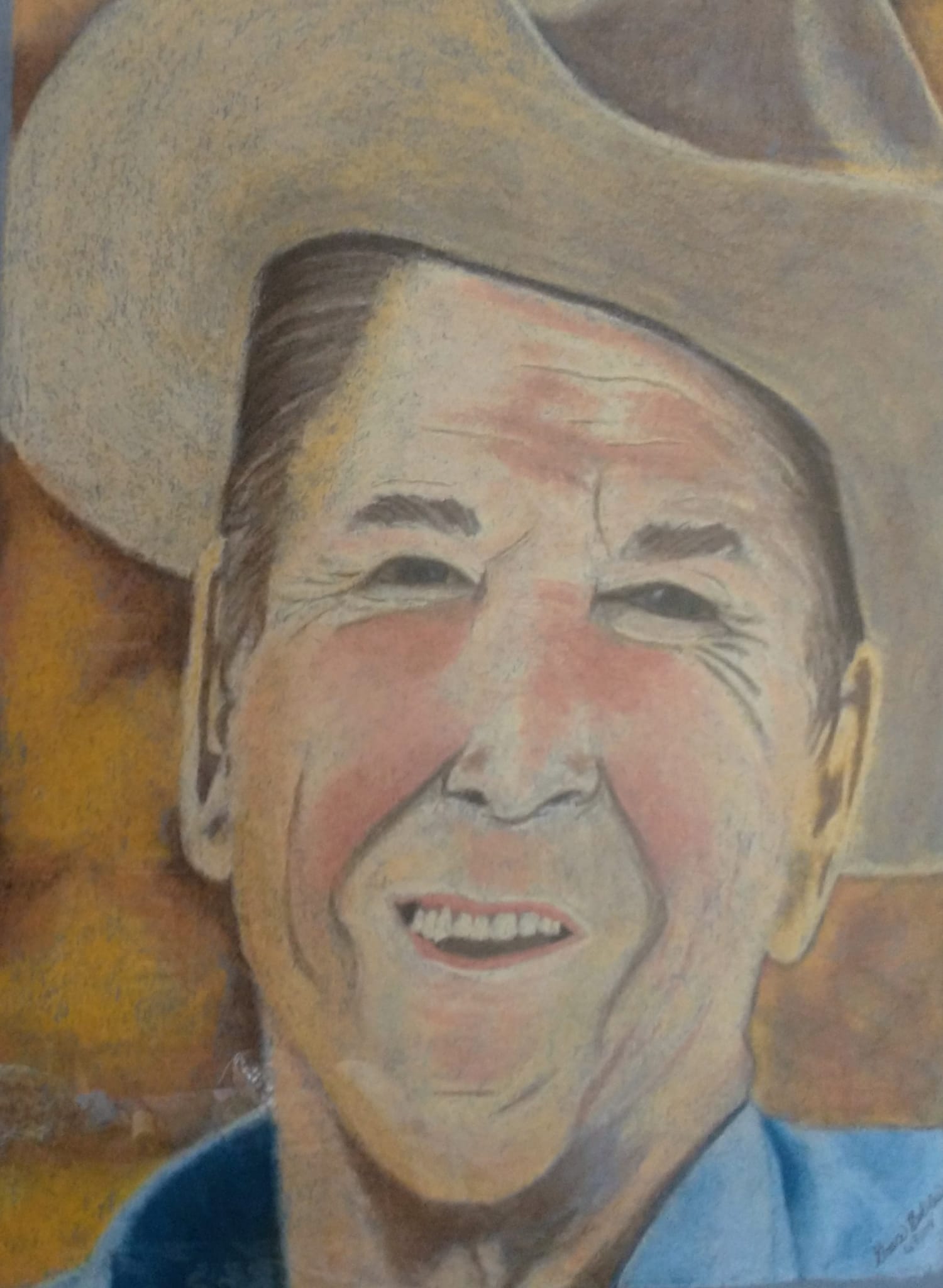
I saw the movie this weekend called Reagan. It is about a man I want to honor in this blog, by telling you some of my own life story and how Ronald Reagan had an influence on me (pic above is a pastel by my 14 year old daughter Grace at the time of Reagan’s death).
I was never interested in politics until 1980. I was a pastor of a church in Lexington, Kentucky at that time. The previous year I had first learned of the impact of Christians and especially pastors in the founding of America, by hearing lectures by Rev. Peter Marshall, jr, and also reading his book called The Light and the Glory. It inspired me to learn more and I took a summer vacation along the east coast in 1979 visiting historic sites that I was learning about. I especially remember listening in Lexington, Massachusetts to the national park ranger tell of the work of Rev. Jonas Clark working with Sam Adams and the patriots. At that moment, I sensed a clear call from God to me to study more along these lines because God perhaps may use me in similar ways.
Many in our church went with me to a gathering called Washington for Jesus on April 29, 1980 where about half a million believers gathered on the national mall to repent and pray for our nation. As I heard major national Christian religious leaders along with Christian political leaders speak about the state of our nation and issues of concern to Christians, my sense of God’s purpose for our nation and the need to do our part in turning the nation to God became strong in my heart. Three months later I organized a Lexington for Jesus movement. But I was not yet focused personally on politics itself.
I then went to Dallas Texas on August 21-22 for what was called a National Affairs Briefing. At that event with well over 10,000 believers, mostly pastors, from across America I was awakened to the need of Christians to be involved in politics. I heard many political speakers for the first time, from both major political parties, speak of biblical principles of government and address political issues of concern to Christians and the need for us to unite to turn America around. (At that event I also purchased books that shaped my thinking more than any others due to their thorough primary sources: The Christian History of the American Revolution and The Christian History of the Constitution by Verna Hall.)
Ronald Reagan, the Republican candidate for President, spoke at that event. I already was well aware of President Jimmy Carter, and his well-known biography as being a “born-again” believer, but also his track record of four years as President. Carter’s faith was genuine but his public policies promoted abortion, homosexuality, and appeasement of atheistic communism as it spread globally. Reagan, although less evangelical in language, spoke more sincerely to the issues and the worldview that most pastors there held in common. I became at that point committed to help him win the election.
I learned there about the new movement called Moral Majority started by Rev. Jerry Falwell. Although I was not a Baptist, it was a major vehicle in which charismatics like me, along with Baptists, fundamentalists, evangelicals and even some Catholics were able to work together for non-partisan political action. When I returned home to Lexington, Kentucky, I then did a lengthy briefing for my own congregation, sharing much of what I learned. And I agreed to help form a local chapter of the Moral Majority, working closely with a Baptist pastor. We paid for an ad in the newspaper just before the election that compared the major candidates’ views on various political issues and spread Christian VoterGuides to local churches.
It felt as if the election was a tipping point in America’s history and in global politics. On November 1, 1980 Reagan won the election for President and national media gave much attention to the role of Moral Majority. It was not just that organization. It was a movement of Christians into politics that made helped Reagan succeed (which the recent movie does not really show). Conservative pastors in politics was a new phenomenon. I received hate mail at that time, along with being in demand in the local newspapers and on local television news shows. I did not represent the Republican Party, but the Kingdom of God in the political sphere. It was an unbelievable change in my life in less than three months’ time.
I blame it on Ronald Reagan. God used him to make me a pastor involved in conservative politics. I soon organized prolife rallies there and in Charlottesville, Virginia where I moved in 1981. I did not plan to leave my role as a pastor for work in politics or government, but over subsequent years, I heard Reagan speak several times and was invited to briefings at the White House (although I personally never met with him). And I attended many politically-oriented conferences and seminars to be more informed on current social issues and on practical matters in order to win elections, etc.
I personally began organizing prolife rallies locally and helped found the Charlottesville Pregnancy Center. I decided that I needed to be a model of what other citizens should do, so I worked phone banks, knocked on doors, ran the table for the party on election day in my precinct, made donations to candidates, etc. I also organized many local forums for pastors and political leaders over the years, including Pat Robertson in my home town when he eventually launched his campaign for President in 1987. In June 1988 members of our church effectively took control of the local Republican party and sent many delegates to the Virginia Republican state convention which also was henceforth led mostly by Christian leaders. This happened in many more states across America and united most Evangelical Christians in common efforts politically nationwide.
This Christian dominance in Republican politics was evident in 1988 at the moment that Reagan finished his two terms in the White House. Within a year, the Berlin Wall came down and the Soviet Union began to dissolve. His leadership had changed both America and global politics. When Reagan passed away in June 2004, I was determined to be one of those who paid respects in Washington, D.C. to honor one of the greatest leaders the United States has ever had.
I will close this blog with words from Reagan written personally to our church movement in 1984. It will not show in his collection of speeches but is indicative of his worldview, as follows: “The Bible says, Righteousness exalts a nation, but sin is a disgrace to any people. We have been an exalted nation for many generations, and through your efforts and prayers, America will continue to embrace a righteous standard. Let us never stop heeding the call for a spiritual revival, and we will see the results. Nancy and I commend you on your dedication and commitment to the Gospel, and we send our best wishes for every future success.”
Forty years later, his words have never been more appropriate. The engagement of Christians in the 1980s in elections was crucial, and our nation seems again to be at a historic crossroads. May God awaken His people to take their part again.
For paid subscribers I have included below the text of three of Reagan’s greatest speeches in my opinion. The first two show his understanding of Christianity in America’s founding and the importance of it still today. The third speech is poignant for its context because his tough rhetoric forced the Soviets to change and allow more openness. In this Moscow speech his respectful but transcendent message of the ideological battle presented at that place and time inside the Soviet Union was incredible.
The content below was originally paywalled.
January 31, 1983 at National Religious Broadcasters, Washington, DC
In a time when recession has gripped our land, your industry, religious broadcasting, has enjoyed phenomenal growth. Now, there may be some who are frightened by your success, but I’m not one of them. As far as I’m concerned, the growth of religious broadcasting is one of the most heartening signs in America today.
When we realize that every penny of that growth is being funded voluntarily by citizens of every stripe, we see an important truth. It’s something that I have been speaking of for quite some time — that the American people are hungry for your message, because they’re hungry for a spiritual revival in this land. When Americans reach out for values of faith, family, and caring for the needy, they’re saying, “We want the word of God. We want to face the future with the Bible.”
Facing the future with the Bible — that’s a perfect theme for your convention. You might be happy to hear that I have some “good news” of my own. Thursday morning, at the National Prayer Breakfast, I will sign a proclamation making 1983 the Year of the Bible.
We’re blessed to have its words of strength, comfort, and truth. I’m accused of being simplistic at times with some of the problems that confront us. But I’ve often wondered: Within the covers of that single Book are all the answers to all the problems that face us today, if we’d only look there. “The grass withereth, the flower fadeth, but the word of our God shall stand forever.” I hope Americans will read and study the Bible in 1983. It’s my firm belief that the enduring values, as I say, presented in its pages have a great meaning for each of us and for our nation. The Bible can touch our hearts, order our minds, refresh our souls.
Now, I realize it’s fashionable in some circles to believe that no one in government should order or encourage others to read the Bible. Encourage — I shouldn’t have said order. We’re told that will violate the constitutional separation of church and state established by the Founding Fathers in the first amendment.
Well, it might interest those critics to know that none other than the Father of our Country, George Washington, kissed the Bible at his inauguration. And he also said words to the effect that there could be no real morality in a society without religion.
John Adams called it “the best book in the world.” And Ben Franklin said, “. . . the longer I live, the more convincing proofs I see of this truth, that God governs in the affairs of men . . . without His concurring aid, we shall succeed in this political building no better than the builders of Babel; we shall be divided by our little, partial, local interests, our projects will be confounded, and we ourselves shall become a reproach, a bye-word down to future ages.”
So, when I hear the first amendment used as a reason to keep the traditional moral values away from policymaking, I’m shocked. The first amendment was not written to protect people and their laws from religious values; it was written to protect those values from government tyranny.
I’ve always believed that this blessed land was set apart in a special way, that some divine plan placed this great continent here between the two oceans to be found by people from every corner of the Earth — people who had a special love for freedom and the courage to uproot themselves, leave their homeland and friends to come to a strange land. And, when coming here, they created something new in all the history of mankind — a country where man is not beholden to government, government is beholden to man.
I happen to believe that one way to promote, indeed, to preserve those traditional values we share is by permitting our children to begin their days the same way the Members of the United States Congress do — with prayer. The public expression of our faith in God, through prayer, is fundamental — as a part of our American heritage and a privilege which should not be excluded from our schools.
No one must be forced or pressured to take part in any religious exercise. But neither should the freest country on Earth ever have permitted God to be expelled from the classroom. When the Supreme Court ruled that school prayer was unconstitutional almost 21 years ago, I believe it ruled wrong. And when a lower court recently stopped Lubbock, Texas, high school students from even holding voluntary prayer meetings on the campus before or after class, it ruled wrong, too.
Our only hope for tomorrow is in the faces of our children. And we know Jesus said, “Suffer the little children to come unto me, and forbid them not, for such is the kingdom of God.” Well, last year we tried to pass an amendment that would allow communities to determine for themselves whether voluntary prayer should be permitted in their public schools. And we failed. But I want you to know something: I’m determined to bring that amendment back again and again and again and again, until — [applause] — —
You know, we were frustrated on two other fronts last year. There are 5 million American children attending private schools today because of emphasis on religious values and educational standards. Their families, most of whom earn less than $25,000 a year, pay private tuition, and they also pay their full share of taxes to fund the public schools. We think they’re entitled to relief. So, I want you to know that shortly, we’ll be sending legislation back up to the Hill, and we will begin the struggle all over again to secure tuition tax credits for deserving families.
There’s another struggle we must wage to redress a great national wrong. We must go forward with unity of purpose and will. And let us come together, Christians and Jews, let us pray together, march, lobby, and mobilize every force we have, so that we can end the tragic taking of unborn children’s lives. Who among us can imagine the excruciating pain the unborn must feel as their lives are snuffed away? And we know medically they do feel pain.
I’m glad that a “respect human life” bill has already been introduced in Congress by Representative Henry Hyde. Not only does this bill strengthen and expand restrictions on abortions financed by tax dollars, it also addresses the problem of infanticide. It makes clear the right of all children, including those who are born handicapped, to food and appropriate medical treatment after birth, and it has the full support of this administration.
I know that many well-intentioned, sincerely motivated people believe that government intervention violates a woman’s right of choice. And they would be right if there were any proof that the unborn are not living human beings. Medical evidence indicates to the contrary and, if that were not enough, how do we explain the survival of babies who are born prematurely, some very prematurely?
We once believed that the heart didn’t start beating until the fifth month. But as medical instrumentation has improved, we’ve learned the heart was beating long before that. Doesn’t the constitutional protection of life, liberty, and the pursuit of happiness extend to the unborn unless it can be proven beyond a shadow of a doubt that life does not exist in the unborn? And I believe the burden of proof is on those who would make that point.
I read in the Washington Post about a young woman named Victoria. She’s with child, and she said, “In this society we save whales, we save timber wolves and bald eagles and Coke bottles. Yet everyone wanted me to throw away my baby.” Well, Victoria’s story has a happy ending. Her baby will be born.
Victoria has received assistance from a Christian couple, and from Sav-A-Life, a new Dallas group run by Jim McKee, a concerned citizen who thinks it’s important to provide constructive alternatives to abortion. There’s hope for America. She remains powerful and a powerful force for good, and it’s thanks to the conviction and commitment of people like those who are helping Victoria. They’re living the meaning of the two great commandments: “Thou shalt love the Lord thy God with all thy heart, and with all thy soul, and with all thy might” and “thou shalt love thy neighbour as thyself.”
Each year, government bureaucracies spend bills [billions] for problems related to drugs and alcoholism and disease. Has anyone stopped to consider that we might come closer to balancing the budget if all of us simply tried to live up to the Ten Commandments and the Golden Rule?
That’s what’s happening with CBN and the 700 Club’s “Operation Blessing.” They’ve given nearly $2\1/2\ million to more than 8,500 churches, and this money is then matched by the local churches. The result has been fantastic: More than 100,000 needy families helped, either through direct or in-kind contributions, ranging from food and clothing to education, dental care, and housework.
The PTL – TV network is carrying out “A Master Plan for People that Love,” opening centers all across the country to provide food, clothing, furniture, and job bank centers at no cost. Don’t listen to those cynics — some of them here in the Capital — who would run our country down. America’s heart is strong, and its heart is good.
You know, I mentioned drugs a moment ago. And I hope you’ll forgive me if I digress just long enough — because I don’t often get the chance to say this publicly — how proud I am of Nancy and the job she’s doing helping to fight drug addiction.
I do that every day for her. [Laughter]
I know that each of you is contributing in your own way to rebuilding America, and I thank you. As broadcasters, you have unique opportunities. And all of us, as Protestants, Catholics, and Jews, have a special responsibility to remember our fellow believers who are being persecuted in other lands. We’re all children of Abraham. We’re children of the same God.
You might be interested to know about a few of the changes that we’re making at the Voice of America. Our transmissions of Christian and Jewish broadcasts are being expanded and improved. This year, for the first time in history, the Voice of America broadcast a religious service worldwide — Christmas Eve at the National Presbyterian Church, in Washington, D.C.
Now, these broadcasts are not popular with governments of totalitarian powers. But make no mistake, we have a duty to broadcast. Aleksandr Herzen, the Russian writer, warned, “To shrink from saying a word in defense of the oppressed is as bad as any crime.” Well, I pledge to you that America will stand up, speak out, and defend the values we share. To those who would crush religious freedom, our message is plain: You may jail your believers. You may close their churches, confiscate their Bibles, and harass their rabbis and priests, but you will never destroy the love of God and freedom that burns in their hearts. They will triumph over you.
Malcolm Muggeridge, the brilliant English commentator, has written, “The most important happening in the world today is the resurgence of Christianity in the Soviet Union, demonstrating that the whole effort sustained over 60 years to brainwash the Russian people into accepting materialism has been a fiasco.”
Think of it: the most awesome military machine in history, but it is no match for that one, single man, hero, strong yet tender, Prince of Peace. His name alone, Jesus, can lift our hearts, soothe our sorrows, heal our wounds, and drive away our fears. He gave us love and forgiveness. He taught us truth and left us hope. In the Book of John is the promise that we all go by — tells us that “For God so loved the world that He gave His only begotten Son, that whosoever believeth in Him should not perish, but have everlasting life.”
With His message and with your conviction and commitment, we can still move mountains. We can work to reach our dreams and to make America a shining city on a hill. Before I say goodby, I wanted to leave with you these words from an old Netherlands folk song, because they made me think of our meeting here today:
We gather together to ask the Lord’s blessing.
We all do extol Thee, Thou leader triumphant
And pray that Thou still our Defender wilt be.
Let Thy congregation escape tribulation.
Thy name be ever praised! O Lord, make us free!
To which I would only add a line from another song: America, America, God shed His grace on thee.
August 23, 1984 at the Dallas Prayer Breakfast
These past few weeks it seems that we’ve all been hearing a lot of talk about religion and its role in politics, religion and its place in the political life of the Nation. And I think it’s appropriate today, at a prayer breakfast for 17,000 citizens in the State of Texas during a great political convention, that this issue be addressed.
I don’t speak as a theologian or a scholar, only as one who’s lived a little more than his threescore ten — which has been a source of annoyance to some — [laughter] — and as one who has been active in the political life of the Nation for roughly four decades and now who’s served the past 3\1/2\ years in our highest office. I speak, I think I can say, as one who has seen much, who has loved his country, and who’s seen it change in many ways.
I believe that faith and religion play a critical role in the political life of our nation — and always has — and that the church — and by that I mean all churches, all denominations — has had a strong influence on the state. And this has worked to our benefit as a nation.
Those who created our country — the Founding Fathers and Mothers — understood that there is a divine order which transcends the human order. They saw the state, in fact, as a form of moral order and felt that the bedrock of moral order is religion.
The Mayflower Compact began with the words, “In the name of God, amen.” The Declaration of Independence appeals to “Nature’s God” and the “Creator” and “the Supreme Judge of the world.” Congress was given a chaplain, and the oaths of office are oaths before God.
James Madison in the Federalist Papers admitted that in the creation of our Republic he perceived the hand of the Almighty. John Jay, the first Chief Justice of the Supreme Court, warned that we must never forget the God from whom our blessings flowed.
George Washington referred to religion’s profound and unsurpassed place in the heart of our nation quite directly in his Farewell Address in 1796. Seven years earlier, France had erected a government that was intended to be purely secular. This new government would be grounded on reason rather than the law of God. By 1796 the French Revolution had known the Reign of Terror.
And Washington voiced reservations about the idea that there could be a wise policy without a firm moral and religious foundation. He said, “Of all the dispositions and habits which lead to political prosperity, Religion and morality are indispensable supports. In vain would that man (call himself a patriot) who (would) labour to subvert these . . . finest [firmest]* props of the duties of men and citizens. The mere Politician . . . (and) the pious man ought to respect and to cherish (religion and morality).” And he added, “. . . let us with caution indulge the supposition, that morality can be maintained without religion.”
I believe that George Washington knew the City of Man cannot survive without the City of God, that the Visible City will perish without the Invisible City.
Religion played not only a strong role in our national life; it played a positive role. The abolitionist movement was at heart a moral and religious movement; so was the modern civil rights struggle. And throughout this time, the state was tolerant of religious belief, expression, and practice. Society, too, was tolerant.
But in the 1960’s this began to change. We began to make great steps toward secularizing our nation and removing religion from its honored place.
In 1962 the Supreme Court in the New York prayer case banned the compulsory saying of prayers. In 1963 the Court banned the reading of the Bible in our public schools. From that point on, the courts pushed the meaning of the ruling ever outward, so that now our children are not allowed voluntary prayer. We even had to pass a law — we passed a special law in the Congress just a few weeks ago to allow student prayer groups the same access to schoolrooms after classes that a young Marxist society, for example, would already enjoy with no opposition.
The 1962 decision opened the way to a flood of similar suits. Once religion had been made vulnerable, a series of assaults were made in one court after another, on one issue after another. Cases were started to argue against tax-exempt status for churches. Suits were brought to abolish the words “under God” from the Pledge of Allegiance and to remove “In God We Trust” from public documents and from our currency.
Today there are those who are fighting to make sure voluntary prayer is not returned to the classrooms. And the frustrating thing for the great majority of Americans who support and understand the special importance of religion in the national life — the frustrating thing is that those who are attacking religion claim they are doing it in the name of tolerance, freedom, and openmindedness. Question: Isn’t the real truth that they are intolerant of religion? [Applause] They refuse to tolerate its importance in our lives.
If all the children of our country studied together all of the many religions in our country, wouldn’t they learn greater tolerance of each other’s beliefs? If children prayed together, would they not understand what they have in common, and would this not, indeed, bring them closer, and is this not to be desired? So, I submit to you that those who claim to be fighting for tolerance on this issue may not be tolerant at all.
When John Kennedy was running for President in 1960, he said that his church would not dictate his Presidency any more than he would speak for his church. Just so, and proper. But John Kennedy was speaking in an America in which the role of religion — and by that I mean the role of all churches — was secure. Abortion was not a political issue. Prayer was not a political issue. The right of church schools to operate was not a political issue. And it was broadly acknowledged that religious leaders had a right and a duty to speak out on the issues of the day. They held a place of respect, and a politician who spoke to or of them with a lack of respect would not long survive in the political arena.
It was acknowledged then that religion held a special place, occupied a special territory in the hearts of the citizenry. The climate has changed greatly since then. And since it has, it logically follows that religion needs defenders against those who care only for the interests of the state.
There are, these days, many questions on which religious leaders are obliged to offer their moral and theological guidance, and such guidance is a good and necessary thing. To know how a church and its members feel on a public issue expands the parameters of debate. It does not narrow the debate; it expands it.
The truth is, politics and morality are inseparable. And as morality’s foundation is religion, religion and politics are necessarily related. We need religion as a guide. We need it because we are imperfect, and our government needs the church, because only those humble enough to admit they’re sinners can bring to democracy the tolerance it requires in order to survive.
A state is nothing more than a reflection of its citizens; the more decent the citizens, the more decent the state. If you practice a religion, whether you’re Catholic, Protestant, Jewish, or guided by some other faith, then your private life will be influenced by a sense of moral obligation, and so, too, will your public life. One affects the other. The churches of America do not exist by the grace of the state; the churches of America are not mere citizens of the state. The churches of America exist apart; they have their own vantage point, their own authority. Religion is its own realm; it makes its own claims.
We establish no religion in this country, nor will we ever. We command no worship. We mandate no belief. But we poison our society when we remove its theological underpinnings. We court corruption when we leave it bereft of belief. All are free to believe or not believe; all are free to practice a faith or not. But those who believe must be free to speak of and act on their belief, to apply moral teaching to public questions.
I submit to you that the tolerant society is open to and encouraging of all religions. And this does not weaken us; it strengthens us, it makes us strong. You know, if we look back through history to all those great civilizations, those great nations that rose up to even world dominance and then deteriorated, declined, and fell, we find they all had one thing in common. One of the significant forerunners of their fall was their turning away from their God or gods.
Without God, there is no virtue, because there’s no prompting of the conscience. Without God, we’re mired in the material, that flat world that tells us only what the senses perceive. Without God, there is a coarsening of the society. And without God, democracy will not and cannot long endure. If we ever forget that we’re one nation under God, then we will be a nation gone under.
If I could just make a personal statement of my own — in these 3 1/2 years I have understood and known better than ever before the words of Lincoln, when he said that he would be the greatest fool on this footstool called Earth if he ever thought that for one moment he could perform the duties of that office without help from One who is stronger than all.
I thank you, thank you for inviting us here today. Thank you for your kindness and your patience. May God keep you, and may we, all of us, keep God.
May 31, 1988 at Moscow State University, Soviet Union
It’s a great pleasure to be here at Moscow State University, and I want to thank you all for turning out. I know you must be very busy this week, studying and taking your final examinations. So, let me just say zhelayu yam uspekha [I wish you success]. Nancy couldn’t make it today because she’s visiting Leningrad, which she tells me is a very beautiful city, but she, too, says hello and wishes you all good luck.
Let me say it’s also a great pleasure to once again have this opportunity to speak directly to the people of the Soviet Union. Before I left Washington, I received many heartfelt letters and telegrams asking me to carry here a simple message, perhaps, but also some of the most important business of this summit: It is a message of peace and good will and hope for a growing friendship and closeness between our two peoples.
As you know, I’ve come to Moscow to meet with one of your most distinguished graduates. In this, our fourth summit, General Secretary Gorbachev and I have spent many hours together, and I feel that we’re getting to know each other well. Our discussions, of course, have been focused primarily on many of the important issues of the day, issues I want to touch on with you in a few moments. But first I want to take a little time to talk to you much as I would to any group of university students in the United States. I want to talk not just of the realities of today but of the possibilities of tomorrow.
Standing here before a mural of your revolution, I want to talk about a very different revolution that is taking place right now, quietly sweeping the globe without bloodshed or conflict. Its effects are peaceful, but they will fundamentally alter our world, shatter old assumptions, and reshape our lives. It’s easy to underestimate because it’s not accompanied by banners or fanfare. It’s been called the technological or information revolution, and as its emblem, one might take the tiny silicon chip, no bigger than a fingerprint. One of these chips has more computing power than a roomful of old-style computers.
As part of an exchange program, we now have an exhibition touring your country that shows how information technology is transforming our lives — replacing manual labor with robots, forecasting weather for farmers, or mapping the genetic code of DNA for medical researchers. These microcomputers today aid the design of everything from houses to ears to spacecraft; they even design better and faster computers. They can translate English into Russian or enable the blind to read or help Michael Jackson produce on one synthesizer the sounds of a whole orchestra. Linked by a network of satellites and fiber-optic cables, one individual with a desktop computer and a telephone commands resources unavailable to the largest governments just a few years ago.
Like a chrysalis, we’re emerging from the economy of the Industrial Revolution — an economy confined to and limited by the Earth’s physical resources — into, as one economist titled his book, “The Economy in Mind,” in which there are no bounds on human imagination and the freedom to create is the most precious natural resource. Think of that little computer chip. Its value isn’t in the sand from which it is made but in the microscopic architecture designed into it by ingenious human minds. Or take the example of the satellite relaying this broadcast around the world, which replaces thousands of tons of copper mined from the Earth and molded into wire. In the new economy, human invention increasingly makes physical resources obsolete. We’re breaking through the material conditions of existence to a world where man creates his own destiny. Even as we explore the most advanced reaches of science, we’re returning to the age-old wisdom of our culture, a wisdom contained in the book of Genesis in the Bible: In the beginning was the spirit, and it was from this spirit that the material abundance of creation issued forth.
But progress is not foreordained. The key is freedom — freedom of thought, freedom of information, freedom of communication. The renowned scientist, scholar, and founding father of this university, Mikhail Lomonosov, knew that. “It is common knowledge,” he said, “that the achievements of science are considerable and rapid, particularly once the yoke of slavery is cast off and replaced by the freedom of philosophy.” You know, one of the first contacts between your country and mine took place between Russian and American explorers. The Americans were members of Cook’s last voyage on an expedition searching for an Arctic passage; on the island of Unalaska, they came upon the Russians, who took them in, and together with the native inhabitants, held a prayer service on the ice.
The explorers of the modern era are the entrepreneurs, men with vision, with the courage to take risks and faith enough to brave the unknown. These entrepreneurs and their small enterprises are responsible for almost all the economic growth in the United States. They are the prime movers of the technological revolution. In fact, one of the largest personal computer firms in the United States was started by two college students, no older than you, in the garage behind their home. Some people, even in my own country, look at the riot of experiment that is the free market and see only waste. What of all the entrepreneurs that fail? Well, many do, particularly the successful ones; often several times. And if you ask them the secret of their success, they’ll tell you it’s all that they learned in their struggles along the way; yes, it’s what they learned from failing. Like an athlete in competition or a scholar in pursuit of the truth, experience is the greatest teacher.
And that’s why it’s so hard for government planners, no matter how sophisticated, to ever substitute for millions of individuals working night and day to make their dreams come true. The fact is, bureaucracies are a problem around the world. There’s an old story about a town — it could be anywhere — with a bureaucrat who is known to be a good-for-nothing, but he somehow had always hung on to power. So one day, in a town meeting, an old woman got up and said to him: “There is a folk legend here where I come from that when a baby is born, an angel comes down from heaven and kisses it on one part of its body. If the angel kisses him on his hand, he becomes a handyman. If he kisses him on his forehead, he becomes bright and clever. And I’ve been trying to figure out where the angel kissed you so that you should sit there for so long and do nothing.” [Laughter]
We are seeing the power of economic freedom spreading around the world. Places such as the Republic of Korea, Singapore, Taiwan have vaulted into the technological era, barely pausing in the industrial age along the way. Low-tax agricultural policies in the subcontinent mean that in some years India is now a net exporter of food. Perhaps most exciting are the winds of change that are blowing over the People’s Republic of China, where one-quarter of the world’s population is now getting its first taste of economic freedom. At the same time, the growth of democracy has become one of the most powerful political movements of our age. In Latin America in the 1970s, only a third of the population lived under democratic government; today over 90 percent does. In the Philippines, in the Republic of Korea, free, contested, democratic elections are the order of the day. Throughout the world, free markets are the model for growth. Democracy is the standard by which governments are measured.
We Americans make no secret of our belief in freedom. In fact, it’s something of a national pastime. Every four years the American people choose a new President, and 1988 is one of those years. At one point there were 13 major candidates running in the two major parties, not to mention all the others, including the Socialist and Libertarian candidates — all trying to get my job. About 1,000 local television stations, 8,500 radio stations, and 1,700 daily newspapers — each one an independent, private enterprise, fiercely independent of the Government — report on the candidates, grill them in interviews, and bring them together for debates. In the end, the people vote; they decide who will be the next President. But freedom doesn’t begin or end with elections.
Go to any American town, to take just an example, and you’ll see dozens of churches, representing many different beliefs — in many places, synagogues and mosques — and you’ll see families of every conceivable nationality worshiping together. Go into any schoolroom, and there you will see children being taught the Declaration of Independence, that they are endowed by their Creator with certain unalienable rights — among them life, liberty, and the pursuit of happiness — that no government can justly deny; the guarantees in their Constitution for freedom of speech, freedom of assembly, and freedom of religion. Go into any courtroom, and there will preside an independent judge, beholden to no government power. There every defendant has the right to a trial by a jury of his peers, usually 12 men and women — common citizens; they are the ones, the only ones, who weigh the evidence and decide on guilt or innocence. In that court, the accused is innocent until proven guilty, and the word of a policeman or any official has no greater legal standing than the word of the accused.
Go to any university campus, and there you’ll find an open, sometimes heated discussion of the problems in American society and what can be done to correct them. Turn on the television, and you’ll see the legislature conducting the business of government right there before the camera, debating and voting on the legislation that will become the law of the land. March in any demonstration, and there are many of them; the people’s right of assembly is guaranteed in the Constitution and protected by the police. Go into any union hall, where the members know their right to strike is protected by law. As a matter of fact, one of the many jobs I had before this one was being president of a union, the Screen Actors Guild. I led my union out on strike, and I’m proud to say we won.
But freedom is more even than this. Freedom is the right to question and change the established way of doing things. It is the continuing revolution of the marketplace. It is the understanding that allows us to recognize shortcomings and seek solutions. It is the right to put forth an idea, scoffed at by the experts, and watch it catch fire among the people. It is the right to dream — to follow your dream or stick to your conscience, even if you’re the only one in a sea of doubters. Freedom is the recognition that no single person, no single authority or government has a monopoly on the truth, but that every individual life is infinitely precious, that every one of us put on this world has been put there for a reason and has something to offer.
America is a nation made up of hundreds of nationalities. Our ties to you are more than ones of good feeling; they’re ties of kinship. In America, you’ll find Russians, Armenians, Ukrainians, peoples from Eastern Europe and Central Asia. They come from every part of this vast continent, from every continent, to live in harmony, seeking a place where each cultural heritage is respected, each is valued for its diverse strengths and beauties and the richness it brings to our lives. Recently, a few individuals and families have been allowed to visit relatives in the West. We can only hope that it won’t be long before all are allowed to do so and Ukrainian-Americans, Baltic-Americans, Armenian-Americans can freely visit their homelands, just as this Irish-American visits his.
Freedom, it has been said, makes people selfish and materialistic, but Americans are one of the most religious peoples on Earth. Because they know that liberty, just as life itself, is not earned but a gift from God, they seek to share that gift with the world. “Reason and experience,” said George Washington in his farewell address, “both forbid us to expect that national morality can prevail in exclusion of religious principle. And it is substantially true, that virtue or morality is a necessary spring of popular government.” Democracy is less a system of government than it is a system to keep government limited, unintrusive; a system of constraints on power to keep politics and government secondary to the important things in life, the true sources of value found only in family and faith.
But I hope you know I go on about these things not simply to extol the virtues of my own country but to speak to the true greatness of the heart and soul of your land. Who, after all, needs to tell the land of Dostoyevsky about the quest for truth, the home of Kandinsky and Scriabin about imagination, the rich and noble culture of the Uzbek man of letters Alisher Navoi about beauty and heart? The great culture of your diverse land speaks with a glowing passion to all humanity. Let me cite one of the most eloquent contemporary passages on human freedom. It comes, not from the literature of America, but from this country, from one of the greatest writers of the 20th century, Boris Pasternak, in the novel “Dr. Zhivago.” He writes: “I think that if the beast who sleeps in man could be held down by threats — any kind of threat, whether of jail or of retribution after death — then the highest emblem of humanity would be the lion tamer in the circus with his whip, not the prophet who sacrificed himself. But this is just the point — what has for centuries raised man above the beast is not the cudgel, but an inward music — the irresistible power of unarmed truth.”
The irresistible power of unarmed truth. Today the world looks expectantly to signs of change, steps toward greater freedom in the Soviet Union. We watch and we hope as we see positive changes taking place. There are some, I know, in your society who fear that change will bring only disruption and discontinuity, who fear to embrace the hope of the future — sometimes it takes faith. It’s like that scene in the cowboy movie Butch Cassidy and the Sundance Kid, which some here in Moscow recently had a chance to see. The posse is closing in on the two outlaws, Butch and Sundance, who find themselves trapped on the edge of a cliff, with a sheer drop of hundreds of feet to the raging rapids below. Butch turns to Sundance and says their only hope is to jump into the river below, but Sundance refuses. He says he’d rather fight it out with the posse, even though they’re hopelessly outnumbered. Butch says that’s suicide and urges him to jump, but Sundance still refuses and finally admits, “I can’t swim.” Butch breaks up laughing and says, “You crazy fool, the fall will probably kill you.” And, by the way, both Butch and Sundance made it, in case you didn’t see the movie. I think what I’ve just been talking about is perestroika and what its goals are.
But change would not mean rejection of the past. Like a tree growing strong through the seasons, rooted in the Earth and drawing life from the sun, so, too, positive change must be rooted in traditional values — in the land, in culture, in family and community — and it must take its life from the eternal things, from the source of all life, which is faith. Such change will lead to new understandings, new opportunities, to a broader future in which the tradition is not supplanted but finds its full flowering. That is the future beckoning to your generation.
At the same time, we should remember that reform that is not institutionalized will always be insecure. Such freedom will always be looking over its shoulder. A bird on a tether, no matter how long the rope, can always be pulled back. And that is why, in my conversation with General Secretary Gorbachev, I have spoken of how important it is to institutionalize change — to put guarantees on reform. And we’ve been talking together about one sad reminder of a divided world: the Berlin Wall. It’s time to remove the barriers that keep people apart.
I’m proposing an increased exchange program of high school students between our countries. General Secretary Gorbachev mentioned on Sunday a wonderful phrase you have in Russian for this: “Better to see something once than to hear about it a hundred times.” Mr. Gorbachev and I first began working on this in 1985. In our discussion today, we agreed on working up to several thousand exchanges a year from each country in the near future. But not everyone can travel across the continents and oceans. Words travel lighter, and that’s why we’d like to make available to this country more of our 11,000 magazines and periodicals and our television and radio shows that can be beamed off a satellite in seconds. Nothing would please us more than for the Soviet people to get to know us better and to understand our way of life.
Just a few years ago, few would have imagined the progress our two nations have made together. The INF treaty, which General Secretary Gorbachev and I signed last December in Washington and whose instruments of ratification we will exchange tomorrow — the first true nuclear arms reduction treaty in history, calling for the elimination of an entire class of U.S. and Soviet nuclear missiles. And just 16 days ago, we saw the beginning of your withdrawal from Afghanistan, which gives us hope that soon the fighting may end and the healing may begin and that that suffering country may find self-determination, unity, and peace at long last.
It’s my fervent hope that our constructive cooperation on these issues will be carried on to address the continuing destruction and conflicts in many regions of the globe and that the serious discussions that led to the Geneva accords on Afghanistan will help lead to solutions in southern Africa, Ethiopia, Cambodia, the Persian Gulf, and Central America. I have often said: Nations do not distrust each other because they are armed; they are armed because they distrust each other. If this globe is to live in peace and prosper, if it is to embrace all the possibilities of the technological revolution, then nations must renounce, once and for all, the right to an expansionist foreign policy. Peace between nations must be an enduring goal, not a tactical stage in a continuing conflict.
I’ve been told that there’s a popular song in your country — perhaps you know it — whose evocative refrain asks the question, “Do the Russians want a war?” In answer it says: “Go ask that silence lingering in the air, above the birch and poplar there; beneath those trees the soldiers lie. Go ask my mother, ask my wife; then you will have to ask no more, ‘Do the Russians want a war?'” But what of your one-time allies? What of those who embraced you on the Elbe? What if we were to ask the watery graves of the Pacific or the European battlefields where America’s fallen were buried far from home? What if we were to ask their mothers, sisters, and sons, do Americans want war? Ask us, too, and you’ll find the same answer, the same longing in every heart. People do not make wars; governments do. And no mother would ever willingly sacrifice her sons for territorial gain, for economic advantage, for ideology. A people free to choose will always choose peace.
Americans seek always to make friends of old antagonists. After a colonial revolution with Britain, we have cemented for all ages the ties of kinship between our nations. After a terrible Civil War between North and South, we healed our wounds and found true unity as a nation. We fought two world wars in my lifetime against Germany and one with Japan, but now the Federal Republic of Germany and Japan are two of our closest allies and friends.
Some people point to the trade disputes between us as a sign of strain, but they’re the frictions of all families, and the family of free nations is a big and vital and sometimes boisterous one. I can tell you that nothing would please my heart more than in my lifetime to see American and Soviet diplomats grappling with the problem of trade disputes between America and a growing, exuberant, exporting Soviet Union that had opened up to economic freedom and growth.
And as important as these official people-to-people exchanges are, nothing would please me more than for them to become unnecessary, to see travel between East and West become so routine that university students in the Soviet Union could take a month off in the summer and, just like students in the West do now, put packs on their backs and travel from country to country in Europe with barely a passport cheek in between. Nothing would please me more than to see the day that a concert promoter in, say, England could call up a Soviet rock group, without going through any government agency, and have them playing in Liverpool the next night. Is this just a dream? Perhaps, but it is a dream that is our responsibility to have come true.
Your generation is living in one of the most exciting, hopeful times in Soviet history. It is a time when the first breath of freedom stirs the air and the heart beats to the accelerated rhythm of hope, when the accumulated spiritual energies of a long silence yearn to break free. I am reminded of the famous passage near the end of Gogol’s “Dead Souls.” Comparing his nation to a speeding troika, Gogol asks what will be its destination. But he writes, “There was no answer save the bell pouring forth marvelous sound.”
We do not know what the conclusion will be of this journey, but we’re hopeful that the promise of reform will be fulfilled. In this Moscow spring, this May 1988, we may be allowed that hope: that freedom, like the fresh green sapling planted over Tolstoy’s grave, will blossom forth at last in the rich fertile soil of your people and culture. We may be allowed to hope that the marvelous sound of a new openness will keep rising through, ringing through, leading to a new world of reconciliation, friendship, and peace.
Thank you all very much, and da blagoslovit vas gospod — God bless you.