In theaters nationwide June 9-11 only. A great way to prepare for America’s 250th anniversary celebrations.
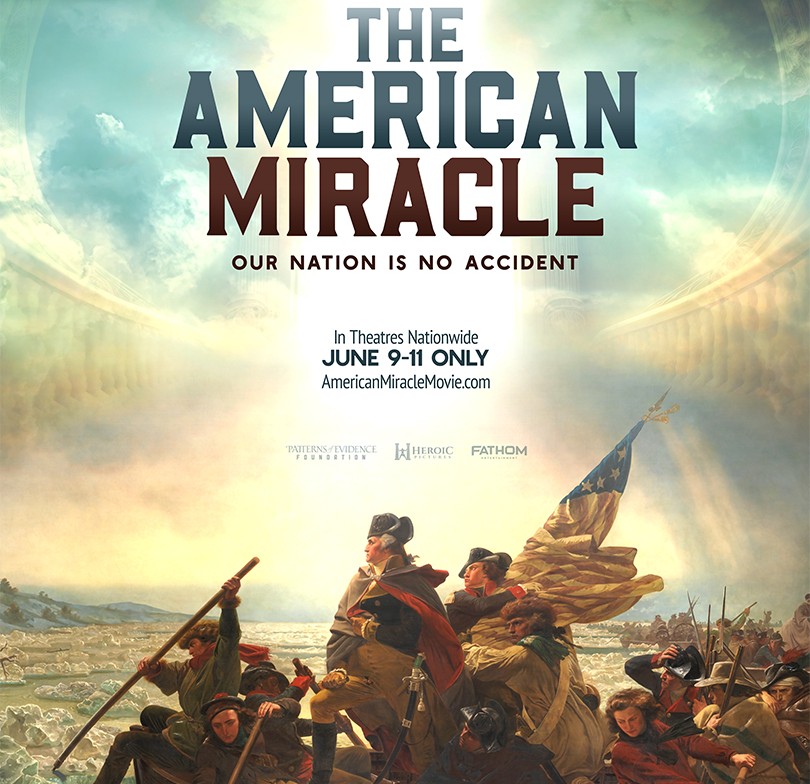
What if the establishment of the United States of America, against all odds, was no accident? What if God’s Divine Hand guided the steps of the Founding Fathers, due to their faithfulness to Him and belief in His Providence? What if America is a miracle?
The American Miracle – Our Nation is No Accident will take its audience on a journey through some of the most significant events in America’s birth and rise to prosperity and power. Inspired by New York Times bestselling author Michael Medved’s book of the same title, this exciting, entertaining, and edifying motion picture experience is being created in anticipation of the 250th anniversary of the Declaration of Independence.
I have worked with the film’s Director and Executive Producer on previous projects, and is pleased to recommend to you this opportunity. Besides the great actors, the film includes commentary by 14 top scholars of American history.
Go now and take your friends and neighbors to learn documented evidence of things you will never find in public school books and curriculum today.
Find tickets near you at this site: https://americanmiraclemovie.com/
Many of the events featured in this movie that occurred during the war for Independence are also in the book America’s Providential History by myself and Stephen McDowell. These miraculous events below were acknowledged by George Washington and the Continental Congress and God was given the glory:
The Evacuation of Long Island, 1776
Trenton and the Crossing of the Delaware, 1776
Victory over Burgoyne at Saratoga, 1777
Discovery of Benedict Arnold’s Treason, 1780
Retreat from Cowpens, 1781
Victory at Yorktown, 1781
[For paid subscribers today I have included details of the hand of God in the above events. The excerpt below is from the book America’s Providential History by Mark Beliles and Stephen McDowell. It is also available to buy at https://americapublications.com/index.html]
The content below was originally paywalled.
The excerpt below is from the book America’s Providential History by Mark Beliles and Stephen McDowell. Available to buy at https://americapublications.com/index.html
The Hand of God Protects the Continental Army
During the Revolutionary War, God performed many miracles on behalf of the American Army because God desired to see America win its struggle for freedom, become a nation, and fulfil its divine purposes. We will look at a number of these miracles.
The Evacuation of Long Island — August 1776
One incident revealing God’s supernatural care occurred shortly after the signing of the Declaration of Independence in August of 1776. During fighting on Long Island, British General Howe and his army of 32,000 men had inflicted heavy losses on the Continental army but had not succeeded in capturing or destroying it. Howe then prepared to attack the 8000 American troops on Brooklyn Heights.
The British army had surrounded Washington’s troops in a great semicircle, with their backs to the nearly mile-wide East River. Here an amazing thing occurred, for General Howe held this position for two days and did not attack. Had he struck, victory would have been certain for the superior British force.
Washington, greatly outnumbered, realized that to fight would mean defeat and the likely end of the war. Surrender was unthinkable. As difficult as it would be, he decided to retreat across the East River since all land routes were blocked by the British. The Continental army could have easily been surrounded by the British, but providentially, adverse weather conditions kept British ships from sailing up the East River. As a result, the Continentals were able to escape.
To make sure the British did not discover their retreat, Washington evacuated his army in great secrecy, even from his own troops. He sent orders for every rowboat, sailboat, and seagoing vessel in the area to be collected. At eight o’clock on the night of August 29, 1776, the evacuation of the troops began.
The day before about one thousand men had come over to reinforce Washington’s army. Part of these reinforcements included Glover’s regiment of Massachusetts fishermen. These men, some of the best mariners in the world, manned the boats that were evacuating not only the troops, but all their supplies, guns, carts, cattle, and horses.
A heavy rain was falling as the evacuation began and the adverse winds, which hindered the British ships, continued. In this weather the sailboats were of little use, and only the few rowboats were employed in the retreat. But at the rate at which the oarsmen could work, a successful evacuation seemed impossible. At eleven o’clock that evening, however, the northeast wind that had been raging for three days amazingly stopped, and the water became so calm that the boats could be loaded with extra weight. A gentle breeze also blew in from the south and southwest, which favored the Continental’s progress across the river to New York.
Yet as the adverse weather changed, a new problem was created. Under the light of a full moon, the British were sure to see the movement of the American troops. Miraculously, though, the Americans retreated all night without being heard or seen. God’s hand was surely upon the army and, as was stated in their newly ratified Declaration of Independence, their “firm reliance on the protection of Divine Providence” was proving invaluable.
During the pre-dawn hours of Friday, August 30, through mistaken orders, General Mifflin prematurely withdrew his men, who were the covering party for the retreat. They were to be the last to be evacuated. However, he ran into General Washington, who knew that they should not be removed, and he ordered them to return. Though they were gone 45 minutes from their post the British had not even noticed.
The retreat continued through the darkness of the pre-dawn, but as the sun began to rise, many troops were yet to be evacuated. Death seemed imminent, but again an astonishing thing occurred. Major Benjamin Tallmadge, who was still on the island, recorded what happened in his memoirs:
As the dawn of the next day approached, those of us who remained in the trenches became very anxious for our own safety, and when the dawn appeared there were several regiments still on duty. At this time a very dense fog began to rise (out of the ground and off the river) and it seemed to settle in a peculiar manner over both encampments.
I recall this peculiar providential occurrence perfectly well, and so very dense was the atmosphere that I could scarcely discern a man at six yards distance… We tarried until the sun had risen, but the fog remained as dense as ever.[i]
The fog remained until the last boats left Long Island.
Another miraculous event occurred during this retreat, and Washington Irving described it in his Life of Washington. Near the ferry where the troops were being evacuated, a family lived who favored the British cause. Upon seeing the army’s embarkation, the lady of the house sent a servant to alert the British of what was happening. The servant managed to slip past the American guards, but upon reaching the British lines, he halted at an outpost of German-speaking mercenaries and was unable to communicate with them.
The servant was put under guard as a suspicious person until the next morning, when a British officer questioned him. Upon hearing the news of the American evacuation, some Redcoats were sent to confirm the report. They cautiously approached the Continental camp only to find it completely empty!
British troops hurried to the river. As they arrived, the fog lifted enough for them to see four boats on the East River. The only boat near enough to be captured contained three vagabonds who had lingered in the camp to plunder it. Otherwise, 8000 men, with nearly all their supplies, had miraculously retreated to New York.
American General Nathanael Greene called the withdrawal from Long Island “the best effected retreat I ever read or heard of.”[ii] This extraordinary retreat was one of the most improbable and important events of the war, and many attributed the fortunate series of events to “a peculiar Providence.”[iii] Surely God was defending American liberty.
Trenton and the Crossing of the Delaware — December 1776
A few months after the retreat from Long Island, Washington found himself in as desperate a situation as on Long Island. He was not engaged in battle or surrounded by the enemy, but his army was dwindling as the men’s enlistment times were up. It was now December and at the first of the year most of the men’s duty was over and few had re-enlisted. Defeat after defeat had brought the army’s and the nation’s morale to its lowest point. Washington knew he had to make a bold stroke and go on the offensive.
In a desperate move, Washington decided to cross the Delaware River in pre-dawn hours in order to surprise the enemy. He chose the early morning of December 26 to attack the Hessian garrison quartered at Trenton, for he knew their accustomed drinking on Christmas would help assure their deep slumber on that early morning.
As the troops prepared to cross the Delaware River, a violent snow and hailstorm suddenly came up. This hardship, however, worked in their favor by inducing the enemy’s sentries to seek cover and reducing the visibility to near zero.
The Americans entered Trenton so unexpectedly and with such surprise to the Hessians that about 1000 prisoners were taken captive after only 45 minutes of battle. Only three Americans were wounded in the fighting. Two had died, but not in fighting; they froze to death on the march. Henry Knox described the event as follows: “The hurry, fright and confusion of the enemy was not unlike that which will be when the last trump will sound.”[iv]
This much needed victory helped raise the spirit of the army and the nation, strengthening them to continue their struggle for liberty. As Knox wrote of the victory at Trenton, “Providence seemed to have smiled upon every part of this enterprise.”[v] Here was another instance of God defending American liberty.
Defeat of Burgoyne at Saratoga — October 1777
On October 17, 1777, British General John Burgoyne was defeated by Colonial forces at Saratoga. This was a much needed victory and an answer to prayer. General Washington had experienced many defeats at the hands of the British, such as the Battle of Brandywine the month before where 1200 Americans lost their lives. In great need, Washington prayed fervently, and when God answered with this victory, he called it a “signal stroke of Providence.”[vi]
Others recognized the precarious position of the American cause. One Sunday in Sharon, Connecticut, Rev. Smith proclaimed that though a long night of disaster had been occurring, God would soon bring a signal victory for the American army. Before the service ended, a messenger arrived with news that British General Burgoyne had surrendered at Saratoga!
The providence of God was evident in this victory. Earlier, General Howe was supposed to have marched north to join Burgoyne’s 11,000 men at Saratoga. However, in his haste to leave London for a holiday, Lord North forgot to sign the dispatch to General Howe. The dispatch was pigeonholed and not found until years later in the archives of the British army. This inadvertence, plus the fact that contrary winds kept British reinforcements delayed at sea for three months, totally altered the outcome at Saratoga in favor of America.
This battle has been called one of the seven most significant battles in history, because once France learned of this triumph, they saw that their longtime enemy might be defeated, and thus Louis XVI decided to ally with the colonies in the war. French support in terms of troops, munitions, ships, and money was invaluable to the American cause.
In response to the victory, the Continental Congress proclaimed a Day of Thanksgiving and Praise to God. In part they stated:
Forasmuch as it is the indispensable duty of all men to adore the superintending providence of Almighty God,…and it having pleased Him in His abundant mercy…to crown our arms with most signal success…it is therefore recommended…to set apart Thursday, the 18th day of December, for solemn thanksgiving and praise.
They recommended for everyone to confess their sins and humbly ask God, “through the merits of Jesus Christ, mercifully to forgive and blot them out of remembrance” and thus He then would be able to pour out His blessings upon every aspect of the nation.[vii]
Providential Discovery of Benedict Arnold’s Treason — September 1780
Miss Hall and Miss Slater write of another miraculous event during the Revolutionary War:
An example of God’s Providential protection against such “imminent, though unseen dangers” was in the amazing capture of the British spy Major Andre which revealed the treachery of Benedict Arnold. Of this event, Washington himself wrote to John Laurens:
“In no instance since the commencement of the War has the interposition of Providence appeared more conspicuous than in the rescue of the Post and Garrison of West Point from Arnold’s villainous perfidy. … A combination of extraordinary circumstances.”
Washington’s letter of September 26, 1780 to Major General William Heath gives more details on what happened.
“Major General Arnold has gone to the enemy. He had an interview with Major Andre, Adjutant General of the British Army, and had put into his possession a state of our Army; of the Garrison at this post; of the number of Men considered as necessary for the defence of it, a Return of Ordinance and the disposition of the Artillery Corps in case of Alarm. By a most Providential interposition, Major Andre was taken in returning to New York with all these papers in General Arnold’s hand writing, who hearing the matter kept it secret, left his Quarters immediately under pretence of going over to West point on Monday forenoon, about an hour before my arrival, then pushed down the river in the barge, which was not discovered till I had returned from West point in the Afternoon.”
Major Andre was finally brought to General Washington on the 26th, and then the full story of his capture came to light. On September 23, three young militiamen had posted themselves on the Old Post Road close to Tarrytown, waiting to waylay “cowboys” who were stealing cattle and driving them into the British lines. Suddenly, about 9:30 in the morning, they saw a solitary rider coming toward them. They stopped him and learned that he was on his way to New York. It was Major Andre who believed that they were loyalists who had established a look-out for the British. He didn’t show them his pass and talked so freely that the young militiamen began to be suspicious. They made him strip off his clothes and discovered the incriminating papers stuffed in the feet of his stockings. Realizing the game was up, Andre then tried to bribe the boys, but they contemptuously dismissed his efforts and took him to the nearest outpost which was North Castle.[viii]
The following is General Washington’s message (delivered by General Greene) to his troops concerning Arnold’s treason and its discovery:
GENERAL ORDERS—Head Quarters, Orangetown, Tuesday, September 26, 1780
Treason of the blackest dye was yesterday discovered! General Arnold who commanded at Westpoint, lost to every sentiment of honor, of public and private obligation, was about to deliver up that important Post into the hands of the enemy. Such an event must have given the American cause a deadly wound if not a fatal stab. Happily the treason has been timely discovered to prevent the fatal misfortune. The Providential train of circumstances which led to it affords the most convincing proof that the liberties of America are the object of Divine Protection.[ix]
Following is the official response of Congress to this event:
Journals of Congress Wednesday, October 18, 1780
Congress took into consideration the resolution reported for setting apart a day of thanksgiving and prayer, and agreed to the following draught:
Whereas it hath pleased Almighty God, the Father of all mercies, amidst the vicissitudes and calamities of war, to bestow blessings on the people of these states, which call for their devout and thankful acknowledgments, more especially in the late remarkable interposition of his watchful providence, in rescuing the person of our Commander in Chief and the army from imminent dangers, at the moment when treason was ripened for execution; in prospering the labours of the husbandmen, and causing the earth to yield its increase in plentiful harvests; and above all, in continuing to us the enjoyment of the gospel of peace;
It is therefore recommended to the several states to set apart Thursday, the seventh day (of December next, to be observed as a day of public thanksgiving and prayer; that all the people may assemble on that day to celebrate the praises of our Divine Benefactor; to confess our unworthiness of the least of his favours, and to offer our fervent supplications to the God of all grace; that it may please him to pardon our heinous transgressions and incline our hearts for the future to keep all his laws; to comfort and relieve our brethren who are any wise afflicted or distressed; to smile upon our husbandry and trade; to direct our publick councils, and lead our forces, by land and sea, to victory; to take our illustrious ally under his special protection, and favor our joint councils and exertions for the establishment of speedy and permanent peace; to cherish all schools and seminaries of education, and to cause the knowledge of Christianity to spread over all the earth.
Done in Congress, the 18th day of October, 1780, and in the fifth year of the independence of the United States of America.[x]
Miraculous Retreat from Cowpens — February 1781
Foster and Swanson, in The American Covenant, relate another event revealing the providence of God:
Led by George Morgan, the Americans defeated Colonel Tarleton’s entire detachment at the Battle of the Cowpens, January 17, 1781. Lord Cornwallis, leading the large British army in the south, was infuriated by this defeat. Destroying his heavy baggage, he headed for the Catawba River to cut off the retreat of the small American army.
Cornwallis reached the Catawba River just two hours after General Morgan had crossed. Confident of victory, the British general decided to wait until morning to cross. But during the night a storm filled the river detaining his troops. Twice more in the next ten days Cornwallis nearly overtook the American Army. On February 3, he reached the Yadkin River in North Carolina, just as the Americans were landing on the eastern slopes. But, before he could cross, a sudden flood cut off the British troops again! On February 13, the Americans reached the Dan River that would lead them into friendly Virginia territory. They crossed and a few hours later, when Cornwallis arrived, rising waters once again stopped him from defeating the American Army. Even Clinton, the commander-in-chief of Lord Cornwallis, acknowledged that Divine Providence had intervened. He wrote: “here the royal army was again stopped by a sudden rise of the waters, which had only just fallen (almost miraculously) to let the enemy over, who could not else have eluded Lord Cornwallis’ grasp, so close was he upon their rear.”
The significance of the Battle of Cowpens and the safe retreat of the patriots that followed is that our small army in the south was saved by God’s providence so that it could harass General Cornwallis and drive him to the sea, which set the stage for the final defeat of the British at Yorktown in October 1781.[xi]
The Battle of Yorktown — October 1781
In October of 1781, British General Cornwallis had his troops stationed at Yorktown, Virginia. While Cornwallis waited for reinforcements, Washington marched his troops from New York to Yorktown. Unknown to Washington or Cornwallis, a French fleet under Admiral De Grasse arrived just in time to defeat the British fleet sent to relieve General Cornwallis at Yorktown.
Without reinforcements, Cornwallis was barely holding out against the siege of the American and French forces. As a last resort he decided to attempt a retreat across the York River. At 10 o’clock on the night of October 17th, sixteen large boats were loaded with troops and embarked for Gloucester. After the first few boats had landed a great turn of events occurred. In the official dispatch to his superior, Cornwallis wrote: “But at this critical moment, the weather, from being moderate and calm, changed to a violent storm of wind and rain, and drove all the boats, some of which had troops on board, down the river.”[xii] Due to this miraculous weather change, Cornwallis was unable to complete his intended retreat and found his force divided when Washington’s batteries opened at daybreak. When the boats finally returned he ordered them to bring back the troops that had passed during the night. Later that day he surrendered his forces to General Washington. This essentially marked the end of the war.
General Washington and our Congress recognized the Providence of God in the battle of Yorktown. The Journals of the Continental Congress record this entry:
Resolved, that Congress will, at two o’clock this day, go in procession to the Dutch Lutheran Church, and return thanks to Almighty God, for crowning the allied arms of the United States and France, with success, by the surrender of the Earl of Cornwallis.[xiii]
And in his congratulatory order to the allied army on the day after the surrender, General Washington concluded:
The General congratulates the army upon the glorious event of yesterday. … Divine service is to be performed tomorrow in the several brigades and divisions. The commander-in-chief recommends that the troops not on duty should universally attend with that seriousness of deportment and gratitude of heart which the recognition of such reiterated and astonishing interpositions of Providence demand of us.[xiv]