Worldview and Voting by Evangelicals in Elections over the last half century
Worldview and Voting by Evangelicals in Elections over the last half century
The Carter Christians
As former President Jimmy Carter is rightly honored with a state funeral for his service to the nation, it is helpful to remember his era of Christianity in American politics.
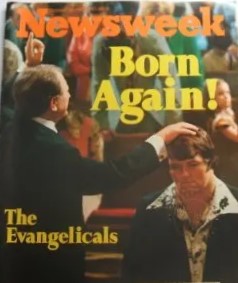
Carter was the first candidate for President who openly identified as a person who was “born again.” His Baptist faith was prominent his campaign and his presidency. Newsweek magazine featured the Evangelicals that year (see cover pic above). The Democrat Party intentionally sought the Evangelical vote and won in 1976. I was about twenty years old and, being born again in 1973, I was aware of all of this when I voted for president as an adult for the first time.
From about 1865 to about 1965 the two major parties mainly divided the Evangelical vote in national elections but Republicans and Democrats dominated in certain regions of the country. The same was true for Catholics but in an opposite pattern from Evangelicals. Most southern Evangelicals voted for Democrats and most northern and western Evangelicals voted for Republicans. Black southern Evangelicals differed from their white counterparts by voting for Republicans most of that century until shifting to a majority voting for Democrats toward the end of that one hundred years.
But after the 1960s it all began to change. Carter won a majority of both white and black Evangelicals in the South in 1976 but by the time he ran for re-election four years later Evangelical voters began to be more educated and motivated by issues that changed the dynamics. Evangelicals began to be more united nationally (transcending their regional biases) because of moral issues that emerged. Reagan cut into the white evangelical voter advantage in the south but still did not win the majority there in 1980. But it was enough to win the national election. More importantly, it was Reagan’s message on issues that united Evangelicals nationally that started a realignment that exists to this day.
Evangelical voters that once were divided for a hundred years, united to elect Jimmy Carter since he was a “born again” candidate. But they were soon disappointed in the policies of Carter as to matters of family values and morals. They slowly became more educated on issues and policies rather than simply if a candidate was “Christian” or had integrity and good private character. Issue-driven Evangelicals slowly began winning in the south and everywhere else.
Carter and the Democrat Party gradually adopted issue after issue (evident in the party platforms from 1980 to 2000) on sexuality, gender, abortion and other things that gave impetus to the shift. The only Evangelicals that stayed with Carter in 1980 and with Democrat candidates over the next decade were those that also trended more liberal or progressive in their theology.
Carter himself was great example of the shift. In the early 1970s while governor in Georgia he showed support for prison reform and equal rights for women, and concern about poverty and educational equity, the environment, and opposition to the Vietnam War. He stood for human rights internationally. These were issues that many Evangelicals agreed with or at least had no discomfort with. Carter won the presidential election in 1976 by being known as a born again believer and Sunday school teacher. But in reality he was always more liberal progressive than people realized.
In the 1970s new issues emerged such as abortion, homosexual agenda, the Equal Rights Amendment, school prayer and religious freedom, and of course the post-Vietnam global spread of atheistic Communism. Carter chose to support these things even if sometimes he might say he “personally” opposed some of them. Then in the subsequent decades it was gay marriage, transgender rights, Islamic Jihad and treatment of Israel as an oppressor that began to be adopted by Democrat Party leaders. Carter adopted them all as did “progressive evangelical” groups that have caused their own denominations to shrink at drastic rates. The same views have chased away believers from the older historic denominations just as they have abandoned the Democrat Party.
Carter was a sincere believer known for his help with Habitat for Humanity and other service-oriented ministry. His faith shaped a lot things for good but he left the more Biblical Southern Baptist Church and joined a progressive Baptist Church. And in his politics, it was his adoption of unbiblical worldviews that undermined his own presidency and the Democratic Party as a whole to this day.
Political pundits and the Democrats tried to label the Evangelical voting shift as caused by the Religious Right. But in reality it was caused by the leftist progressives who pushed for policies within the Democrat party that were contrary to what Evangelicals held to for decades. And really these were the traditional values of Christians that preceded even the existence of America for many centuries.
The Trump Christians
By the 1990s the realignment was solidified and united about 75% or 80% of Evangelical voters (Black Evangelicals being the exception) across the nation in voting for Republican candidates. This was basically about the same for every Republican candidate from Dole to Bush to McCain to Romney to Trump.
One difference in Trump’s election and is that finally a majority of Catholics began to vote Republican as well. This is something that basically has never happened on a national scale in American electoral history. Only Black Evangelicals have yet to have a majority shift away from the Democrat Party.
When analyzing the 2024 election we have far more detailed data on the Evangelical and Christian vote than we had back in the 1970s.
In 2024 self-identified Christians (Liturgical, Evangelical, Catholic, et al) constituted 72% of all voters. Of these, Trump won 56%, and only 43% voted for Harris. For most of the hundred years before the 1970s Christians split their votes almost evenly between the two parties. Now, there is a 15% difference. It is a huge block of voters (about 17 million votes). And they have not swayed very much regardless of who the Republican candidate has been for the past 30 years or so.
But the data shows even more as to how a Trump Christian voter is identified today.
If we break it down by not just identifying as a Christian but actually being a regular church attendee, the gap is much larger. Evangelical regular church attendees voted 2 to 1 for Trump. Pentecostals voted 3 to 1 for Trump, as did believers holding to a Biblical worldview. In other words, if you were active in a church community where you heard the Bible being taught and its values and worldview as it relates to culture and society, you and your community overwhelmingly supported Republican candidates.
The idea that devout serious Biblical Christians have had trouble voting for Trump is only marginally true. There may be a few that are vocal via social media, but the church community is strongly unified with a strong majority as to how it perceives the parties and candidates. About 66 to 75 percent in almost any Evangelical church today are Trump Evangelicals. The 1976 era Carter Evangelicals have largely disappeared and only the progressive or liberal Evangelicals vote for Democrats today. Of these 25-33% of voters, roughly half are African-Americans, so only about 15% or so of white Evangelicals vote for Democrats.
Of the active church attendees who voted for Trump, the major factor by far in forming their opinion was the party platforms or actual policy positions, not media or other influences. In other words, these Trump Evangelicals are pretty well informed and knowledgeable via trusted sources outside the legacy media or social media. Catholics who voted for Trump relied more on family and friends than other sources for their information. Evangelicals said that that about 30% of their churches endorsed a candidate and about 54% provided information on Biblical issues that were relevant to the election. Only about 16% thought that the personal morals or character of a candidate was a factor.
The conclusion is that the Evangelical voter has dramatically changed beginning about 50 years ago. They once were split but have become more united. And they once were swayed by regional and cultural and party priorities or by simple claims of a candidate being “born again,” but now they vote more consistently on policy and issues that align with their Biblical worldview on a national scale. There is a maturity and sophistication in their voting pattern that did not exist for a century at least. And if Catholic voters continue to align that way, along with shifts among ethnic groups such as Latinos (with their orientation toward faith and family), it will likely help Republican candidates.
But the Republican Party can also make the mistake that the Democrats made starting 50 years ago and abandon those values. Trump has remade the party and has elevated more people who support abortion and other policies that (if it continues) could cause united informed Evangelicals to look elsewhere. And it always possible that the Democrat Party may reform and reclaim the values that could attract the informed Evangelical voter. The Kingdom of God transcends parties and nations. They come and go, but God’s Kingdom remains. Only to the degree that a party or a nation seeks to conform to the worldview of the Bible is there blessing for society.
My organization publishes a book for international use on how Christians can do the practical things to win elections. It has several contributing writers but is not widely available. If you are interested you can contact me. The introduction of that book is written by me and is made available below in the special paid subscribers section. Become a subscriber if you want to read it.
The content below was originally paywalled.
A New Paradigm for Christians in Politics
Mark Beliles
As a pastor and historian who has traveled to over sixty countries, I have become aware of the lack of understanding in the modern Christian world of what it takes to actually build a political movement that wins elections and begins to govern and establish public policy with a Biblical worldview.
In the last century, if Christians got involved in politics, it often was without broad support of the Christian community who viewed it as not a godly activity. And if they did get involved it was usually a person with celebrity name recognition from their family or megachurch and they got elected but did not build a broad sustainable political movement that could shift the nation. Sadly, often another problem was that these isolated Christians in government were then considered ineffective and a waste of time, or else were attacked as extremists or became compromised by the world and associated with scandals.
Christians in politics is essential to disciple the nations. Government is an important sphere and if Christians transform others spheres but ignore government, the nation will never see major transformation. This is historically proven to be true as I have researched and written about in my book National Transformation and another series of books called Christ’s Strategy to Transform Nations.
These books also show that politics cannot be the ONLY focus for Christian involvement; we need good leaders in all the spheres of influence: journalism and arts, education, business, health care, family, religion and government.
But this book is about specifically politics, about winning elections. But that is only one part of a successful political movement that is needed to transform the government of a nation. So, this introductory chapter will focus on the big picture of building a political movement.
Pre-Political Preparation of People
One of the mistakes Christians have made is to assume that just because a person says they are a Christian, that is enough to be effective in government. But Scripture tells us that although we are new creatures in our souls when we accept Jesus as our Savior and Lord, our minds still are in need of renewal (Rom 12:1,2), and our character needs to become conformed to Biblical standards of morality and behavior. Even if some Christians who go into politics have proven good character (many do not), the reality is that MOST Christians have never had any training in a Biblical worldview of government. So the need today is to prepare people for this beforehand. This is especially the job of the church and its leadership.
Prayer/Prophetic groups
We all know the need for prayer in everything we do, and there are certainly many strong prayer groups within individual churches and networks, and in cities and nations. But there needs to especially be formed a sustained prayer movement that focuses on politics and government. Paul said in 1 Timothy 2 that prayer should first of all be done for those in government. Unless we prepare the way in prayer, no political movement can succeed.
A deliberate plan must be in place for prayer groups to be aware of Christians already in government positions or preparing for seek office in elections. Prayer groups that gather near or inside government buildings is recommended for helping to win in the spiritual warfare. Annual prayer breakfasts for political leaders and other such events are also good. Using technology for connecting by phone and internet for prayer is also important.
Pastoral/Apostolic Coalitions with special political Committees
Sometimes a mega-church can have impact on an election, but to really raise up a national political movement it requires the gathering of pastors, bishops and apostolic leaders from many denominations and church networks for that purpose. Of course, already there are gatherings for pastors in cities and nations, but that usually is focused almost exclusively on religion and church matters. What is needed is for a coalition of pastors and apostolic leaders to be formed for the purpose of overseeing a city and nation transformation movement in all the 7 spheres, with political transformation being a subset of that.
This coalition would create a pastoral/apostolic political committee focusing just on politics but would not be itself trying to be heads of a political party or be candidates themselves. It would not be in the public eye at all. Others (most likely not pastors) would be appointed by this committee to lead the Christian political movement and all its subgroups and committees that will be identified later in this chapter. Of course, for pastors in this committee to remain behind the scenes and not speaking to the media requires a humility on their part for the good of God’s kingdom. If a pastor feels called to actually seek political office, that is fine, but it is best if this committee does not.
The pastoral/apostolic political committee would have the responsibility of advising the political parties and organizations, and especially of approving the candidates that they deem of good character and worldview. It would also maintain relationship with the candidates after they win elections and are in government office, so as to give pastoral support and bring greater accountability. This is not just for elected government leaders but for the vast majority of Christians holding other government jobs in various agencies. If a pastoral/apostolic political committee does this work effectively, there is usually not going to be scandals and actions by Christians in government that disappoint the nation’s believers.
Community Action Councils
As mentioned above, a coalition of pastors and apostolic leaders should be formed for the purpose of overseeing a city and nation transformation movement in all the 7 spheres. In each community there should be an action council that includes pastors but not just for pastors, but for leaders in all the spheres of influence: Arts/Media, Business, Church, Health Care, Education, Family, and Government.
A national coalition and its special pastoral/apostolic political committee is great to have but unless it has corresponding local community action councils, it really will not have major impact. In some countries, local community councils like this already exist that God led believers there to come together.
If at all possible, a national coalition should not compete with these but try to include and connect those that already exist. The local councils should try to cooperate and support any efforts to coordinate nationally. Again, these local councils do not focus exclusively on politics, and often those that already exist tend to avoid politics and just do other good works. So the need is to make sure that political coordination and action is included and supported strongly. Without integration of Christian political movements and parties with the local action councils, little impact is possible.
Public Policy and Issue Research Groups
Some Christians are already active in special issue interests such as abortion, gender ideology, helping the poor and other things. This is good, but for a political movement to be successful, there needs to be more in-depth and comprehensive research done that provides strong data and information for candidates, elected officials, and agency staff to use arguing about public policy and proposing solutions and laws to address problems effectively.
Christian scholars must be drafted and appointed and some paid to do this research. These are not political activists, but Biblical worldview intellectuals who are gathered in new or existing thinktanks or educational institutions (often affiliated with universities). Their task is to apply Biblical worldview to current social problems, especially in economics and government. These scholars can be commissioned (and paid if necessary) by the larger transformation coalition to provide data and public policy position papers of use to the Christian political movement. Common language and communication strategies must be in place for the media and election strategies discussed later in this chapter.
Citizen and Candidate Education in Biblical Worldview
Scholars without a strong Biblical worldview are not helpful in research, and neither are Christian candidates and Christian voters. Sometimes we think if we get more Christians to vote, that will be good, but often they will vote for the bad candidates without their own minds being renewed.
Biblical worldview about not just politics, but all spheres of society, must be taught in more churches if there is going to be a successful Christian political movement. Some organizations may already exist that are doing that, and to coordinate and support them would be wise. But where there is need for more, then a plan should be developed by the apostolic coalition to create and promote various seminars, schools, online courses especially with the focus on government and politics. A comprehensive government course is an essential requirement for all candidates of Christian political parties. Someday an entire school of government and law should be formed that is accredited.
Direct Political Action for Winning Elections
Everything listed so far was not directly political in nature. Those were pastoral and educational matters that were essential foundations to prepare the Christian people of the nation for every kind of social transformation. With those in place it is time to turn to essential components of political activity necessary or success. Please note that running in an election is only one of them. Without doing what has already been listed, along with many of the things that are added below, the rest of this book and all its chapters will have no benefit.
Elections
How to run a campaign, coordinate volunteers and mobilize voters is the focus of the rest of this entire book. There are two major groups to coordinate with: political parties and single-issue special interest groups (i.e. anti-abortion, anti-gender ideology, etc). An pastoral/apostolic political committee must identify existing parties and activist groups to work with or create new ones.
It takes more time to create a new party and is preferable if there is an existing one that will welcome Christians and their issues, but this means cooperating with unbelievers and supporting some issues that are not that high importance to Christians. Even if a new party is created, it is best not to call it Christian and not to use Christian language in its literature and verbal communications to the general public so as not to limit the party to only Christians. You can use overt Christian language when speaking to churches and Christian groups. In a nation with only a minority Christian population, you cannot actually govern unless you attract non-Christian voters to your party. An over-emphasis on only Christians and purity of issues might make you feel better about yourself as a voice in the nation, but will doom your party to never actually governing and changing the nation for Christ.
You have to accept that the goal is actual changing of policy and that means compromising and working with others as long as it is not sinful activity. A minority party may be able to win in local elections where candidates are better known to the people, but in national elections where there is not enough Christian voters for your candidate to win, you should make alliances with non-Christian parties so that the lesser of evils has the greatest chance to win. If they do, then a few of you may be part of that government and get more experience and name recognition and gradually your party grows larger and becomes the leader of a coalition of parties that wins and actually governs the nation.
See the rest of this book on elections, but other vital strategic political components not discussed much in this book are below.
Financing
Without money you cannot have a successful political movement. Church budgets are not enough and probably inappropriate to use. Relying on wealthy candidates tends to only help themselves, not a movement. So, an pastoral/apostolic political committee must identify fundraising strategies and potential donors and business partners for helping all of the items in this introductory chapter. In the previous section the idea of joining in an existing political party is also a potential avenue for greater funding sources already in place. Either way, you should hire experts to help with fundraising. But all of the following items need funding in order to succeed, so it goes beyond simply financing election campaigns.
Public Relations and Media
As mentioned above, in order to attract non-Christian voters and actually win elections, the messaging strategy is critical. Experts are needed to train all candidates and elected officials in your movement to use language consistent and wise so as to avoid alienating voters and avoid giving material to your opponents to use against you. Christians tend to be attacked and stereotyped by the secular media and deliberately maligned by movements whose goals are threatened by our Christian morals. There is always going to be lies and accusations that you cannot avoid, but a wise strategy prepares pre-appointed spokesmen for responding in behalf of your movement.
It is of utmost importance to identify friendly news and media organizations and to create multiple new organizations that will work in coordination with a similar message. With modern technology and social media outlets, it is easy to create news organizations that are nothing more than one person at a computer. But the key is to give these media organizations secular names, not Christian ones, so that when they publish an article or post a video it looks to the public eye as a respectable and mainstream source of information. But all these would be coordinated to hold press conferences and issue press releases almost simultaneously in order to create trending news stories and become the leading idea in public discussion. This must be done when your party wishes to push a certain policy, but also when hearing of a bad policy or action that existing government leaders or opposing candidates are pushing.
Immediate opposition voices in media are critical to sway public opinion. A party should also have a public relations leader who knows protocol and can invite key leaders for public events in a way that is respectable.
Protests and Litigation
Going along with messaging above, another way of winning the battle for public opinion is by mobilizing peaceful protests against bad policies and actions of the government. Sometimes only protest gets media coverage, and Christians need to face this reality and use it. The world’s way of protest is often ugly, disrespectful and sometimes violent. Although a Christian should not do it that way, it is still vital for believers to say “no” to things that are evil and harmful. The secular movements that oppose our values are highly organized an effective in protesting. Christians need to realize its importance and prepare.
The pastoral/apostolic political committee should appoint people with good training by experts how to prepare people for peaceful protests. As in the discussion above on media organizations it is strategic to create multiple organizations with non-Christian secular names that relate to single-issues. Often, a core of people ready to protest can mobilized but the organization that calls for the protest can be different each time. The multiple protest organizations may have one leader of each that speaks to the press, but in reality, draws from a common pool of Christian activists. Sometimes protests will lead to arrests, depending on the government of the nation, even though the protestors have done nothing wrong. So, there must be a willingness for one’s reputation to suffer for higher good of Christ’s kingdom in this way.
There should be a calendar of protests planned for each year, perhaps every month or even every week if possible. Besides the ones that are planned to support the political movement, there should also be an emergency quick-action group of protestors when there is something bad that happens due to government abuse of power, new evidence of corruption or vote-stealing by a politician or party, etc. A few people should be paid to protest in order to be free to respond immediately and not be limited by their jobs.
Another way of protesting corruption is by mobilizing Christian lawyers to fight in the courts. Every bad policy or law that is passed should immediately be challenged by a lawsuit. This slows it from being implemented and sometimes causes it to be stopped or modified. Any Christian whose rights are violated should be defended by the lawyers. The pastoral/apostolic political committee should identify and support existing Christian legal networks or create new ones.
Lobbying and Government Job Placement
Another key and related area for a successful political movement is efforts to sway existing government officials on key issues and public policies that are up for a vote in congress or city councils. It is vital to get experts to train lobbyists to spend time setting up appointments to talk face to face with leaders.
The pastoral/apostolic political committee should appoint (and pay for some of) its lobbyists and then connect them with the research from its thinktanks and with its media organizations that will be trying to sway public opinion at the same time that the lobbyist is talking to the government official.
Along with these things, there should be leaders who mobilize letters and emails, etc from thousands of Christians at the same time to their elected officials that says the same thing that the lobbyist is saying. Meeting with existing politicians in power who are from different parties and hold different worldviews is never going to change many, but a few here and there that switch their vote on a piece of legislation can sometimes make a big difference. Pastors meeting with government officials should not just pray for them and take a photo op, but also see their role as a lobbyist as well, coming with information speak to the politicians about the same thing the other lobbyists are.
Another key but often overlooked strategy for a successful political movement is identifying people and recommending them for job openings in government agencies and political staffs. Christians often focus only on winning an elected position, but 99% of government jobs are unelected. These jobs are paid or sometimes volunteer jobs. But these more often than not determine how public policies are implemented in a nation, despite what a higher-up elected official might say. If Christians dominated these positions then a Biblical worldview can be more and more realized in their policies.
The key action is for the pastoral/apostolic political committee to identify key Christian leaders already in government agencies who can help recommend someone else when a job opens that needs to be filled. And if some Christian politicians and other influential leaders endorse them, they will probably be hired. An exhaustive database should be developed among churches in the community of people who might serve in government agencies if there were openings available, and a person put in charge to constantly be giving notice to people to apply and organize the recommendations for them.
The powerful thing that happens through this is more and more Christians get experience in public service and get name recognition and are then able to move up to higher positions that open, and perhaps can become candidates in elections later on with a resume that is impressive.
Conclusion
We have presented 5 pre-political components that are essential along with 5 directly political components necessary for a successful Christian political movement. A pastoral/apostolic political committee should have someone in charge of each area and help create a sub-committee for each area to coordinate with all the multiple organizations necessary.
But we must also be using practical things that are helpful for Christians to win elections and transform government in their nations for Christ.