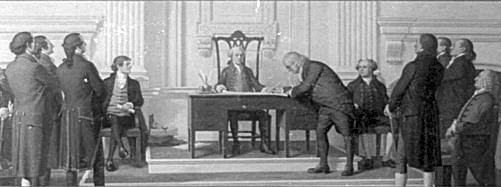
The fourth of July has come and gone and citizens have celebrated across America the nation’s 250th anniversary of independence. But did you know that the Declaration of Independence was not signed until August 2nd?
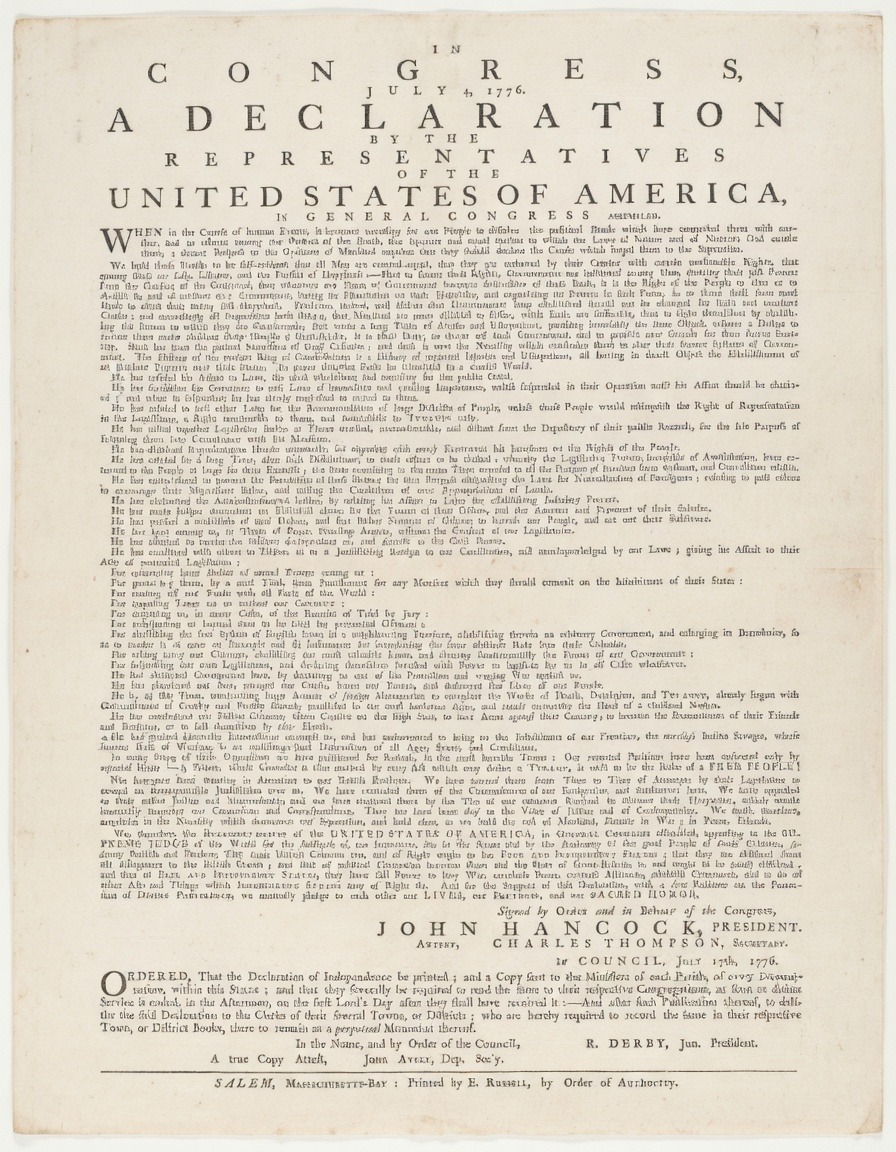
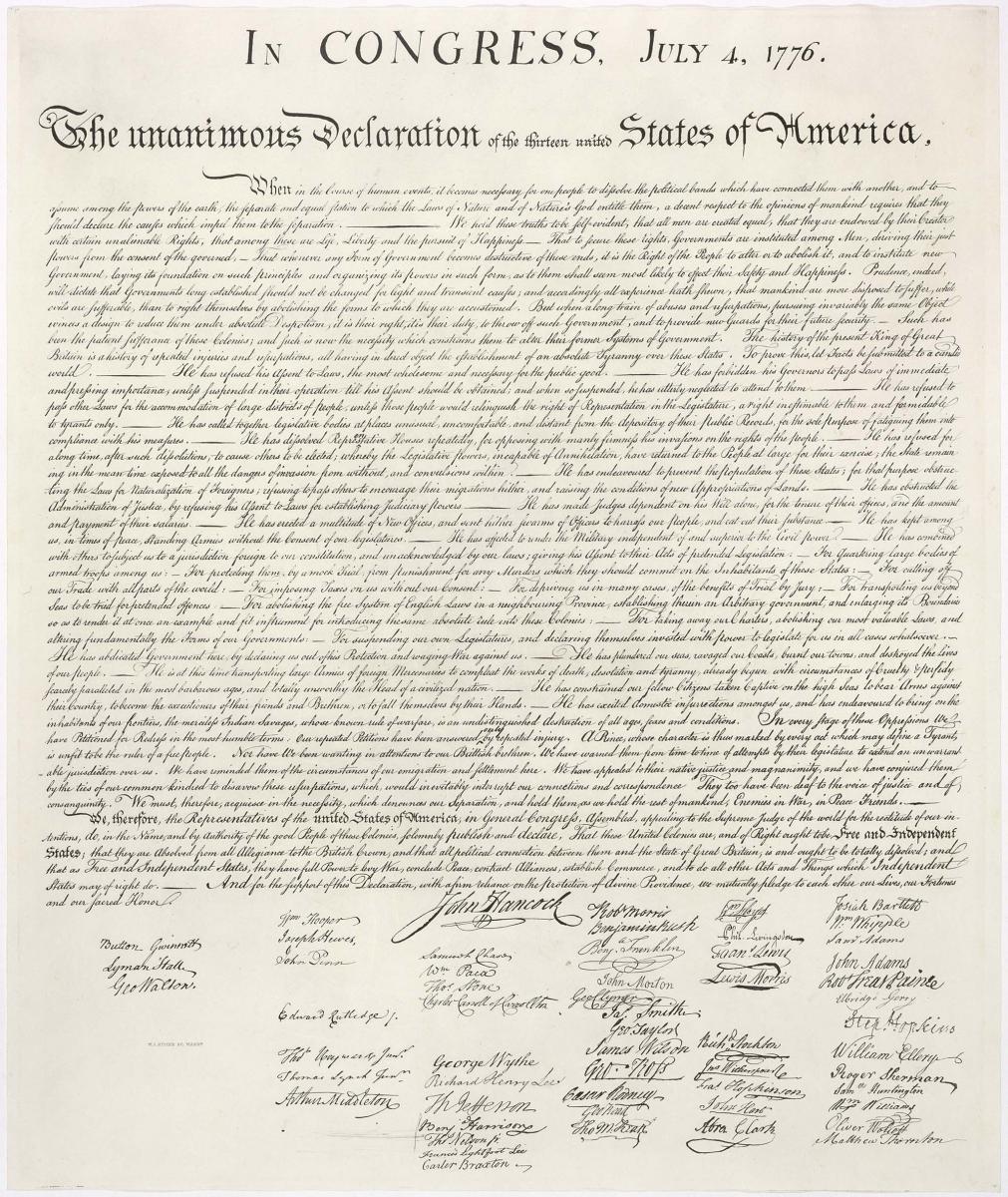
The initial broadsides were published on July 4, 1776 but no signatures were there. The names of John Hancock and Charles Thomson were printed as the president and secretary, respectively, of the Continental Congress that authorized the printing. But the copy with the 56 signatures was not completed until August 2, 1776. Some of the notable statements and speeches that are often remembered occurred at that date, not earlier in July. Although completed Aug 2, copies were not printed for distribution for another six months when the Signer’s identities became publicly known.
An early broadside is below and the later signed version follows (Stone engraving).
Notice that in the first document that went out there is an addendum at the bottom that said it should go to churches first to be read the congregations and then to the town authorities afterward. This reveals how important Christians were to the American Revolution. The Biblical worldview taught by colonial clergy created the “American mind” that Jefferson drew from in his draft. For the same reasons, Christians in America today are critical to these principles enduring to subsequent generations. Hence, our August 2 event described below.
Aug 2 online event:
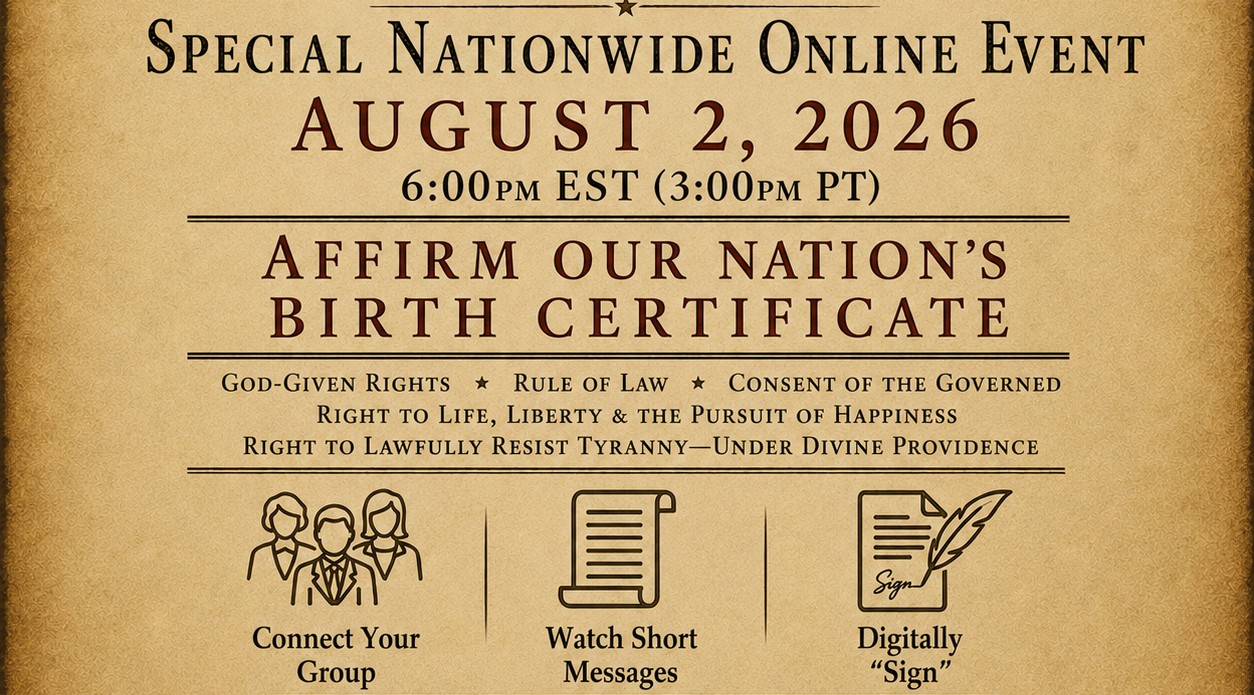
Two weeks from now on August 2, 2026 you are invited to join a live online event at 6pm. Fourteen top Christian historians and leaders will be part of this program to highlight the biblical principles in the Declaration and then call us to Americans today to pledge ourselves to educate and use our influence to support these ideas for God’s kingdom purposes in our nation going forward.
On August 2 our 90 minute event will open with prayer and welcome by Kirk Cameron and then the following Christian historians and leaders (many authors on the topic) will join me in speaking:
Paul Jehle, Plymouth Rock Foundation
Stephen McDowell, Providence Foundation
David Barton, Wallbuilders
Jim Garlow, WellVersed
Jerry Newcombe, Providence Forum
Travis Weber, Family Research Council
Bill Federer, American Minute
John Eidsmoe, Plymouth Rock Foundation
U.D. Roberts, Brentwood Press
Gary Amos, Author on the Declaration
Carole Adams, Foundation for American Christian Education
Gary Porter, Constitution Leadership Initiative
Some are pre-recorded but there will be some of these leaders connecting live from historic locations such as Plymouth, Massachusetts, Charlottesville, Virginia, and Washington, DC. There will also be a reading of the names of the 56 signers by persons today from each of the original 13 colonies.
And then at the end everyone across the country will have opportunity to sign a facsimile of the document they have printed out from our webpage, or else they will sign digitally online. This is a covenant renewal act before God similar to what our Founders did for us 250 years ago when they pledged their lives, fortunes and sacred honor for us.
TransformNation Substack is a reader-supported publication. To receive new posts and support my work, consider becoming a free or paid subscriber.
[The best explanation of what happened on July 4 versus August 2 is done by professor Herbert Friedenwald. An excerpt of his 1984 book is below for our paid subscribers.]
The content below was originally paywalled.
The following excerpt is from chapter six of THE DECLARATION OF INDEPENDENCE: AN INTERPRETATION AND AN ANALYSIS by HERBERT FRIEDENWALD, PH.D., 1984
[Friedenwald explains below why events on July 4 and August 2 are confused.]
For a full elucidation of this matter, it is necessary to reproduce the subsequent entries bearing upon the signing and official promulgation of the document. On the same day (July 4) the printed Journal informs us that a resolution was adopted to send copies of the document to the several assemblies, conventions, and committees or councils of safety, to the commanding officers of the continental troops; and to have it proclaimed in each of the United States and at the head of the army. On the 19th, four days after it was made known to the Congress that New York had given her tardy as sent to the wishes of the remainder, it was determined to have the Declaration “passed on the 4th, . . . fairly engrossed on parchment, with the title and style of ‘The Unanimous Declaration of the Thirteen United States of America’; and that the same, when engrossed, be signed by every member of Congress.”
On the second of August the Journal records that “The Declaration of Independence, being engrossed, and compared at the table, was signed by the members.” These last two entries appear in print only in the Secret Journal, first published in 1821, as if it was the intention thereby to protect for a time the members who subscribed their names to an act that would have rendered them liable to trial for treason, if the revolution had been suppressed by the British government. And, further, the first official reference to signing the Declaration, coming as it does two weeks after its adoption, would seem to indicate, also, that the idea of thus consummating the act was an afterthought.
On the 8th of January of the following year, when the approach of the British to Philadel phia had rendered it necessary to transfer temporarily the scene of activities to Baltimore, the Congress agreed for the first time to have an authentic copy of the Declaration printed with the names of the members who had subscribed it, and to send one to each of the states with the request “to have the same put upon record.” The records as reproduced above are the only references to the Declaration in the printed Journal subsequent to July 4.
Turning now to the original manuscripts, we find in the entry for July 4 a significant disagreement with the printed Journal. In the first place there are two manuscript Journals among the volumes of the Continental Congress papers, now deposited in the Library of Congress, covering the proceedings of that day. One is known as the Rough Journal, and the other as the Transcript. From the latter, as indicated by a note in the handwriting of Charles Thomson, the Journal was printed. But in neither is to be found a copy of the Declaration with the signatures of the members appended, nor any copy of the signatures. In the Rough Journal, we find a blank space over which has been placed a printed broadside of the Declaration, attached to the page by red wafers. Following this, on the next page, we read: “Ordered that the Declaration be authenticated and printed. That the committee appointed to prepare the Declaration superintend and correct the press.” This entry occurs in no other manuscript nor in any printed Journal, and its omission is to be explained only upon the supposition that in copying the proceedings of the day for the printer these sentences were overlooked by the usually careful Secretary, Thomson. For, had there been any desire to withhold them from publication, they would have appeared upon the pages of the Secret Journal, upon which they are not to be found.
In the other manuscript, the Transcript, the Declaration is copied out in full in its proper place in Thomson’s handwriting. From this it would appear that a copy of the manuscript of the Declaration was sent to Dunlap, the printer, immediately after the adoption of the resolution providing for its authentication and printing, and that performing his work with all possible alacrity, he had copies struck off not later than the day following that on which it was received, namely on the 5th. The authentication of this broadside, as required by vote of the Congress, was accomplished by affixing the signatures of Hancock, President, and Charles Thomson, Secretary, the words “by Order and in Behalf of the Congress,” being added.
With this evidence both from print and manuscript before us, we are now in position to enter upon an examination of the question of the date of the signing. And if we are to arrive at anything approaching accuracy, all statements not strictly contemporary with the actual event must be disregarded. Nothing but additional confusion has resulted from placing reliance upon the recollections of the participants, as embodied in letters written more than forty years after the occurrences to which they refer. The memories of the Fathers are not to be trusted for details, after the lapse of so long a period, any more than those of ordinary mortals.
In attempting to marshal the evidence of real weight then, we are at once struck by the fact that there are extremely few statements of value on which reliance can be placed. And the further point is revealed, that diligent search has not discovered any account of the signing which we know took place on August 2, except the formal record in the Journal.
We have seen that the authority of prime importance, the original manuscript Journal, contains no reference to any act of signing on July 4. The only entries respecting such an act are those bearing date of July 19 and August 2, as given above. Next in importance may be considered Jefferson’s entry in his autobiography (written certainly within a very short time after the events which he makes note of, and perhaps even as he states “whilst these things were going on” wherein he records that after the Declaration had been agreed to it was ” signed by every member present except Mr. Dickinson.” This is the only direct statement to be found that the signing took place on this day, and as will be shown, it is manifestly incorrect. Suffice it to state here that Robert Morris, in addition to Dickinson, could not have signed on that day, as he also absented himself in order that the vote of Pennsylvania might be cast for independence. As against Jefferson’s assertion we have three contemporary references of signal importance. Samuel Chase of Maryland signed on August 2.
On July 5, when still absent from Philadelphia for the purpose of keeping Maryland in line, he wrote from Annapolis to John Adams, asking, “How shall I transmit to posterity that I gave my assent?” To this John Adams sent the well known reply on July 9, “As soon as an American Seal is prepared, I conjecture the Declaration will be subscribed by all the members, which will give you the opportunity you wish for, of transmitting your name among the votaries of independence.” Again, Elbridge Gerry, who had left Philadelphia on account of ill-health, twelve days after the Declaration was adopted, wrote to John and Samuel Adams from Kingsbridge, New York, on July 21, as follows: “Pray subscribe for me ye Declaration of Independency if ye same is to be signed as proposed. I think we ought to have ye privilege, when necessarily absent, of voting and signing by proxy.” These statements are to be interpreted in only one way, namely, that there could have been no signing on July 4, even on paper, as Jefferson contended many years later when driven into a corner. No scrap or trace of such a document has ever been discovered, nor any reference to it except this one of Jefferson’s.
As all the other documents of importance to which signatures are attached are in existence, having been carefully preserved by Secretary Thomson, he would certainly not have allowed an original of such value to have been destroyed. Taken in connection with Chase’s query and John Adams’s reply, the words of Gerry ” to be signed as proposed,” and “signing by proxy” practically preclude the possibility of a signing on July 4.
Turning now to a consideration of individual delegates who were present and might have signed on July 4, we are confronted by the fact that had a signing then taken place, the list would have been strikingly different from that with which we are familiar. New Hampshire’s interests were then looked after by Josiah Bartlett and William Whipple. Those of Massachusetts by John Hancock, the two Adamses, Robert Treat Paine and Elbridge Gerry. Stephen Hopkins and William Ellery represented Rhode Island, while Roger Sherman and Samuel Huntington served Connecticut. The delegates from New York in Congress on that day were William Floyd, Francis Lewis, George Clinton, Henry Wisner, John Alsop, Robert R. Livingston, Philip Livingston, and possibly, Lewis Morris. Those from New Jersey were Richard Stockton, John Witherspoon, Francis Hopkinson, Abraham Clark, and probably John Hart. Disturbed Pennsylvania had to put her reliance on James Wilson, Benjamin Franklin, John Morton, Thomas Willing and Charles Humphreys; and little Delaware upon Caesar Rodney, George Read, and Thomas McKean. Maryland had in Congress William Paca, Thomas Stone, and John Rogers; Virginia, Thomas Jefferson, Benjamin Harrison, Carter Braxton, and probably also Thomas Nelson, Jr., and Francis Lightfoot Lee; North Carolina, Joseph Hewes and John Penn; South Carolina, Edward Rutledge, Thomas Heyward, Jr., Thomas Lynch, Jr., and Arthur Middleton; and finally, Georgia’s delegation was made up of Button Gwinnett, Lyman Hall, and George Walton.
It has been possible to determine definitely that of these forty-nine men all but forty-five were in Philadelphia on July 4. As to the remaining four, though no evidence has been discovered to show that they were absent, no positive statement has been found indicating their presence. These were the men in Congress on July 4, who voted for the Declaration, and whose names would have been affixed to the paper if it had been signed on that day. Comparing them with the list of those who signed on or after August 2, marked discrepancies appear.
In the first place, as has already been stated, New York’s entire delegation, for lack of instructions, even abstained from voting upon the question of independence, and assuredly would not have signed a document for which they had not voted; and George Clinton, John Alsop, R. R. Livingston, and Henry Wisner, who were in Philadelphia on July 4, but not on August 2, never affixed their signatures, though Livingston might have done so, as he attended the Congress later on for several terms. Secondly, on July 20, Pennsylvania’s entire membership was rearranged, and only four of those who had represented her previous to that time, Franklin, Morris, Morton, and Wilson, were re-elected. Similar changes occurred in many of the other delegations.
Passing over for the moment the names of those who were not in the Congress on August 2, when the general signing took place, we are enabled to determine that some of those whose signatures are affixed to the Declaration, could not have signed on July 4, by showing that either they were then not members of the Congress, or, if members, were absent from their posts. Thus William Williams, whose name appears among Connecticut’s signers, did not reach Philadelphia until towards the end of July, having been directed to repair to that city on the eleventh, by the Council of Safety of his state. Of Pennsylvania’s signers, Rush, Clymer, Smith, Taylor, and Ross were not members until July 20. Chase and Charles Carroll, of Carrollton, were in attendance upon the Maryland Convention at Annapolis, and were being re-elected delegates on the very day when some suppose them to have been in Philadelphia, signing the Declaration. Similarly George Wythe, on that day, was chairman of the committee of the whole of the Virginia Convention, and with him was Richard Henry Lee, who because of sickness in his family had left Philadelphia on June 13. Again, on July 8 Hewes of North Carolina asks solicitously about the welfare of Hooper, whom he had expected in Philadelphia long before.
Attempting now to determine the names of some of those who were present on the day officially appointed for signing the engrossed document (August 2), we reach the conclusion that a far greater number than has generally been supposed were not in Philadelphia on that day either. Attention has been repeatedly drawn to the absence of Matthew Thornton and Thomas McKean. Thornton was not elected a member until September 2, and did not take his seat in Congress until the fourth of the following November.’ He is differentiated from all the other signers, in that he is the only one who took no part in the discussion and vote on independence, and did not arrive in Philadelphia until more than three months after the general signing had taken place. His signing is to be explained only by an unusually liberal interpretation of the resolution of July 19, which provided that after engrossment the document should be signed by every member of the Congress.
But this resolution could not have intended that all members subsequently elected should sign, or else a series of extra sheets would have had to be provided for the purpose. Colonel McKean was for a long period absent from the Congress with his regiment, and he is himself authority for the statement that he signed some time in 1781. And the first published list of signers, in 1777, omits his name.
But little notice has, however, been taken of no less significant absences than these. Oliver Wolcott, broken in health, did not remain in Philadelphia for the final decision on independence. He knew how his colleagues would cast the vote of their colony, and that his continued attendance was not therefore requisite, so he left about the end of June, and could not have been back in Philadelphia again before the end of September. In the meantime William Williams, his substitute, had signed, and there was in reality no occasion for Wolcott to append his signature. But having taken part in the early agitation and debates he was allowed to sign under the general rule.
Elbridge Gerry, too, so important a factor in the early days of the discussion about asserting independence, who had left Philadelphia for rest and recuperation on July 16, did not return until September 3, a month after he is supposed to have signed. On August 24, he was at Hartford, Connecticut, and in a letter to General Gates writes that he is on his way to Philadelphia, “from which I have been absent for about a month for health.” The two famous Virginians, George WTythe and Richard Henry Lee, we have seen, were in Virginia on July 4. They remained there for a considerable period after that date, and were also absent from Philadelphia on August 2. On July 20, Jefferson mentions in a letter that he intends to set out on his return home not later than August 11, to visit his wife who is extremely ill, and adds that he hopes to see Lee and Wythe in Philadelphia before he departs. On the fifth of August he deplores the fact that Lee is unable to attend until the twentieth, as it prevents his visiting Mrs. Jefferson.
Examining the Journal, we find that Lee’s name first reappears there on August 27, and Wythe’s not until nearly a month later. Lee after the earlier date and Wythe after September 23 are repeatedly selected to serve on important committees. Had they been present before, it is entirely probable that they would have been chosen for similar service, as their counsel was much sought in those days, when attendance on the Congress was slim. Lee, therefore, must have signed some time after the end of August, and Wythe probably a month later, though their signatures lead Virginia’s column on the document. It is altogether likely, too, that Pennsylvania’s large delegation did not all affix their signatures on the same day, as it was unusual for so many delegates from one state to be in attendance at one time. As they came and went at intervals, they probably signed whenever, after the second of August, they, happened to be in attendance on the Congress.
The engrossed document is itself largely responsible for the erroneous views which have been held respecting the date of the signing. Being headed by the legend, “In Congress, July 4, 1776,” and ending with the fifty-six signatures, the natural inference to be made, until better information was obtainable, was that this official document was signed on that day. It is further misinforming, not only as regards the date of signing, but in its title, “The unanimous Declaration of the thirteen united States,” under the date July 4. For on that day, as has been shown, New York’s delegates had no authority to vote, so that unanimity was procured by their silence, but twelve colonies, therefore, taking part in the final ballot. And again, seven of the names that are affixed are those of men who were not members of the Congress on July 4 — Thornton, Williams, Rush, Clymer, Smith, Taylor and Ross; while exactly the same number were in the Congress on that date but never signed at any time — Clinton, Alsop, R. R. Livingston, Wisner, Willing, Humphreys and Rogers.
With all these data before us the inference is allow able that to but few men did the actual act of signing assume the large importance that it has since attained. The unanimous adoption of the Declaration was the important event, the signing a mere final touch, an after-thought. But two men, Chase and Gerry have recorded any anxiety respecting permission to sign. The others signed in accordance with the resolution passed on July 19, as a matter of course, and all except McKean, had signed when the copies of the Declaration, with the signatures of the members, were printed and distributed in accordance with the resolution of January 18, 1777.
Finally, a word may be added respecting the location of the signatures on the engrossed document. They are arranged in six columns in geographical order. Beginning at the left hand, the generous space of an entire column is given to Georgia — a treatment quite out of keeping with the extent of her efforts to support and advance independence at this time. In the next are those of North and South Carolina, followed by those of Maryland and Virginia, Pennsylvania and Delaware, New York and New Jersey. The representatives of these states having all signed, but one column more was left for all of New England, and the thirteen signatures from that region are crowded into the remaining space. When Thornton signed, there was no place for him to write his name with the New Hampshire delegation, so he was compelled to put it at the very end of the document, below the representatives of Connecticut. Nor was there room to allow for the grouping, with a space between each state, as is the case in all the other columns, except where great Pennsylvania’s overwhelming numbers invade little Delaware’s small allotment of territory.
If, as has been shown, there could have been no signing on July 4, this does not militate against the fact that the men who signed, and their successors in the Congress, had a full appreciation of the importance of the day. Beginning with 1777, each succeeding anniversary, during the whole period of the existence of the Continental Congress, was observed in appropriate manner with a banquet, toasts, fireworks and bonfires, and, much as we do in our time, committees were always appointed to see to it that no fitting detail was omitted that might render the occasion one of proper festivity and rejoicing.