Excerpts from “Defending the Declaration: How the Bible and Christianity Influenced the Writing of the Declaration of Independence”
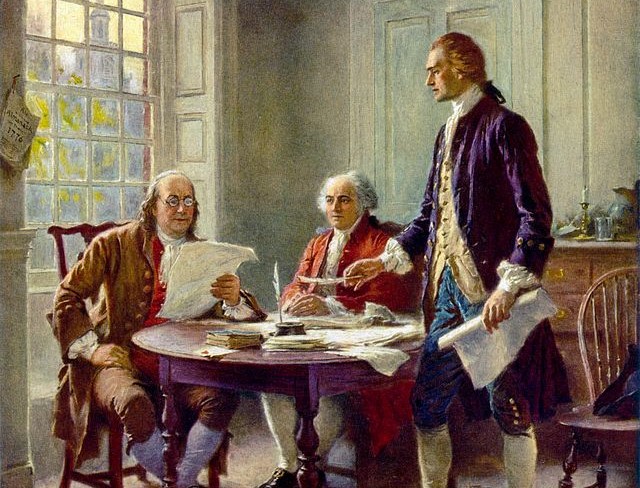
On this day that we celebrate American independence we recall these words of the Declaration of Independence written by Thomas Jefferson: “…all men are created equal, that they are endowed by their Creator with certain unalienable Rights, that among these are Life, Liberty and the pursuit of Happiness…”
Many years later Jefferson explained that “….our right to life, liberty, …the pursuit of happiness;….we do not claim these under the charter of [earthly] kings or legislators; but under the King of Kings.” (Jefferson letter to John Manners, June 12, 1817)
Even most Christians today fail to understand how our founding documents were shaped by the Bible and Christianity. Therefore, we offer below excerpts from a book we publish by Dr. Gary Amos. For footnotes & sources get the book!
[Buy the book here https://checkout.square.site/merchant/C3JZ5XN30Q8TE/checkout/B3LUX46D5DYLZCSWKXUMHFXO]
Christianity and the Development of Rights Theory
Christianity did not conquer Hellenism and statism overnight. The hold of prevailing pagan core beliefs and social practices in the larger culture was too strong. Apart from one’s being converted to an entirely new way of thinking, people in general uncritically assumed that “what is, is right.” Christianity was born during the age of empire and flourished only despite it. For centuries the church was under the control of political rulers and emperors. Even “converted” emperors could not bring themselves to renounce the imperio-papal principle, and its rationale of power. There was survival at stake and an empire to run, despite the clear teaching of Christ and the Apostles. But there was always a remnant advocating for the new principles, such as when Pope Gelasius advocated the separation of church and state as early as the fifth century.
Not until the Gregorian Reform and the Investiture Struggle (1075-1122) did the Biblical model begin to gain ascendancy in Western political theory and become the central focus of debate about rights. This was the time in which “the Bishop of Rome sought to emancipate the clergy from the control of emperor, kings, and feudal lords, and sharply to differentiate the church as a political and legal entity from secular politics.” The modern Christian theory of rights was born in this period, due to the work of Christian jurists and legal scholars, even though the principles had been present in the linguistics of Scripture and in the examples of Christ and the Apostles for more than a thousand years.
After the Gregorian Reform, we enter an entirely different atmosphere. Whereas the classicists could never easily equate property and right, or dominium and ius, the “medieval lawyer always regarded property (dominium) as a right (ius).” Irnerius, who founded the law school at Bologna at the end of the eleventh century, specifically equated dominium with ius, following the Biblical model. Later, Irnerius’s successor Azo insisted that property is not only a right (dominium is a ius), but a ius or right is also a meritum (claim). So, Tuck says, by the time of Azo, the concept of claim rights was clearly extant in medieval thinking. Tierney is convinced that claim rights came much earlier than Azo. But Tierney agrees with Tuck’s more important point that for the Catholic canonists of that period, all rights became claim rights. According to Tuck, “they required other men to act in some way toward” the one asserting the claim.
The “Unalienable Right” to Life
Most important for our purposes is the fact that the Catholic law scholars were the first to articulate the ground for what we now call inalienable rights. The word unalienable is a term from property law, and seems to be an odd word to use when speaking of rights. However, the Catholic law scholars of the early thirteenth century used the word dominium or property to signify “any right which could be defended against all other men, and which could be transferred or alienated by its possessor.” Rights to things were clearly property rights and could be transferred or alienated unconditionally. But rights to one’s own person were different. The development of thinking about rights of the person led to the concept of inalienable rights. Tuck says, “To a large extent, this must be bound up with the increasing elaboration and sophistication of the canon law. It was the canon lawyers who developed “Unalienable Rights” and applied such important maxims as the principle that personal iura [rights of the person] cannot be transferred to others nor be the subject of contracts.”
Tuck notes that the church is designed for charitable purposes, and says it is “not surprising that a theory about rights as claims should have evolved from within an institution which was so concerned with the claims made on other men by the needy or deserving.” So it was the church, in an era of reform, and under the influence of Scripture, that began translating its high regard for the person into the belief that every man’s life and person was sacred.
Men have rights, such as the right to life. But because a man has a duty to live his life for God, the right is inalienable. He can defend his life against all others, but not destroy it himself. No man has the right to do harm to himself, to commit suicide, or to waste his life. He has a property interest – dominion – in his own life, but not total control. It is hard to overstate the importance of this development in rights theory where rights of the person are concerned. Sadly, this progress in rights theory was immediately threatened, and disastrously so, by a powerful faction within the Catholic Church led by Pope Innocent III and culminating in Fourth Lateran (1215), which rejected the Biblical rights model and laid the foundation for the Inquisition.
The “Unalienable Right” of Property
Although the church in the Gregorian Reform era was generally united in its belief about the inalienable right to life (at least prior to Fourth Lateran in 1215), various groups within the church vigorously disagreed over the inalienable right of property. Gratian in the Decretum (circa. A.D. 1140) had said that men only hold all things in common possession. The Franciscans took this to mean that property ownership was a result of man’s fall into sin. Property was not part of God’s original plan with Adam, not part of the law of nature. Instead, property was the product of civil society and human law and convention.
The Dominicans, following Thomas Aquinas (d. 1274), disagreed. Aquinas pointed out that before man fell into sin, God had given man dominion and all that it implied. To own property was not a mark of sin but was a gift of God. For Aquinas, property was part of the law of nature before man’s fall into sin, and was not merely the product of civil society and human convention. To own property did not end one’s innocence before God.
The Dominican pro-property position undercut the Franciscan teaching about apostolic poverty. Conversely, if the Franciscans were right that some men could live in an innocent way, then all men could. A long and intense struggle ensued between the Franciscans and the Dominicans. Duns Scotus applied his energies to defending the Franciscan position, saying that the law of nature positively ruled out property (dominium). Pope John XXII responded by issuing the bull Quia Vir Reprobus (1329) defending the Dominican position. Richard Tuck summarizes the pope’s position by saying, “God’s dominium over the earth was conceptually the same as man’s dominium over his possessions, and that Adam ‘in the state of innocence, before Eve was created, had by himself dominium over temporal things.’” “(P)roperty was thus natural to man, sustained by divine law, and could not be avoided. (A)ll relationships between men and their material world were examples of dominium: for some lonely individual to consume the products of his countryside was for him to exercise property rights in them. Property had begun an expansion towards all the corners of man’s moral world.”
William of Ockham tried and failed to refute the pope’s position. Thus, the Franciscan side was silenced for the most part while the Dominicans enjoyed the church’s official endorsement. For centuries after this debate, the matter was considered settled. Dominium or property “was not a phenomenon of social intercourse, still less of civil law: it was a basic fact about human beings, on which their social and political relationships had to be posited.” Dominium or property dealt with the very character of men and God’s plan for men in the world. The Dominican view was received by the Calvinists in the Protestant reformation and bypart of the law of nature. Instead, property was the product of civil society and human law and convention the English common law so that in America and England the right to property was called inalienable. To deny men the right of property is to deny an aspect of their personhood.
[In the paid subscriber section below is explanation of two more unalienable rights: Right to Liberty and to the Pursuit of Happiness. Subscribe now or buy the full book here. https://checkout.square.site/merchant/C3JZ5XN30Q8TE/checkout/B3LUX46D5DYLZCSWKXUMHFXO]]
The content below was originally paywalled.
The “Unalienable Right” of Liberty
The church for a time was uncertain whether liberty was an inalienable right. Although Scripture clearly taught principles of spiritual liberty, no ancient society promoted personal liberty in the Western sense as an inalienable right. The Romans, for example, had made liberty the contrary of a right, meaning that libertas could not be equated with ius. The early medievalists failed to link them as well.
Libertas came to be viewed as a ius (liberty became a right) between the time of Richard Fitzralph (1350s) and Jean Gerson (1402). Fitzralph insisted that man’s natural dominium at creation in Genesis 1 was an auctoritas or authority. Gerson insisted that at Creation, men’s ius (right) was not only an auctoritas (authority) but a facultas (ability). Gerson was then able to “treat liberty as a kind of dominium” (liberty as a property). By this time it had been settled already in Christian thinking that dominium (property) was a ius (right). Gerson helped make it clear that liberty is a right as well and thus, a property right of man.
Since a man’s liberty relates directly to his personhood, the question immediately arose whether liberty was an alienable right. As noted earlier, the Dominicans insisted that men had some rights or dominia that were transferable and some that were not. Some rights were alienable, some were not. Personal rights were inalienable because these were rights over which man did not have total control or sovereignty. Liberty was thus a right and a property of man, but inalienable, for, as the Dominicans insisted, “men were not . . . in general free to enslave themselves, and they could not rightfully be traded as slaves if the grounds for their servitude were unclear.” Once liberty came to be viewed as a right, it quickly passed into the category of inalienable rights for those following Dominican theology. Renaissance humanists, on the other hand, building on Greek and Roman ideas, rejected the notion that liberty is an inalienable right.
In a sense, Gerson and Fitzralph simply emphasized two different parts of the Genesis 1 model. God created man in His own image, endowing man with certain faculties. And He gave man the creation mandate or dominion decree investing man with authority. Both faculties and authority are part of the Biblical model in Genesis 1. Through the Bible’s influence on the thinking of men like Gerson, liberty came to be viewed as a property right, part of man’s person, and thus inalienable.
The “Pursuit of Happiness”
The Declaration of Independence lists the “pursuit of happiness” as one of the “unalienable rights” given to man by his Creator. This, too, is erroneously called an Enlightenment idea. Supposedly it replaced the Christianity of colonial America with a secular religion. It appears to many to be a hedonistic rather than Christian assertion. But it, too, has its roots in the Christian common law, the teaching of the Church, and the Bible.
Jefferson took the phrase “pursuit of happiness” from the Virginia Constitution of 1776, which said: “(A)ll men . . . have certain inherent rights, of which, (are) the enjoyment of life and liberty, with the means of acquiring and possessing property, and pursuing and obtaining happiness and safety.”
The term happiness was a technical term in the English common law. The Framers used it in the same sense as Sir William Blackstone in his Commentaries on the Laws of England (1765). There Blackstone explained that God made man and placed man on earth to live according to God’s laws and plan. God has “so inseparably interwoven the laws of eternal justice with the happiness of each individual, that the latter cannot be attained but by observing the former; and if the former be punctually obeyed, it cannot but induce the latter.”
Happiness, according to Blackstone, referred to man’s “felicity,” or his sense of well-being and blessedness in his earthly existence that comes from obeying the laws of his Creator. Right living, then, leads to man’s “substantial ‘happiness,’” which relates not to man’s redemption or heavenly rewards, but to whether man pleases God and is blessed in this life. If before God a man’s actions are right, they “tend to man’s real happiness,” but if they are displeasing to God, they are obviously “destructive of man’s real happiness.”
This common law concept of happiness was not part of some rationalistic faith in progress itself. Rather, it was part of the formal study of ethics in Christian philosophy which for centuries had been based on the teachings of the Bible. The English word happy was the equivalent of the Latin word beatus used in medieval theology describing the future state of the redeemed in heaven and the earthly life of the faithful. Its importance in the teaching and liturgy of the English Christian tradition is hard to overestimate. It traced its heritage to the beatitudes of Matthew 5 in Christ’s Sermon on the Mount and the multitude of Old Testament verses translated by the KJV word blessed. Rather than being an Enlightenment term, happiness is the translation of the Hebrew Bible word esher in the Old Testament, the Greek Bible word makarios in both the Septuagint and the New Testament, and the Vulgate beatus.
The history of the word is not hard to uncover. In the Greek Old Testament and in pre-Christian Judaism, the concept of being “blessed” or “happy” played a prominent role. Georg Bertram notes that in both the Old and New Testaments, “Blessedness is fulness of life; it relates first to earthly blessings.” In the New Testament, due to the special emphasis on the proclamation of the kingdom of God, most instances of “happy” refer to “the distinctive religious joy which accrues to man from his share in the salvation of the kingdom of God.” Nevertheless, the New Testament continues the earlier theme that earthly joy and happiness are gifts from God to man (1 Timothy 4:4; 6:17).
Like other Christian concepts that became part of formal philosophy and the common law, the Biblical notion of happiness runs deep within the channels of the common law. Its use is so obvious and extensive in the growth of English legal thought, one wonders whether those today who call it an Enlightenment term have read anything at all from the source materials of the common law, materials that were well-known and widely read by the American founders.