with special focus on writings of Blackstone
During this 250th Anniversary year of American Independence, we are learning about events that happened at this time back in 1776. But the winter months were not significant in terms of the war effort, but were very important in terms of the shift in public opinion among citizens and their colonial legislatures. Therefore we now focus on the Biblical ideas of governance back in Europe that were read by American’s Founders and contributed to this shift.
In the last two blogs, we highlighted Jean-Jacques Burlamaqui (1694–1748), a Genevan jurist, and then Baron de Montesquieu (1689 –1755), a French judge. Their key works were translated in 1752 into English and became known to American leaders.
Today we will focus on another major ideological writer, Sir William Blackstone 1723-1780), an English jurist.
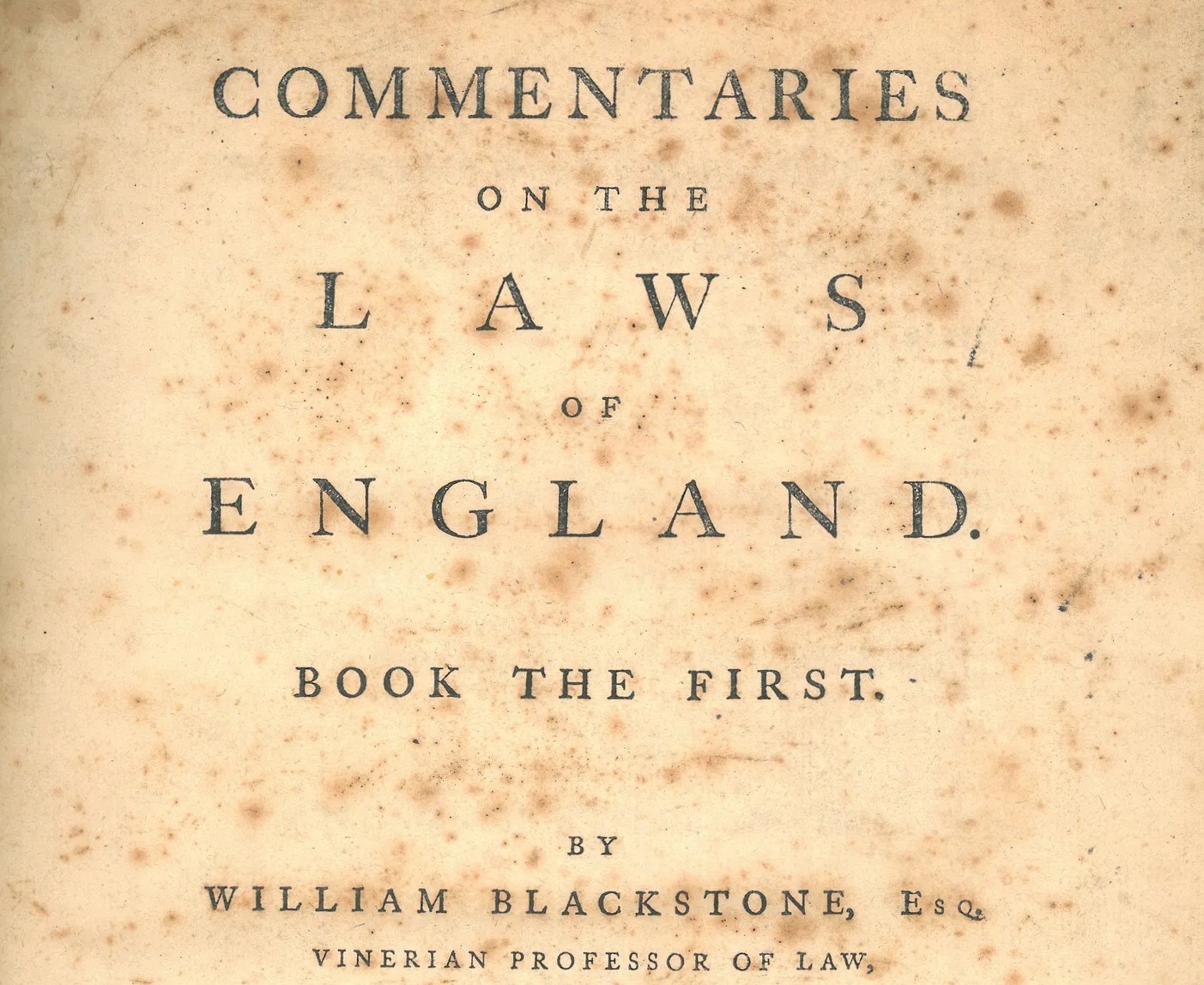
Blackstone’s Commentaries on the Laws of England
William Blackstone was the single most influential legal authority in colonial America. His Commentaries were the standard legal textbook for American lawyers, judges, and statesmen in the decades leading to the Revolution.
A. How the Bible Shaped Blackstone’s Legal Thought
Blackstone was not merely influenced by Christianity culturally—his legal philosophy is explicitly grounded in biblical theology.
1. Law Rooted in the Law of God
Blackstone famously begins Book I by declaring:
“The law of nature… being coeval with mankind and dictated by God himself… is of course superior in obligation to any other.”
He teaches:
God is the supreme lawgiver.
Natural law reflects God’s will.
Human laws are valid only if consistent with divine law.
This directly echoes:
Romans 2:14–15 (law written on the heart)
Psalm 19 (God’s law perfect and binding)
Classical Protestant natural law theology
For Blackstone, English common law ultimately rests on divine moral order.
2. The Image of God and Human Equality
Blackstone affirms:
All men are naturally equal.
No person has inherent authority over another by nature.
This reflects:
Genesis 1:26–27 (image of God)
The Christian doctrine of moral equality before God
Civil authority arises not from inherent superiority but from lawful constitution.
3. Rights as God-Given
Blackstone identifies three primary “absolute rights”:
Personal security (life and bodily integrity)
Personal liberty
Private property
He describes these as rooted in natural law and the divine will.
This parallels:
Exodus 20 (protection of life, liberty, property)
Biblical prohibitions against theft and murder
The stewardship principle in Genesis
Unlike purely secular rights theory, Blackstone explicitly ties rights to God’s design.
4. Limits on Government
Blackstone insists:
Parliament is powerful, but not morally unlimited.
Human law cannot contradict natural law.
He affirms:
No human laws are of any validity if contrary to the law of nature.
This reflects:
Acts 5:29 – “We must obey God rather than men.”
Reformation resistance theology
Although he upheld parliamentary sovereignty legally, he recognized moral limits grounded in divine authority.
5. Crime and Moral Order
Blackstone’s criminal law assumes:
Crime is not merely social harm.
Crime is a moral violation of divine law.
Many offenses (perjury, blasphemy, Sabbath violations) were understood within a biblical moral framework.
Law, for Blackstone, protects both civil peace and moral order.
B. How Blackstone Influenced the American Revolution
Blackstone’s influence in America was immense.
1. The Primary Legal Text in America
His Commentaries were used at:
Harvard University
Yale University
Princeton University
Nearly every major American founder read Blackstone.
2. Influence on Revolutionary Legal Arguments
American colonists argued:
Parliament violated their natural rights.
Taxation without representation violated constitutional liberty.
These arguments used Blackstone’s framework of:
Natural rights
Constitutional limitations
The rights of Englishmen
His structure gave Americans the legal vocabulary to argue Britain had violated its own constitutional principles.
3. Influence on the Declaration of Independence
Declaration of Independence reflects Blackstone’s categories:
Even Jefferson’s language closely parallels Blackstone’s formulation of rights.
4. Influence on American Common Law
After independence, American courts continued applying English common law largely as systematized by Blackstone.
His framework shaped:
Early state supreme courts
American criminal law
Property law
Constitutional interpretation
Many early U.S. Supreme Court opinions cite Blackstone as authority.
5. Influence on the U.S. Constitution
United States Constitution reflects Blackstone in:
Due process protections
Habeas corpus (Book I emphasis)
Trial by jury
Protection of property
The Bill of Rights strongly reflects Blackstonian legal categories.
C. Why Blackstone Was So Crucial to the Revolution
Unlike Locke (philosophy) or Montesquieu (political theory), Blackstone supplied:
Practical legal authority
Courtroom language
A respected English source colonists could cite
When Americans declared independence, they did not see themselves as rejecting law—but defending the higher law Blackstone himself described.
Summary
The Bible shaped Blackstone by:
Grounding natural law in God’s will
Defining rights as divinely rooted
Teaching moral limits on human legislation
Viewing crime as violation of divine order
Affirming human equality before God
Blackstone influenced the American Revolution by:
Educating colonial lawyers and statesmen
Providing the legal vocabulary of natural rights
Shaping the Declaration’s structure
Influencing early American courts
Supplying the legal framework for constitutional government
[Curated quotations from Blackstone’s Commentaries on the Laws of England is provided below in the paid subscriber section.]
The content below was originally paywalled.
Commentaries on the Laws of England
By William Blackstone
Blackstone’s Commentaries (1765–1769) was the single most influential legal treatise in colonial America. It shaped legal education, constitutional interpretation, and revolutionary political theory. The Founders read him carefully—even when they disagreed with him.
Below is an extensive curated list of representative quotations (standard 18th-century English edition; wording may vary slightly by printing). Citations are given by Volume and Chapter.
I. On the Nature of Law
4
“Law, in its most general and comprehensive sense, signifies a rule of action.” (Vol. I, Intro.)
“A law is a rule of civil conduct prescribed by the supreme power in a state.”
“Municipal law is a rule of civil conduct prescribed by the supreme power in a state, commanding what is right and prohibiting what is wrong.”
“This will of his Maker is called the law of nature.” (Vol. I, ch. 2)
“The law of nature, being coeval with mankind and dictated by God himself, is of course superior in obligation to any other.”
“No human laws are of any validity, if contrary to this.”
II. On Natural Law and Revelation
“Upon these two foundations, the law of nature and the law of revelation, depend all human laws.”
“The doctrines thus delivered we call the revealed or divine law.”
“The revealed law is of infinitely more authority than what we generally call the natural law.”
“No human laws should be suffered to contradict these.”
III. On the Rights of Persons
“The principal aim of society is to protect individuals in the enjoyment of those absolute rights which were vested in them by the immutable laws of nature.” (Vol. I, ch. 1)
“The absolute rights of man… are usually summed up in one general appellation, and denominated the natural liberty of mankind.”
“This natural liberty consists in a power of acting as one thinks fit, without any restraint or control, unless by the law of nature.”
“The three great and primary rights are: the right of personal security, the right of personal liberty, and the right of private property.”
IV. On Personal Liberty
“Personal liberty consists in the power of locomotion, of changing situation, or moving one’s person to whatsoever place one’s own inclination may direct.”
“Confinement of the person, by secretly hurrying him to gaol… is a less public, a less striking, and therefore a more dangerous engine of arbitrary government.”
“Of great importance to the public is the preservation of this personal liberty.”
V. On Property
“The third absolute right, inherent in every Englishman, is that of property.” (Vol. I, ch. 1)
“The right of property consists in the free use, enjoyment, and disposal of all his acquisitions.”
“So great… is the regard of the law for private property, that it will not authorize the least violation of it.”
“There is nothing which so generally strikes the imagination… as the right of property.”
“That sole and despotic dominion which one man claims and exercises over the external things of the world.”
VI. On the Social Compact and Government
“The only true and natural foundations of society are the wants and fears of individuals.”
“Civil liberty… is no other than natural liberty so far restrained by human laws as is necessary and expedient for the general advantage of the public.”
“Every subject of England is bound to pay obedience to the king.”
“The king can do no wrong.”
VII. On Parliamentary Sovereignty
“The power and jurisdiction of parliament… is so transcendent and absolute, that it cannot be confined.”
“It hath sovereign and uncontrollable authority in the making, confirming, enlarging, restraining, abrogating, repealing, reviving, and expounding of laws.”
“True it is, that what the parliament doth, no authority upon earth can undo.”
(These passages later troubled American revolutionaries.)
VIII. On Mixed Government
“The British constitution… consists of three distinct branches; the legislative, executive, and judicial.”
“In all tyrannical governments the supreme magistracy… is vested in one and the same man.”
“In this distinct and separate existence of the judicial power… consists one main preservative of the public liberty.”
IX. On Criminal Law and Punishment
“Crimes are a breach and violation of the public rights and duties due to the whole community.” (Vol. IV)
“It is better that ten guilty persons escape, than that one innocent suffer.”
“Punishments ought to be proportioned to the offense.”
“The end, or final cause, of human punishment is not by way of atonement or expiation… but as a precaution against future offenses.”
X. On Trial by Jury
“The trial by jury ever has been, and I trust ever will be, looked upon as the glory of the English law.”
“This institution… preserves in the hands of the people that share which they ought to have in the administration of public justice.”
XI. On Arms and Self-Defense
“The fifth and last auxiliary right of the subject… is that of having arms for their defense, suitable to their condition and degree.” (Vol. I, ch. 1)
XII. On Religious Liberty
“The rights of conscience are, indeed, beyond the reach of any human power.”
“To punish a man for his religious principles… is a persecution of the worst kind.”
XIII. On Allegiance and Rebellion
“Allegiance is the tie or ligamen which binds the subject to the king.”
“Treason… is a breach of allegiance.”
“The natural person of the king is perfect; but the law ascribes to him a kind of political immortality.”