Especially featuring Montesquieu
During this 250th Anniversary year of American Independence, we are learning about events that happened at this time back in 1776. The winter months were not significant in terms of the war effort, but were very important in terms of the shift in public opinion among citizens and their colonial legislatures. The Biblical ideas of governance that caused this shift are what we are focusing on now.
In the last blog, we listed some key writings from Europe between 1700 and 1775 that was part of the Christian intellectual influence on America’s emerging leaders. We highlighted Jean-Jacques Burlamaqui (1694–1748), a Genevan jurist, who wrote within the Reformed Protestant intellectual tradition.
Today we will focus on another major ideological writer, Baron de Montesquieu.
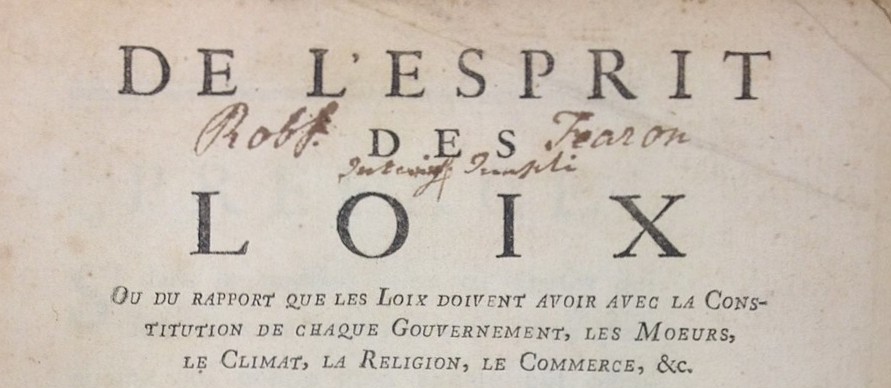
Montesquieu’s The Spirit of the Laws
Charles-Louis de Secondat, Baron de Montesquieu (1689 –1755), generally referred to as simply Montesquieu, was a French judge, intellectual, historian, and political philosopher. No one was quoted by America’s Founders more than he. Although he was not known for being devout, he was raised in a French Protestant family and married a Protestant woman. This shaped his worldview along with other influences.
A. How the Bible Shaped Montesquieu’s Political Thought
Montesquieu is often labeled a “Enlightenment thinker,” but his framework assumes:
A moral universe governed by divine order
Human fallenness
The need for institutional restraint
His political philosophy reflects biblical assumptions in key areas.
1. Law Rooted in Divine Order
Montesquieu begins by defining laws as “necessary relations arising from the nature of things.”
He insists:
God is Creator.
The physical and moral universe operates according to divine order.
Human law must conform to this higher order.
Although he avoids heavy theological language, the structure of his argument presupposes a Creator whose moral design governs reality.
2. Human Nature: A Doctrine of Fallenness
Montesquieu famously wrote:
“Constant experience shows us that every man invested with power is apt to abuse it.”
This reflects a political anthropology very close to:
Jeremiah 17:9 – the heart is deceitful.
Genesis 3 – corruption of human nature after the Fall.
Unlike utopian Enlightenment thinkers, Montesquieu assumes:
Power corrupts.
Virtue is fragile.
Institutions must restrain sinful tendencies.
This is deeply consonant with Augustinian and Reformed views of human depravity.
3. Separation of Powers: Institutionalized Distrust
His most famous contribution:
Legislative
Executive
Judicial powers must be separated.
Why?
Because no fallen human should hold unchecked authority.
This principle aligns with:
Deuteronomy 17 (limits on kings)
The biblical pattern of distributed authority (prophets, priests, kings)
The Mosaic system of judges (Exodus 18)
His system is essentially a structural safeguard against human sin.
4. Liberty Defined as Security Under Law
Montesquieu defines liberty not as license, but:
The right to do what the laws permit.
This reflects:
Biblical ordered liberty
Law as protective, not oppressive
Justice as the framework for freedom (Psalm 119)
Freedom exists under moral constraint—not autonomous individualism.
5. Moderate Government vs. Despotism
Montesquieu contrasts:
Moderate governments (limited by law)
Despotism (rule by arbitrary will)
His fear of concentrated, arbitrary power echoes covenantal political thought in Protestant Europe.
B. How The Spirit of the Laws Influenced the American Revolution
Montesquieu’s impact on America was massive—perhaps greater institutionally than any other European political thinker.
1. Separation of Powers in American Government
United States Constitution reflects Montesquieu’s model:
Article I – Legislative
Article II – Executive
Article III – Judicial
The Framers explicitly cited him as authority for structural liberty.
2. Influence on The Federalist Papers
The Federalist Papers repeatedly reference Montesquieu, especially in:
Federalist No. 47 (Madison)
Federalist No. 48
Federalist No. 51
James Madison defends separation of powers directly using Montesquieu’s arguments.
C. Republican Virtue
Montesquieu taught that republics require virtue—public morality.
This harmonized with:
American Protestant civic theology
Sermons preached during the Revolution
The belief that liberty survives only in a moral people
His political theory meshed naturally with colonial Christian culture.
[Curated quotations from Montesquieu’s Spirit of the Laws is provided below in the paid subscriber section.]
The content below was originally paywalled.
The Spirit of the Laws
By Montesquieu (1748)
Montesquieu’s The Spirit of the Laws is one of the most influential political treatises of the Enlightenment. It shaped constitutional thought in Britain, America, and beyond—especially its doctrine of separation of powers and analysis of republican government.
Below is an extensive curated list of representative quotations (standard English translation; wording may vary slightly by edition). Citations are given by Book and Chapter.
I. On the Nature of Laws
4
“Laws, in their most general signification, are the necessary relations arising from the nature of things.” (Book I, ch. 1)
“Every being has its laws.”
“God has his laws; the material world its laws; intelligences superior to man have their laws; beasts have their laws; man has his laws.”
“Before laws were made, there were relations of possible justice.”
“To say that there is nothing just or unjust but what is commanded or forbidden by positive laws, is the same as saying that before the describing of a circle, all the radii were not equal.”
II. On Government Types
“There are three sorts of government: republican, monarchical, and despotic.” (Book II, ch. 1)
“Republican government is that in which the body, or only a part of the people, is possessed of the supreme power.”
“Monarchical government is that in which a single person governs, but by fixed and established laws.”
“Despotic government is that in which a single person directs everything by his own will and caprice.”
III. On the Principle of Governments
“There is this difference between the nature of government and its principle: that its nature is that by which it is constituted; its principle, that by which it is made to act.” (Book III, ch. 1)
“The principle of a republican government is virtue.”
“The principle of monarchy is honor.”
“The principle of despotic government is fear.”
“Virtue in a republic is a love of the republic; it is a love of democracy.”
“Political virtue is a renunciation of ourselves.”
IV. On Political Liberty
“Political liberty in a citizen is that tranquility of mind which arises from the opinion each person has of his safety.” (Book XI, ch. 6)
“Liberty is the right of doing whatever the laws permit.”
“If a citizen could do what they forbid, he would be no longer possessed of liberty.”
V. On Separation of Powers
4
“In every government there are three sorts of power: the legislative; the executive in respect to things dependent on the law of nations; and the executive in regard to matters that depend on the civil law.” (Book XI, ch. 6)
“When the legislative and executive powers are united in the same person… there can be no liberty.”
“There is no liberty if the power of judging be not separated from the legislative and executive powers.”
“Everything would be lost if the same man, or the same body… were to exercise those three powers.”
VI. On Moderate Government
“Constant experience shows us that every man invested with power is apt to abuse it.” (Book XI, ch. 4)
“Power ought to check power.”
“It is necessary from the very nature of things that power should be a check to power.”
“Political liberty is to be found only in moderate governments.”
VII. On Laws and Climate
“The heat of the climate may be so excessive that the body there will be absolutely without strength.” (Book XIV)
“In cold countries there is little sensibility for pleasure; in temperate countries there is more; in warm countries it is exquisite.”
(These passages reflect Montesquieu’s environmental determinism, highly debated today.)
VIII. On Religion and Law
“The Christian religion… is far from giving birth to despotic government.” (Book XXIV)
“The Christian religion, by recommending a pure morality, has done great service to civil society.”
“It is of great importance that human laws should not be at variance with religion.”
“When the magistrate is armed with religion, he may make it serve his own passions.”
IX. On Commerce
“Commerce cures destructive prejudices.” (Book XX, ch. 1)
“The natural effect of commerce is to lead to peace.”
“Two nations who traffic with each other become reciprocally dependent.”
“Commerce is a profession of people who are equal.”
X. On Slavery
“Slavery is not good in itself.” (Book XV)
“It is impossible for us to suppose these creatures to be men, because allowing them to be men, a suspicion would follow that we ourselves are not Christians.”
(A powerful ironic condemnation of pro-slavery arguments.)
XI. On Republican Government
“When virtue ceases, ambition enters those hearts which are capable of receiving it.” (Book III)
“The corruption of each government almost always begins with that of its principles.”
“In a democracy the people are in some respects the monarch; in others the subject.”
XII. On Representation
“The people should not enter the government, except to choose their representatives.” (Book XI)
“The great advantage of representatives is their capacity of discussing public affairs.”
XIII. On Law and Justice
“An unjust law is no law at all.”
“Laws should be so framed as to be suitable to the people for whom they are made.”
“The political and civil laws of each nation should be so adapted to the people for whom they are framed that it should be a great chance if those of one nation suit another.”
XIV. On England (Model of Mixed Government)
“This nation will lose its liberty; it will perish, when the legislative power shall be more corrupt than the executive.” (Book XI)
“The English constitution is that of a republic, though it has the appearance of a monarchy.”
XV. On Punishment
“Every punishment which does not arise from absolute necessity is tyrannical.”
“It is better to prevent crimes than to punish them.”