Sources of American Liberty and Law
Our primary focus in the coming months is on the influences and events that led to and shaped the birth of the United States as an independent nation in 1776. In recent blog posts we have looked at excerpts of writings and documents written by colonial leaders in America between 1607 and 1733. They showed Christian and Bible-based motivation and thought behind their efforts to build new societies in what later became the United States. Their thinking did not arise in a vacuum. They were shaped by the writings and work of many generations of Christian leadership in Europe.
In today’s blog we will start to examine some of the political and legal reasoning and documents that occurred back in Europe before 1734.
1612, Spain
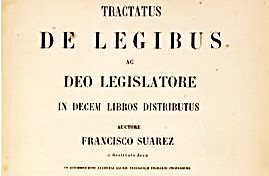
Most of the documents we will examine were by English and Protestant thinkers, but one from a Spanish and Roman Catholic context, was written in 1612 by Francisco Suárez. He was a Jesuit priest, philosopher and theologian, one of the leading figures of the School of Salamanca movement in Spain. His Treatise on the Laws and God the Lawgiver or Tractatus de Legibus ac Deo Legislatore is a seminal work in legal philosophy that intricately weaves biblical principles into its discourse on law and governance. He sought to harmonize divine law with human legal systems, drawing extensively from Scripture to underpin his arguments.
Influence of the Bible on Suárez’s Work:
Divine Origin of Law: Suárez posits that all legitimate laws emanate from God’s eternal law, a concept rooted in biblical teachings. He emphasizes that human laws must align with divine commandments to be just, reflecting passages like Psalm 19:7, which extols the perfection of God’s law.
Natural Law and Human Reason: Aligning with Romans 2:14-15, which speaks of the law written on human hearts, Suárez argues that natural law is accessible through human reason and reflects God’s eternal law. This underscores the belief that moral principles are inherent and universally recognizable, as they are divinely ordained.
Limitation of Monarchal Power: Suárez challenges the divine right of kings, asserting that sovereignty originates from God but is vested in the people, who delegate authority to rulers. This perspective resonates with biblical narratives where leaders are accountable to God’s law and the collective will, such as in Deuteronomy 17:14-20, which outlines the king’s duties and limitations.
In summary, Francisco Suárez’s Tractatus de Legibus ac Deo Legislatore integrates biblical concepts to articulate a framework where divine law informs human legal structures. Although there was no direct influence on the English colonists, his assertions on the derivation and delegation of political authority contributed to the philosophical currents that inspired movements toward self-governance and resistance to tyranny, including eventually the American Revolution.
1625, Netherlands
The Spanish thought from the Salamanca movement certainly were an influence on Hugo Grotius (1583–1645), a Protestant Dutch humanist, diplomat, lawyer, theologian, jurist, statesman, poet and playwright. He is often called the “father of international law,” who was deeply influenced by biblical principles in his seminal work, De Jure Belli ac Pacis (On the Law of War and Peace, 1625). He argued that moral and legal principles governing war and peace were rooted in natural law, which he believed was aligned with divine law as revealed in the Bible. Several biblical concepts directly shaped his views on just war and international law.
1. Biblical Principles in Grotius’s Just War Theory
The Concept of Just War (Lex Talionis & Just Punishment)
Grotius justified war under certain conditions, particularly in cases of self-defense, punishment of wrongdoing, and restoring justice—all principles echoed in the Bible.
Example: Romans 13:4 states that rulers are “God’s servants” who “bear the sword” to execute justice on wrongdoers, reinforcing Grotius’s belief that war could serve as a means of divine justice.
Love and Restraint in Warfare
Grotius argued that war should be conducted with restraint, particularly in the treatment of non-combatants. This aligns with biblical teachings on mercy and justice.
Example: Deuteronomy 20:10-15 outlines ethical conduct in warfare, urging Israelites to first offer peace before attacking and protecting non-combatants.
The Sanctity of Agreements and Treaties
Grotius emphasized that treaties and agreements between nations were sacred and should be honored, drawing from biblical examples of covenants.
Example: Joshua 9 records Israel’s treaty with the Gibeonites, which had to be honored even when it was made under false pretenses, reflecting the biblical precedent for upholding international agreements.
2. Biblical Influence on Grotius’s View of Peace
Peacemaking as a Moral Imperative
The Bible strongly promotes peacemaking, which influenced Grotius’s belief that nations should seek diplomatic solutions before resorting to war.
Example: Matthew 5:9 – “Blessed are the peacemakers, for they will be called sons of God.”
Forgiveness and the Limitation of War
Grotius advocated for the limitation of excessive violence and revenge in war, echoing the biblical principles of forgiveness and measured justice.
Example: The biblical principle of limiting retribution (Exodus 21:23-25: “eye for an eye”) was interpreted by Grotius as a way to restrict unnecessary escalation in war.
In summary, Hugo Grotius’s The Law of War and Peace was deeply shaped by biblical principles, particularly on just war, peacemaking, and the sanctity of agreements. His ideas influenced colonial thinkers and, eventually, the American Revolution, helping to shape arguments for justified rebellion and natural rights.
1628, England
A more direct influence on the American colonists was the English Petition of Right. It was a significant constitutional document presented to King Charles I by Parliament. It outlined specific liberties of the subjects and restricted the king’s ability to infringe upon those rights. The Bible profoundly influenced the principles and language of the Petition, as many English political thinkers and parliamentarians were deeply rooted in Biblical thought.
Key Biblical Influences in the Petition of Right
The Principle of Rule of Law
Biblical Basis:
Deuteronomy 17:18-20 – “When he takes the throne of his kingdom, he is to write for himself on a scroll a copy of this law… that he may learn to revere the Lord his God and follow carefully all the words of this law.”
Petition of Right:
The document insisted that the monarch is not above the law and must govern according to established legal principles, and especially challenged the king’s arbitrary imprisonment without trial.
Protection from Unlawful Imprisonment (Habeas Corpus)
Biblical Basis:
Acts 16:37 – “But Paul said to the officers: ‘They beat us publicly without a trial, even though we are Roman citizens, and threw us into prison.'”
Petition of Right:
It condemns the king’s practice of imprisoning individuals without a specific charge or fair trial, mirroring the biblical demand for just and lawful treatment.
Right to Property and Protection from Arbitrary Taxation
Biblical Basis:
1 Kings 21:3 – Naboth refuses to sell his vineyard, emphasizing the God-given right to property.
Petition of Right:
Protests against the king’s imposition of forced loans and taxes without parliamentary consent, and thus aligns with biblical principles that protect against unjust seizure.
No Quartering of Soldiers
Biblical Basis:
Luke 3:14 – John the Baptist advises soldiers, “Do not extort money and don’t accuse people falsely—be content with your pay.”
Principle: Soldiers should not oppress or burden civilians.
Petition of Right:
Prohibits the forced billeting of soldiers in private homes without the owner’s consent, and that power should not be abused to the detriment of ordinary citizens.
Due Process and Fair Trials
Biblical Basis:
Deuteronomy 16:18-20 – “Appoint judges… who will judge the people fairly. Do not pervert justice or show partiality.”
Petition of Right:
Asserts that citizens should not be punished or executed without a lawful trial and echoes the Bible call for justice and righteousness in judgment.
In summary, the English Petition of Right was deeply rooted in biblical principles, emphasizing justice, rule of law, and protection from tyranny. These ideas significantly shaped the American colonists, and eventually, American Revolutionary thought.
1629, England/Netherlands
Besides obvious legal documents such as the Petition of Right, theological leaders also influenced ideology that shaped American colonial society. William Ames was an English Puritan minister and philosopher who also taught for over twenty years in the Netherlands. His Medulla Theologica (The Marrow of Theology), published in 1629, significantly influenced the religious and political thought that helped shape the ideological foundation of the American colonies. Here’s how:
1. Promoting Puritan Theology and Covenant Theology
The Marrow of Theology was a systematic presentation of Puritan Reformed theology, emphasizing the idea of covenant theology—the belief that God enters into binding agreements with people, requiring moral and social obligations.
This concept of covenantal relationships extended beyond theology into political theory, reinforcing the idea that rulers and governments were accountable to God and to the people they governed.
Puritans who settled in New England carried this belief with them, using it to justify self-government and resistance to tyranny.
2. Emphasis on Natural Law and Resistance to Tyranny
Ames argued that moral and legal obligations were not derived merely from human authority but from divine law and natural law.
This notion supported the idea that a government that violated fundamental moral and divine principles could be resisted, an idea that resonated strongly with the American colonists in their opposition to British rule.
3. Influence on New England’s Political and Educational Institutions
Ames’ work became a key theological and philosophical text for the Puritans of New England, many of whom saw themselves as a covenantal community.
His teachings were influential at Harvard College and other institutions, shaping the education of many early American leaders.
The Puritan emphasis on a morally righteous society under God’s rule contributed to a culture of political engagement and civic duty, which later fueled revolutionary sentiments.
In summary, William Ames’ The Marrow of Theology played a significant role in shaping Puritan political thought. His ideas on covenant theology, resistance to tyranny, natural law, and moral governance provided a religious justification for self-rule and rebellion against oppressive government, laying the ideological foundation for the eventual American fight for independence.
1638, Scotland
The National Covenant of Scotland (1638) was heavily shaped by the Bible, particularly in its defense of Presbyterianism against the imposition of Anglicanism by King Charles I. The Scottish Covenanters viewed their commitment as a covenant with God, drawing direct parallels from the Old Testament. Here’s how the Bible influenced it:
Covenantal Theology – Inspired by biblical covenants, such as those made between God and Israel (e.g., Deuteronomy 28), the Scots saw their national identity and religious obligations in covenantal terms, believing they had a divine duty to uphold true Christian worship.
Defense of Presbyterianism – The Covenant opposed episcopacy (rule by bishops) and emphasized governance by elders, modeled after the New Testament church structure (Acts 14:23, Titus 1:5).
Resistance to Tyranny – The Covenanters saw biblical precedents for resisting rulers who violated God’s laws, citing examples like the Hebrew midwives disobeying Pharaoh (Exodus 1:17) and the Apostles proclaiming, “We must obey God rather than men” (Acts 5:29).
Call for National Repentance – The Covenant included language of national repentance, reflecting prophetic calls in the Bible (e.g., Joel 2:12-17) for returning to God to secure His favor.
In summary, the biblical foundations of the Scottish National Covenant not only shaped Scotland’s religious and political resistance but also helped lay the ideological groundwork for American colonial mindsets. The Scottish Presbyterian and Covenanter tradition greatly shaped the Presbyterians in the colonies who significantly influenced the American Revolution.
The content below was originally paywalled.