A Wakeup Call for Christian Transformation of the Arts
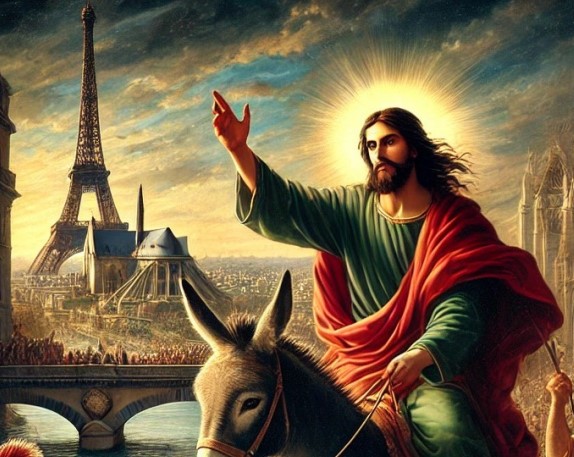
Many people were shocked by the parody of the Last Supper in the opening ceremony of the Paris Olympics. The idea of “tolerance” in the modern pagan mind, like the ancient pagan mind, is not just allowing other viewpoints, but blatant disrespect for the Christian worldview and beliefs. The arts are especially used for this disrespect. More than ever, the calling of Christians into the arts, media, entertainment and especially journalism is of utmost urgency. The freedom of the public square that Christianity historically made possible, is now largely hostile to our values. It will take great courage in the “cancel culture” environment for Christian artists and journalists to speak, but we cannot run from it. We are trying to equip and connect Christians in the arts and media to have a long-term strategic plan for transformation.
One of our friends in South Africa is working in this sphere. The blog this week is by Nigel Desmond. He has some thoughts worthy of consideration below.
Nigel has bachelor of arts from Cape Town University. He and his wife have led various organizations working in the area of worldview and arts. They pioneered the National festival of Christian arts in Grahamstown in the 90s and since then have led various organizations and festivals around the country and have spoken on the arts at different churches and in different conferences. They pioneered and lead an initiative called the “nation building initiative” which had quite a strong focus on the arts.
Christ’s Triumphal Entry Into Paris, by Nigel Desmond
Sometimes the loudest voice is the one that hardly speaks at all. That certainly was the case this week during and after the opening ceremony of the Olympic Games. The opening showcase found itself at the center of a huge controversy as around the world christians and non-christians cried out at the parody of the last supper which appeared to be at the heart of the ceremony.
On social media a maddened crowd amassed until it could aptly be described by the Biblical verse Acts 2 v 32 “the frenzied crowd shouted out one thing, and others shouted out something else, until they were all in mass confusion with many, not even knowing why they were there”
The voices began on social media, and like a wildfire burned around the world, it wasn’t just christians who noticed, but people of every faith and no faith at all found themselves talking and listening to this moment, which overshadowed the art, artistry, beauty and performance that was the opening. I, like millions of Christians was both horrified and shocked by the mockery offered to our faith. Truth be told I was shocked, but not surprised, mockery of Christ and the open contempt for our most cherished values and institutions are now so common that statements that would’ve been radical and revolutionary in previous generations are so banal now that they are mainstream.
So the voices began to cry out. First came the shock, then came the denials and the defenders as the Olympic committee sought to backpedal and gaslight the public. They pointed to other gods. It was about Dionysus and Bacchus they said. It was Sequana, goddess of the Seine who rode in on that lighted horse they tried to tell us, until posts (now deleted ) from one of the performers on social media, crowing about the “gay new testament”, gave the lie to their words.
So as the dust begins to settle, and the voices start to quiet, what remains? For me the voice I cannot help but hear is not the lovely voice of Céline Dion, which many thought had been silenced forever by disease, but another quiet voice. I hear the voice they tried to silence, I feel the presence they seek to deny, because suddenly across the world the name of Jesus is on everyone’s lips. I am reminded of G.K. Chesterton‘s poem.
The Donkey (reproduced here in part)
With monstrous head and sickening cry. And ears like errant wings, The devils walking parody. On all four footed things.
The tattered outlaw of the Earth, Of ancient crooked will: Starve, scourge, deride me: I am dumb! I keep my secrets still!
Fools! I also had my hour One far, fierce, hour and sweet: there was a shout about my ears, And palms before my feet.
2000 years ago when Christ came to Jerusalem, he sent his disciples ahead of him to prepare a place for him to eat his last supper with them. He told him to find a donkey on which he could enter into Jerusalem and if challenged, they were just to say, “the master has need of him”. We all got to watch Jesus eating his last meal with his disciples as “The Last Supper” was splashed across the media last week. Like the donkey in Chesterton‘s poem the devil‘s parody and mockery of this holy moment in history carried the presence of Jesus into the city of Paris and all over the world we felt him. As they flashed what should be kept hidden, to their chagrin, they unveiled the One they had wanted to hide. In mocking him, they only made an ass of themselves.
In da Vinci’s painting Christ sits in the centre, because he is the centre. The last supper was the prelude to the crucifixion but after the crucifixion came the resurrection. When Christ died and rose again from the dead he validated what he had taught; that he is the Way, the Truth and the Life. As the debate raged last week whether what was depicted was right or whether it was wrong many failed to see that without Christ at the centre the very debate itself was meaningless. Because without God, without truth, there is no such thing as right and wrong. Around the figure of Christ, we see his disciples and his detractors trying to make sense of the moment using words such as freedom, love, inclusion and tolerance. As Tom Holland says “Today we are all like fish swimming in Christian water” because before Jesus’ time these concepts -freedom, love, inclusion, tolerance were so far from the norm of the culture but today due to the life and the teaching of Jesus Christ these concepts have so permeated our the world that we take them for granted.
In G.K. Chesterton’s poem, Christ is not mentioned at all, and yet his presence hangs in the air above the words. In a similar way, the presence of Jesus hangs over the Olympics as once again he comes riding into the world’s consciousness. Then, as now, his presence is humble and quiet. There are shouts of adulation and rejection in equal measure, but if we stop and listen carefully we may hear his voice.
His followers shout and seek to make him king, King of the world-but he hasn’t come for that. He is already the King of Kings. We have no more power to make him what he is, than his enemies have to make him something that he is not. Some in the crowd mock and jeer and believe that perhaps tomorrow they can crucify him out of the mind of the world, but all they managed to do is once again lift him up for all to see.
So, why has Jesus riden into Paris? He’s at the center of the painting and of our minds and of history because by his humiliation in death we saw the weak overcome the powerful, we saw the marginalised uplifted and the aliens become citizens of heaven. Simply put he came to die that we might live. He died for the powerful who arrested and crucified him. He died for Judas, who sold the privilege of being in his presence to make a quick buck. He died for the broken, the poor, the weary, the weak. He’s at the center because he died for Peter who denied him, for the disciples who ran away in his hour of need. He died for slaves and masters, men and women, Jews and gentlies.
His presence was felt at the Parisian table because he came to die for the drag queens, who like the soldiers of Rome mock him, not knowing that in his eyes, and in his love they could find their truest identity. He died for the IOC, he died for the crowds on each bank of the Seine and who look on online. He died for each athlete making their way down the river carrying flags of nations he calls us to disciple.
And it grows quiet, all I hear is the steady beating of the blood in my ears and then I hear his voice like a whisper, he’s calling out my name. He looks up and catches my eye, and I realize he has also come to be crucified for my sin, for me. Can you see him, can you hear him now?
For paid subscribers below is a discussion of the problem of Christian abdication of the arts and a strategy for reclaiming this sphere (an excerpt from my book on How Nations Speak Their New Tongues).
The content below was originally paywalled.
[Below is an excerpt from my book on How Nations Speak Their New Tongues]
The modern withdrawal of Christians from Journalism and the Arts
With the explosion of so many new forms of communication in the 20th century, it should have been the easiest time of any period in history for Christians to be the salt and light of the world. Christians had the opportunity to influence the entire culture in every sphere of life, but instead recent times have proven to be the greatest period of apostasy and secularization of culture. Pagan philosophy has become dominant in the television, radio, music, and movie industry. This did not happen because paganism conquered Christian thought. Rather it happened because Christians began to accept a faulty theological premise in the late 1800s to avoid the things that were “worldly” or non-spiritual. It was a waste of time and money, they believed, because culture would get worse and worse before the end-time return of Christ.
By the 1960’s virtually every influence of Christianity on the media had disappeared and pagan worldviews and philosophies gained the ascendancy by default. Christians began to see themselves as an irrelevant counter-culture, and the world agreed with their assessment.
From 1933 to 1966, Christians in America influenced communication in Hollywood. Movie and television scripts were read by representatives of the Roman Catholic Church, the Southern Baptist Church and by the Protestant Film Office. In addition, Hollywood studios and producers followed the Motion Picture Code, which stated:
1) No film or episode may ridicule any religious faith.
2) Ministers of religion should not be portrayed as comic characters or as villains.
3) Religious ceremonies should be carefully and respectfully handled.
There was no sex, minimal violence, limited profanity, or blasphemy in movies. Movies and television programs communicated the true, the good, and the beautiful. But during the 1960s, Christians abandoned their role in film, and Hollywood put in its own ratings systems that have now proved virtually irrelevant at preventing the “f-word,” taking the Lord’s name in vain, vulgar references to sexual organs, sexual intercourse, explicit nudity, severe violence, depictions of alcohol and drug abuse, gender confusion, etc.
Christians have been replaced as script reviewers by homosexuals, atheists and Marxists. More importantly, godless and immoral individuals have taken the leading role in writing scripts and producing shows that shape popular culture with their ideas and morals such as gay “marriage” and other perversions. Agenda-driven entities in the entertainment industry give awards to movies and television programs that communicate their point of view while ensuring that opposing viewpoints never receive Academy Awards or other recognition. They demonize opposing views and use the coercive power of government to punish “unacceptable” viewpoints.
A Strategy for Reformation of the Media
Christians have been diligent to claim every new form of media communication for evangelistic purposes and have done quite well at it. But most Christian programming is rarely seen in prime-time; most are found in the “religious” time slots on Sunday mornings and focused only on the theme of salvation. Few have worked to invest their time into using media to communicate biblical ideas in a comprehensive way. Few Christians have worked to enter the major newspapers, magazines, television networks, and Hollywood with the goal of bringing a Biblical worldview to bear upon it. Christians who have gone into these fields for personal reasons have usually had very little Biblical influence beyond witnessing for Christ to their associates. There have been successful films with Christian themes, but most have not been the product of the Christian community.
The same is true of music, drama, and dance. Christians have “religious” music, etc. which witnesses for Christ but few believers infiltrate or buy the mainstream companies for such art. In the world of painting and sculpture, Christians complain about the filth funded by the government and displayed in public art museums, when instead Christians with a solid Biblical worldview should have a goal of becoming the owners and directors of such museums and arts organizations. When was the last time a Bible-believing church teenager talked about such a career? Are we guilty of making them seem unimportant compared to religious goals?
If Augustine were alive today, he might say, “Television, movies, videos, and websites are the books of the ignorant.” Recently, certain Christian universities have begun to train graduates for such careers—a refreshing beginning. The Christian Broadcasting Network developed a comprehensive “Family Channel” that broadcasts shows and news that are not primarily religious. A television channel in Hungary, owned by Christians, is becoming more comprehensive by making not just religious shows for church people, but shows of interest to everyone. World magazine is a nationally distributed weekly news magazine in America that presents all types of news from a Biblical perspective. Similar efforts are occurring in South Africa and Latin America. Christians are also making news-oriented media and communicating a more comprehensive worldview via the internet and through social media.
Instead of making films and music that bless believers, Christians must provide resources in the arts and media that will impact everyone with a Biblical worldview. When Christian businessmen understand this vision, they will invest and purchase major television networks, motion picture studios, newspapers, and theater chains across the country. The nations do not need more expensive church buildings and facilities. They need Christians to establish film studios. That is where Christian businessmen should invest their money.
Good News Communications led by Ted Baehr in America produces MovieGuide, helping Christians discern the worldview of most movies and works to raise up more believers to enter the film industry. PureFlix is a new company that Christians have formed to deliver online (in place of Netflix and others) films with a more wholesome, clean content with a good worldview. This will not be of interest to non-believers but Christians can find out better movies to support with their attendance or online rental and these finances send a message to even secular film studios what people want. It leads to better movies for everyone. Trying to influence the secular owners and producers of media to change is difficult, so instead we should become the owners and producers of the best quality films ourselves.
The idea of investing so much money in such things as movies and art is hard to rationalize at first. But until Christians once again recognize that art and media are not in themselves worldly, and that being salt and light in every area of culture is essential for societal redemption, our culture will not be redeemed. We will keep complaining from the comfort of our living rooms that our point-of-view never gets fair coverage in the news or decent programs on prime-time, while the non-Christians in media will continue to control the elections, the public opinion, and the framing of the debates of the issues of our day. It is time for Christians to establish themselves in the arts and for the Christian community to back them wholeheartedly.
Today Christians must use the arts to influence their communities. Even if they are not personally artistic, believers can help guide secular reading groups in discussing issues dealing with faith and spirituality. Churches can sponsor literary and other festivals using photography, film, and television to bring together the community that would not normally come to a church. No venues are expressly prohibited to Christians, provided attendance does not imply worship or veneration of a god other than the Christian God.
Jesus and the prophets were the master storytellers of their time. Arts and media are also telling stories. We need to imitate our Lord and once again take up the weapons of our warfare which are “mighty in God for pulling down strongholds, casting down arguments and every high thing that exalts itself against the knowledge of God, bringing every thought into captivity to the obedience of Christ” (2 Cor. 10:3-5).
In summary, it is essential that Christians reclaim leadership in the arts and journalism.
———————————–
Resources for becoming owners and editors of major Arts and Media so as to include biblical worldview of culture