Excerpts from new book by Dr. Paul Jehle
In the previous blog I announced that I was helping to organize an important event online on August 2 this year, the date our Founders actually signed the Declaration of Independence, 250 years ago. Go to www.250Declaration.com to find out how you can be a part of this nationwide renewal of America’s covenant with God.
In today’s blog, the key organizer with me of the August 2nd event, Dr. Paul Jehle of Plymouth, Massachusetts, provides us an exceprt from his brand new book: Declaring Liberty: Is the Declaration of Independence Still Relevant Today? it is available through retailers online and I highly recommend it. Enjoy this excerpt below.
THE LEGACY OF THE DECLARATION
The Declaration is Unique
David Armitage, professor of history at Harvard University has noted;
No American document has had a greater global impact than the Declaration of Independence. It has been fundamental to American history longer than any other text because it was the first to use the name “the United States of America”: in this sense, the Declaration was the birth certificate of the American nation.
It enshrined what came to be seen as the most succinct and memorable statement of the ideals on which that nation was founded: the rights to life, liberty, and the pursuit of happiness; the consent of the governed; and resistance to tyranny. And, as the first successful declaration of independence in world history, its example helped to inspire countless movements for independence, self-determination, and revolution after 1776.
Note that Professor Armitage says that it has had such a global impact because it is unique. And what makes it so unique? It had the most succinct and memorable statement of the ideals on which that nation was founded. And what were those ideals? He lists rights to life, liberty, pursuit of happiness, consent of the governed, and resistance to tyranny.
The Laws of Nature and Nature’s God – or the law of nature and the law of God as we saw in chapter 2. If a nation bases their nation’s laws on the law of nature (Creator) and the law of God (Redeemer) it will thrive in empowering individuals to liberty.
Rights of life, liberty and the pursuit of happiness (property) endowed by the Creator – unalienable rights that are given by God and cannot be taken away by any government. Unalienable rights are given to individuals, and they empower families, businesses, churches and civil governments to stay within their God designed jurisdictions.
Rights are secured by government – the purpose of government in every sphere of jurisdiction is to protect rights, not provide them. It is not the purpose of government to force equality from the outside, but to empower people to express their liberty of diversity from the inside.
Governments operate by the consent of the governed – the protection of God-given rights is secured by government at all levels from the self-governed individual, family, business, church and state by consent (or permission) of their representatives in each sphere.
People have a right to change their government after “a long train of abuse” by following the steps of lawful resistance to tyranny – or interposition. Built into this process is the understanding that internal fortitude and self-control must be the focus so that a government can change from the bottom-up, with the last resort being a call to self-defense and forceful resistance.
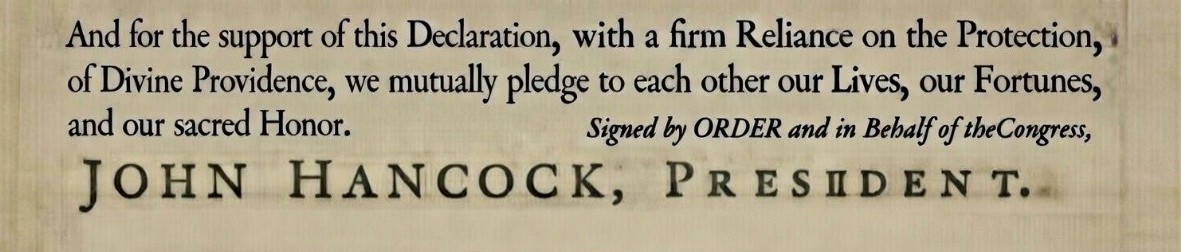
At all levels of society, we must embrace a firm reliance on the Protection of Divine Providence to ultimately get the government He has designed for our nation. A declaration of the source of our rights must ultimately be on of dependence on God more than merely resisting evil and corruption.
The Declaration is Submitted to a Candid World
A line from the Declaration says: “A decent respect to the opinions of mankind requires that they should declare the causes which impel them to the separation… let facts be submitted to a candid world.”
The Declaration was never intended by the delegates to apply only to the United States. If so, they would only have published it among themselves and Great Britain. They knew that the ideas expressed in it were universal and could be implemented anywhere there were enough people with the character and integrity to support self- government for the purpose of empowering liberty.
On the fiftieth anniversary of the Declaration, in 1826, both John Adams (at 90 years of age) and Thomas Jefferson (at 83) died. It shocked the nation and caused them to reconsider the Declaration’s meaning. Jefferson is reported to have said weeks before he died that the Declaration was ‘An instrument… pregnant with our own and the fate of the world.’
Professor Armitage explains how the Declaration’s influence began to spread;
The other powers of the earth were naturally curious about what the Declaration said. By August 1776, news of American independence and copies of the Declaration itself had reached London, Edinburgh, and Dublin, as well as the Dutch Republic and Austria. By the fall of that year, Danish, Italian, Swiss, and Polish readers had heard the news and many could now read the Declaration in their own language as translations appeared across Europe. …One of its most enthusiastic admirers was the nineteenth-century Hungarian nationalist, Lajos Kossuth: for him, the Declaration was nothing less than ‘the noblest, happiest page in mankind’s history.’
The Declaration goes International – Treaty of Watertown with the Mi’kmaq Nation
Claimed to be the first international treaty between the United States and another sovereign nation immediately after and inspired by the Declaration of Independence, it took place on July 19, 1776. It is an excellent example of how the Declaration inspired a friendly peace treaty with Native Americans.
…15 days after the signing of the Declaration of Independence, between the Provincial Council of Massachusetts, empowered by the Continental Congress to act on behalf of all 13 colonies, and the delegates of the Mi’kmaq and Maliseet First Nations. This treaty, with wording taken directly from the Declaration is the sister document and stands alone as the true vessel of sovereignty of the United States of America.
It was at General George Washington’s direct request that this treaty of peace, friendship and military alliance be consummated, thereby recognizing the crucial role that indigenous nations might play in the colonist’ struggle for freedom and independence from England. As James Bowdoin, the president of the Massachusetts Council stated, ‘the United States now forms a long and strong chain, and it is made longer and stronger by our brethren, the Mi’kmaq Tribes joining with us; and may Almighty God never suffer this chain be broken.’
The Rebuttals to the Declaration
The people who read the Declaration around the world loved it, but those with power that did not want to diffuse it were terrified of its words, scrambling to maintain the status quo. Loyalist Governor Hutchinson (who had been Governor of Massachusetts) offered a rebuttal noting “the absurdity of making the governed to be governors.”
Jeremy Bentham, the European “father of the welfare state” who wrote his own Short Review of the Declaration, refuting the concept of natural rights, stated; “They attempt to establish a theory of Government… that is subversive of every actual or imaginable kind of Government.”
When discussing the assertion that all men are created equal, he wrote; “This surely is a new discovery.” He asserted that no government has ever acknowledged unalienable rights for; “Here they have laid the axe to the root of all Government.”
The rebuttals rested on the presupposition that the ideas in our Declaration are perposterous – independence and equality – because they have not existed in the majority of governments on the earth. In essence, the rebuttal states that the power exercised in centralized, top-down government cannot be difused since it would threaten the way things have been done in the past!
Though times have changed, the attacks on the notion of God-given rights and self-government have not. The arguments are the same, for the very idea of calling on the God of the Universe, as revealed in the Bible, for the individual to get rights from Him rather than government, “lays the axe to the root.”
But it was the “right to revolution” (changing a government), stated in the Declaration, that put fear in all the monarchies of Europe. True it was, that there is always a tendency for humanity to go from one extreme to the other, for if all colonies revolted, we would tend to move toward anarchy.
The lessons of history are hard to ignore. The fruit of a revolution reveals which set of ideas were the seeds of their resistance. The source of liberty will always determine its quality.
The most common misconception taken from the Declaration by other countries wanting its quality of liberty was simply copying the words but leaving out one key concept – God. By doing so, they rejected His jurisdictional way of bringing forth His rule – bottom- up beginning with the individual. Others deliberately deceived the populace. No better example of this was the French Revolution.
[The rest of this excerpt is below – available only for paid subscribers. It explains the history of revolutions that emerged after the American one and why the fruit was different at times. For those reading this blog in other countries, we invite you to join the August 2nd event to join with Americans to pray for God’s kingdom purposes to be renewed here that will bless the world.]
Pre-sale of my book!
And don’t forget to help me get the Christian history of America out to the nation, by ordering my new book (with co-author Jerry Newcombe) using the presale link here.
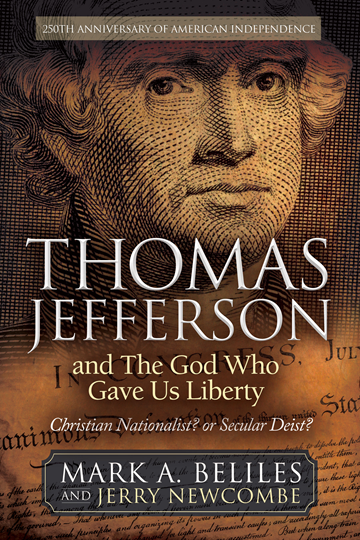
Thomas Jefferson and the God Who Gave us Liberty: Christian Nationalist? Secular Deist?. (Order now using this pre-sale link through Barnes and Noble for special price of $17.76. If enough people do it, it will likely lead them to stock it in their stores.) Don’t buy it through Amazon or elsewhere. Your purchase will help preserve knowledge of America’s Christian history for future generations. Buy now!
The content below was originally paywalled.
[Paul Jehle’s excerpt continues here…]
The French Revolution
The French Revolution of 1789 was said to be inspired by the Declaration, but its declaration of human rights left out the crucial source of those rights – God. If God does not grant the rights, then government is the source and freedom will by consequence be limited and if left unchecked – eliminated.
Consider Gary DeMar’s brief critique of the French Revolution as an example:
“The murdering mobs that attacked the nearly empty Bastille (at the time of the siege there were only seven non-political prisoners) believed their actions were for a better France, similar to what today political revolutionaries have in mind. The storming of the Bastille was a catalyst for what became known as the reign of terror. “French society underwent an epic transformation as feudal, aristocratic and religious privileges evaporated under a sustained assault from left-wing political groups and the masses on the streets.” How bad was it? Internally, popular sentiments radicalized the Revolution significantly, culminating in the rise of Maximilien Robespierre and the Jacobins and virtual dictatorship by the Committee of Public Safety during the Reign of Terror from 1793 until 1794 during which between 16,000 and 40,000 people were killed.…In time, the just cause of the revolutionary mobs got out of hand, and people began to notice. “During the Reign of Terror, extreme efforts of de-Christianization ensued, including the imprisonment and massacre of priests and destruction of churches and religious images throughout France. An effort was made to replace the Catholic Church altogether, with civic festivals replacing religious ones. The establishment of the Cult of Reason was the final step of radical de- Christianization.”
Not all revolutions are equal. The root can be discerned in time through the fruit. There are far fewer proper lawful interposition against tyranny based in the principles of God’s Word than reactionary anarchy. But for our purposes here, consider some of the revolutions inspired by the Declaration.
Other Revolutions inspired by our Declaration
The nations in Central and South America, inspired by our Declaration, copied its contents along with our Constitution, expecting to get stability and order, as well as good government, from the documents. They soon found out that the words alone were not the source of liberty, but instead the fruit of it. Here are some others;
The Manifesto of the Province of Flanders in 1790, the Haitian Revolution (1804), Venezuelan (1811), Granada (1811), Argentine (1816), Chilean (1818), Costa Rica, El Salvador, Guatemala, Honduras, Mexico, Nicaragua and Peru (1821), Bolivia and Uruguay (1825), Ecuador (1830), Colombia (1831), New Zealand (1835), Paraguay (1842), Dominican Republic (1844), Liberia (1847), Hungary (1849)
Though the words from our Declaration were quoted in many of these, the meanings were often ignored or changed, God and His law was left out, and the results merely exchanged one form of tyranny for another. Those revolutions that deliberately deceived the populace, but never had any intention of settling the movement on a solid footing of the unique ideas in our Declaration were the following:
European Communist Revolutions
The European revolutions of 1848 never quoted our Declaration. Inspired by the Communist Manifesto of Karl Marx, these revolts focused on overthrowing government itself. The result was the reign of an all-powerful State.
The ideas in our Declaration, drawn from the laws of nature and nature’s God give unalienable rights to the individual and thus bind down the civil government’s power by the chains of a written Constitution. When the chains are forged on the people rather than the government, the ideas in our Declaration are either being ignored or their meanings revised.
Twentieth and Twenty-first Century Revolutions
The Declaration inspired the break-up of the Ottoman Empire, the Austria-Hungry Empire, the independence of Czechoslovakia, Vietnam and virtually 70 other revolts between 1945 and 1979 alone. The 21st century has seen uprisings in the streets of Europe and America similar to what was seen in the revolts following the Communist Manifesto. But what quality of liberty are they seeking?
Some trade a larger form of centralized tyranny for a smaller one. Standards of living decline for the individual, and social turmoil, debt and poverty increase. As historian Bill Federer has noted, the vast majority (over 95%) of all governments have been centralized tyrannies with very little liberty held as an inalienable right by the people throughout history.
The most common change has been from an empire mentality to a more regionalized tyranny. Remember that the source of liberty determines its quality.
Leading Idea – The ideas in the Declaration transcend America. Any nation can utilize them if they are willing to express and apply them by empowering individuals to live by them in the jurisdictions where they have influence.