Plus two key writings of John Adams just before Independence

In the photo above is a chair that likely was used by the Continental Congress and Lafayette during the American Revolution. Behind the chair in my library is a set of the Journals of the Continental Congress. In this 250th anniversary year, our family has a story that goes back to that pivotal time in the history of nations.
This week 250 years ago delegates were in Philadelphia debating what to do. The Virginia Convention decided on May 15 to move for independence from England. On that same day the Congress decided to recommend that each state form their own governments, but had not yet declared independence together.
Two days later the delegates (including Jefferson) went to church together for the Continental Day of Fasting and Prayer to “…confess and bewail our manifold sins and transgressions, and, by a sincere repentance and amendment of life, appease his righteous displeasure, and, through the merits and mediation of Jesus Christ, obtain his pardon and forgiveness…” The Congress “…recommended to Christians of all denominations, to assemble for public worship…” There were 16 prayer proclamations by Congress. This part of the abundant evidence that this was a Christian Revolution. The Journals of the Continental Congress shown in the photo confirm this history.
The History of the chair
It is a classic example of an 18th-century Chippendale-style side chair (sometimes called a transitional Queen Anne/Chippendale chair), most likely made in the American colonies (or possibly England) between approximately 1750 and 1780. It was also most likely used by the Continental Congress and Lafayette.
This chair was passed down over generations through my son-in-law’s family. Someone unidentified wrote a note generations ago that was attached under the seat of the chair (see pic below). The note has a couple of historical errors. It said:
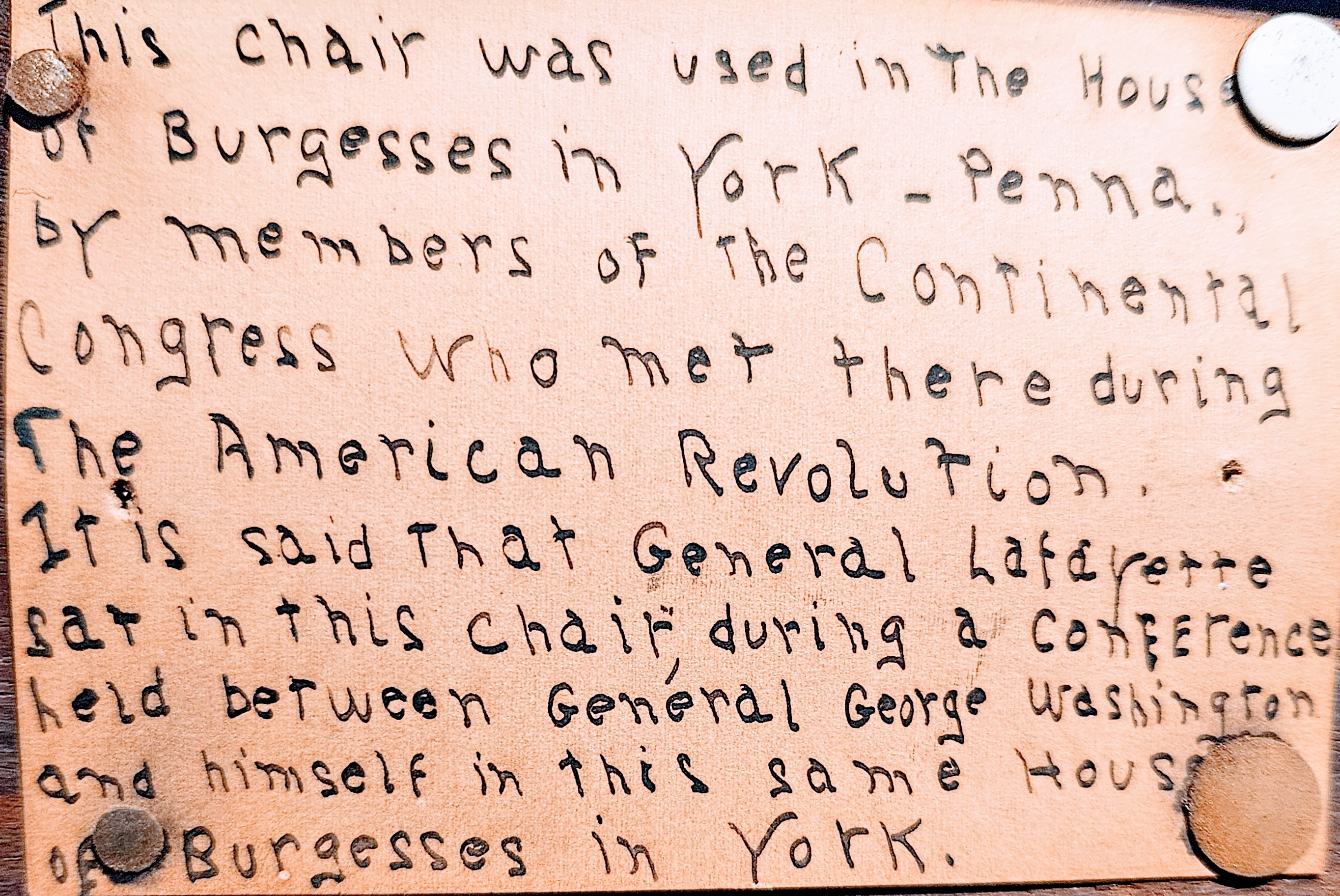
Historical facts confirm that the Continental Congress was in York, Pennsylvania in 1777-78 due to the British occupying Philadelphia. And it is certain that General Marquis de Lafayette met with them in January 1778. So the claim that this chair was used by Congress and Lafayette, along with the unique time period of this particular chair, is strong.
There are a couple errors in the note above. It says “Lafayette sat in this chair during a conference held…at the House of Burgesses” when actually it was the Courthouse in York. And it says Lafayette conferred with George Washington while there but actually at York he conferred with the Board of War. Of course, Lafayette was with Washington all the time as member of his staff – just not in that York meeting. Again, the Journals of the Continental Congress that I possess provide the correct details of these important meetings. The errors in the note show that someone long ago knew of the chair’s provenance but were not professional historians.
The family that passed this chair down to us were connected to the American Revolution in a couple ways. The Patton family had roots in Philadelphia itself and one of that family was Mary Boynton Dill who was also a top Pennsylvania leader of the Daughters of the American Revolution. But the Smiths (via Fah family) had roots in York itself. One way or the other, the chair came down to us.
My recent trip to Boston
My wife and I traveled to Massachusetts last week. Being in Virginia, it is not often that we have opportunity to be in that part of the country with a little free time. We spent a short time in Plymouth where the Pilgrims founded a Christian colony. My friend Dr. Paul Jehle is a pastor there and Director of the Plymouth Rock Foundation. He took us around to see the evidence of our nation’s Christian roots visible in a rock, statues, buildings and memorials that I had not seen in many years.
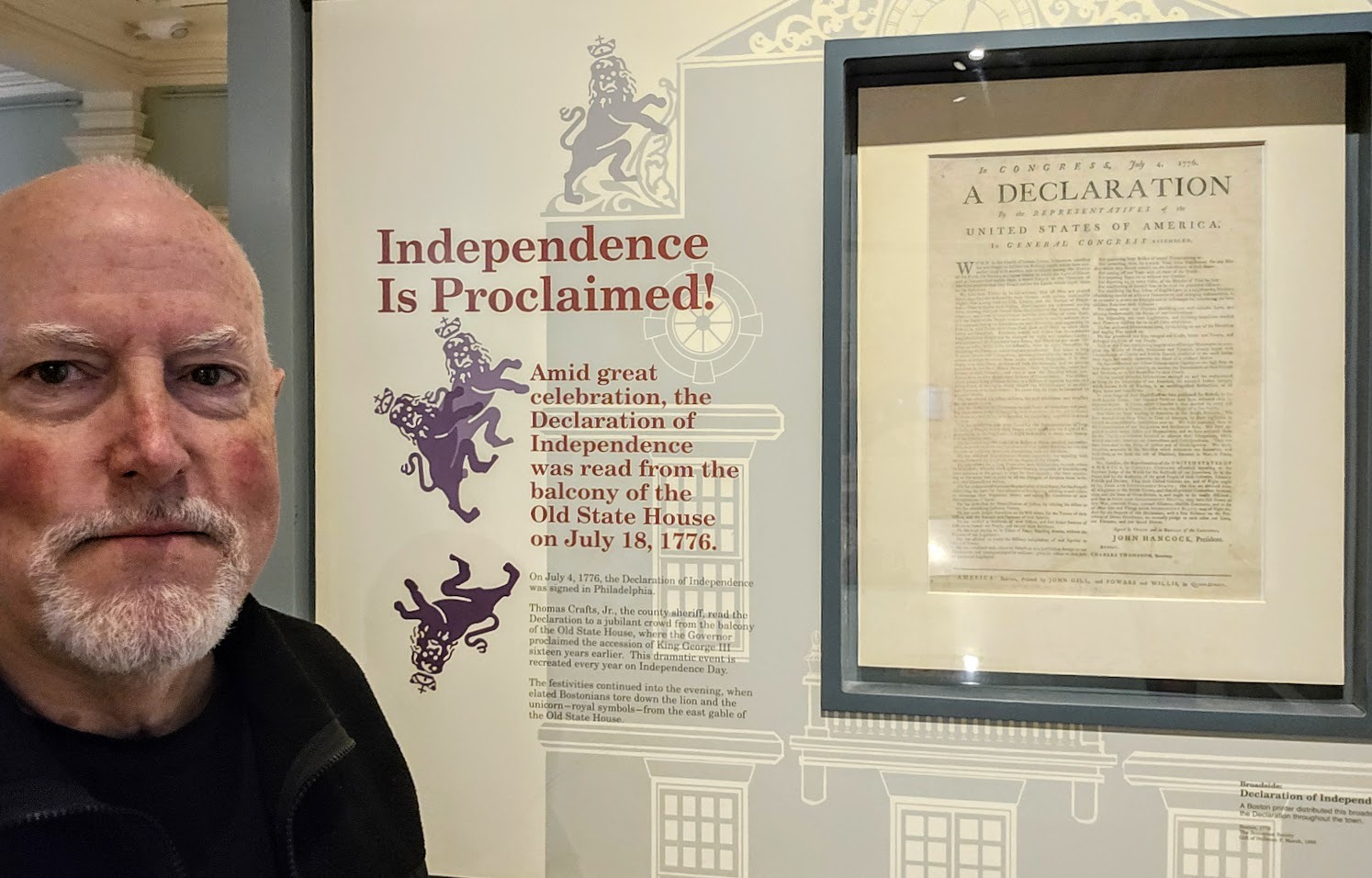
Then we had a brief visit in Boston. Every Christian needs to go there and walk the Freedom Trail. We saw the covenant monument on Boston Common and then the State House, the Park Street Church, the Granary Burial Ground (graves of patriots such as Sam Adams and others), the Old South Meeting House (where political meetings were often held), the old State House, and Faneuil Hall. We had seen most of these before but it was meaningful for us to be there again during this 250th anniversary. See pics below of me at old State House where the Declaration was read publicly with inside nice exhibits including a old copy of the Declaration).
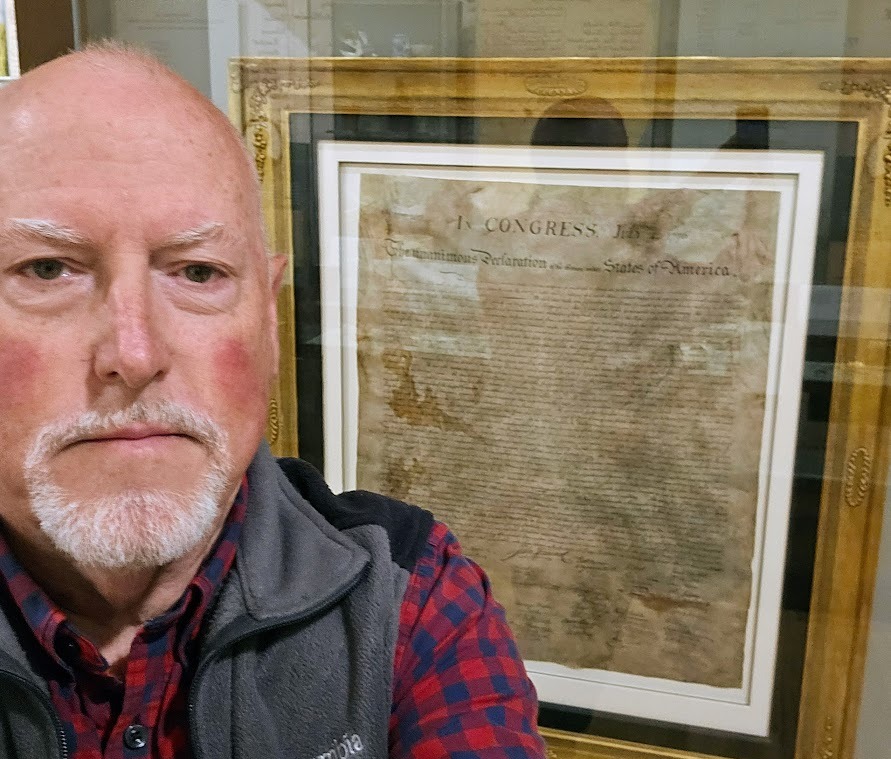
Then this week back home in Charlottesville, Virginia, I went to Monticello, the home of Thomas Jefferson, for the first time in a while. I was also glad to see special exhibits there such as another old copy of the Declaration. See pic below.
I encourage all Americans to take opportunity this year to go see historic sites. See documents. See statues. See buildings. See old chairs. You may not see them normally. But this year, our nation can see, remember, and perhaps repent and return.
Having just been in Boston, I though it fitting to include below two key documents to understand the mind of New England men such as John Adams, who helped Jefferson draft the Declaration of Independence. Later Adams would write that it was the principles of Christianity that provided the only possible foundation for unity in the Revolution. The documents below represent the Biblical governmental ideology that we have been showing (for several months now) that was passed on from Europe to America’s Founders. Paid subscribers can read below these key writings of John Adams in April and May, 1776, just before independence. These should be read by every American.
The content below was originally paywalled.
John Adams to James Sullivan May 26. 1776
Dear Sir
Your Favours of May 9th. and 17th.1 are now before me; and I consider them as the Commencement of a Correspondence, which will not only give me Pleasure, but may be of Service to the public, as, in my present Station I Stand in need of the best Intelligence, and the Advice of every Gentleman of Abilities and public Principles, in the Colony which has seen fit to place me here.
Our worthy Friend, Mr. Gerry has put into my Hand, a Letter from you, of the Sixth of May, in which you consider the Principles of Representation and Legislation, and give us Hints of Some Alterations, which you Seem to think necessary, in the Qualification of Voters.2
I wish, Sir, I could possibly find Time, to accompany you, in your Investigation of the Principles upon which a Representative assembly Stands and ought to Stand, and in your Examination whether the Practice of our Colony, has been conformable to those Principles. But alass! Sir, my Time is So incessantly engrossed by the Business before me that I cannot Spare enough, to go through So large a Field: and as to Books, it is not easy to obtain them here, nor could I find a Moment to look into them, if I had them.
It is certain in Theory, that the only moral Foundation of Government is the Consent of the People. But to what an Extent Shall We carry this Principle? Shall We Say, that every Individual of the Community, old and young, male and female, as well as rich and poor, must consent, expressly to every Act of Legislation? No, you will Say. This is impossible. How then does the Right arise in the Majority to govern the Minority, against their Will? Whence arises the Right of the Men to govern Women, without their Consent? Whence the Right of the old to bind the Young, without theirs.
But let us first Suppose, that the whole Community of every Age, Rank, Sex, and Condition, has a Right to vote. This Community, is assembled—a Motion is made and carried by a Majority of one Voice. The Minority will not agree to this. Whence arises the Right of the Majority to govern, and the Obligation of the Minority to obey? from Necessity, you will Say, because there can be no other Rule. But why exclude Women?3 You will Say, because their Delicacy renders them unfit for Practice and Experience, in the great Business of Life, and the hardy Enterprizes of War, as well as the arduous Cares of State. Besides, their attention is So much engaged with the necessary Nurture of their Children, that Nature has made them fittest for domestic Cares. And Children have not Judgment or Will of their own. True. But will not these Reasons apply to others? Is it not equally true, that Men in general in every Society, who are wholly destitute of Property, are also too little acquainted with public Affairs to form a Right Judgment, and too dependent upon other Men to have a Will of their own? If this is a Fact, if you give to every Man, who has no Property, a Vote, will you not make a fine encouraging Provision for Corruption by your fundamental Law? Such is the Frailty of the human Heart, that very few Men, who have no Property, have any Judgment of their own. They talk and vote as they are directed by Some Man of Property, who has attached their Minds to his Interest.
Upon my Word, sir, I have long thought an Army, a Piece of Clock Work and to be governed only by Principles and Maxims, as fixed as any in Mechanicks, and by all that I have read in the History of Mankind, and in Authors, who have Speculated upon Society and Government, I am much inclined to think, a Government must manage a Society in the Same manner; and that this is Machinery too.
Harrington has Shewn that Power always follows Property. This I believe to be as infallible a Maxim, in Politicks, as, that Action and Re-action are equal, is in Mechanicks. Nay I believe We may advance one Step farther and affirm that the Ballance of Power in a Society, accompanies the Ballance of Property in Land. The only possible Way then of preserving the Ballance of Power on the side of equal Liberty and public Virtue, is to make the Acquisition of Land easy to every Member of Society: to make a Division of the Land into Small Quantities, So that the Multitude may be possessed of landed Estates. If the Multitude is possessed of the Ballance of real Estate, the Multitude will have the Ballance of Power, and in that Case the Multitude will take Care of the Liberty, Virtue, and Interest of the Multitude in all Acts of Government.
I believe these Principles have been felt, if not understood in the Massachusetts Bay, from the Beginning: And therefore I Should think that Wisdom and Policy would dictate in these Times, to be very cautious of making Alterations. Our people have never been very rigid in Scrutinizing into the Qualifications of Voters, and I presume they will not now begin to be so. But I would not advise them to make any alteration in the Laws, at present, respecting the Qualifications of Voters.
Your Idea, that those Laws, which affect the Lives and personal Liberty of all, or which inflict corporal Punishment, affect those, who are not qualified to vote, as well as those who are, is just. But, So they do Women, as well as Men, Children as well as Adults. What Reason Should there be, for excluding a Man of Twenty years, Eleven Months and twenty-seven days old, from a Vote when you admit one, who is twenty one? The Reason is, you must fix upon Some Period in Life, when the Understanding and Will of Men in general is fit to be trusted by the Public. Will not the Same Reason justify the State in fixing upon Some certain Quantity of Property, as a Qualification.
The Same Reasoning, which will induce you to admit all Men, who have no Property, to vote, with those who have, for those Laws, which affect the Person will prove that you ought to admit Women and Children: for generally Speaking, Women and Children, have as good Judgment, and as independent Minds as those Men who are wholly destitute of Property: these last being to all Intents and Purposes as much dependent upon others, who will please to feed, cloath, and employ them, as Women are upon their Husbands, or Children on their Parents.
As to your Idea, of proportioning the Votes of Men in Money Matters, to the Property they hold, it is utterly impracticable. There is no possible Way of Ascertaining, at any one Time, how much every Man in a Community, is worth; and if there was, So fluctuating is Trade and Property, that this State of it, would change in half an Hour. The Property of the whole Community, is Shifting every Hour, and no Record can be kept of the Changes.
Society can be governed only by general Rules. Government cannot accommodate itself to every particular Case, as it happens, nor to the Circumstances of particular Persons. It must establish general, comprehensive Regulations for Cases and Persons. The only Question is, which general Rule, will accommodate most Cases and most Persons.
Depend upon it, sir, it is dangerous to open So fruitfull a Source of Controversy and Altercation, as would be opened by attempting to alter the Qualifications of Voters. There will be no End of it. New Claims will arise. Women will demand a Vote. Lads from 12 to 21 will think their Rights not enough attended to, and every Man, who has not a Farthing, will demand an equal Voice with any other in all Acts of State. It tends to confound and destroy all Distinctions, and prostrate all Ranks, to one common Levell. I am &c. John Adams
Adam’s Thoughts on Government April 1776
If I was equal to the task of forming a plan for the government of a colony, I should be flattered with your request, and very happy to comply with it; because as the divine science of politicks is the science of social happiness, and the blessings of society depend entirely on the constitutions of government, which are generally institutions that last for many generations, there can be no employment more agreeable to a benevolent mind, than a research after the best.
Pope flattered tyrants too much when he said,
“For forms of government let fools contest,
That which is best administered is best.”
Nothing can be more fallacious than this: But poets read history to collect flowers not fruits—they attend to fanciful images, not the effects of social institutions. Nothing is more certain from the history of nations, and the nature of man, than that some forms of government are better fitted for being well administered than others.
We ought to consider, what is the end of government, before we determine which is the best form. Upon this point all speculative politicians will agree, that the happiness of society is the end of government, as all Divines and moral Philosophers will agree that the happiness of the individual is the end of man. From this principle it will follow, that the form of government, which communicates ease, comfort, security, or in one word happiness to the greatest number of persons, and in the greatest degree, is the best.
All sober enquiries after truth, ancient and modern, Pagan and Christian, have declared that the happiness of man, as well as his dignity consists in virtue. Confucius, Zoroaster, Socrates, Mahomet, not to mention authorities really sacred, have agreed in this.
If there is a form of government then, whose principle and foundation is virtue, will not every sober man acknowledge it better calculated to promote the general happiness than any other form?
Fear is the foundation of most governments; but is so sordid and brutal a passion, and renders men, in whose breasts it predominates, so stupid, and miserable, that Americans will not be likely to approve of any political institution which is founded on it.
Honor is truly sacred, but holds a lower rank in the scale of moral excellence than virtue. Indeed the former is but a part of the latter, and consequently has not equal pretensions to support a frame of government productive of human happiness.
The foundation of every government is some principle or passion in the minds of the people. The noblest principles and most generous affections in our nature then, have the fairest chance to support the noblest and most generous models of government.
A man must be indifferent to the sneers of modern Englishmen to mention in their company the names of Sidney, Harrington, Locke, Milton, Nedham, Neville, Burnet, and Hoadley. No small fortitude is necessary to confess that one has read them. The wretched condition of this country, however, for ten or fifteen years past, has frequently reminded me of their principles and reasonings. They will convince any candid mind, that there is no good government but what is Republican. That the only valuable part of the British constitution is so; because the very definition of a Republic, is “an Empire of Laws, and not of men.” That, as a Republic is the best of governments, so that particular arrangement of the powers of society, or in other words that form of government, which is best contrived to secure an impartial and exact execution of the laws, is the best of Republics.
Of Republics, there is an inexhaustable variety, because the possible combinations of the powers of society, are capable of innumerable variations.
As good government, is an empire of laws, how shall your laws be made? In a large society, inhabiting an extensive country, it is impossible that the whole should assemble, to make laws: The first necessary step then, is, to depute power from the many, to a few of the most wise and good. But by what rules shall you chuse your Representatives? Agree upon the number and qualifications of persons, who shall have the benefit of choosing, or annex this priviledge to the inhabitants of a certain extent of ground.
The principal difficulty lies, and the greatest care should be employed in constituting this Representative Assembly. It should be in miniature, an exact portrait of the people at large. It should think, feel, reason, and act like them. That it may be the interest of this Assembly to do strict justice at all times, it should be an equal representation, or in other words equal interest among the people should have equal interest in it. Great care should be taken to effect this, and to prevent unfair, partial, and corrupt elections. Such regulations, however, may be better made in times of greater tranquility than the present, and they will spring up of themselves naturally, when all the powers of government come to be in the hands of the people’s friends. At present it will be safest to proceed in all established modes to which the people have been familiarised by habit.
A representation of the people in one assembly being obtained, a question arises whether all the powers of government, legislative, executive, and judicial, shall be left in this body? I think a people cannot be long free, nor ever happy, whose government is in one Assembly. My reasons for this opinion are as follow.
1. A single Assembly is liable to all the vices, follies and frailties of an individual. Subject to fits of humour, starts of passion, flights of enthusiasm, partialities of prejudice, and consequently productive of hasty results and absurd judgments: And all these errors ought to be corrected and defects supplied by some controuling power.
2. A single Assembly is apt to be avaricious, and in time will not scruple to exempt itself from burthens which it will lay, without compunction, on its constituents.
3. A single Assembly is apt to grow ambitious, and after a time will not hesitate to vote itself perpetual. This was one fault of the long parliament, but more remarkably of Holland, whose Assembly first voted themselves from annual to septennial, then for life, and after a course of years, that all vacancies happening by death, or otherwise, should be filled by themselves, without any application to constituents at all.
4. A Representative Assembly, altho’ extremely well qualified, and absolutely necessary as a branch of the legislature, is unfit to exercise the executive power, for want of two essential properties, secrecy and dispatch.
5. A Representative Assembly is still less qualified for the judicial power; because it is too numerous, too slow, and too little skilled in the laws.
6. Because a single Assembly, possessed of all the powers of government, would make arbitrary laws for their own interest, execute all laws arbitrarily for their own interest, and adjudge all controversies in their own favour.
But shall the whole power of legislation rest in one Assembly? Most of the foregoing reasons apply equally to prove that the legislative power ought to be more complex—to which we may add, that if the legislative power is wholly in one Assembly, and the executive in another, or in a single person, these two powers will oppose and enervate upon each other, until the contest shall end in war, and the whole power, legislative and executive, be usurped by the strongest.
The judicial power, in such case, could not mediate, or hold the balance between the two contending powers, because the legislative would undermine it. And this shews the necessity too, of giving the executive power a negative upon the legislative, otherwise this will be continually encroaching upon that.
To avoid these dangers let a distant1 Assembly be constituted, as a mediator between the two extreme branches of the legislature, that which represents the people and that which is vested with the executive power.
Let the Representative Assembly then elect by ballot, from among themselves or their constituents, or both, a distinct Assembly, which for the sake of perspicuity we will call a Council. It may consist of any number you please, say twenty or thirty, and should have a free and independent exercise of its judgment, and consequently a negative voice in the legislature.
These two bodies thus constituted, and made integral parts of the legislature, let them unite, and by joint ballot choose a Governor, who, after being stripped of most of those badges of domination called prerogatives, should have a free and independent exercise of his judgment, and be made also an integral part of the legislature. This I know is liable to objections, and if you please you may make him only President of the Council, as in Connecticut: But as the Governor is to be invested with the executive power, with consent of Council, I think he ought to have a negative upon the legislative. If he is annually elective, as he ought to be, he will always have so much reverence and affection for the People, their Representatives and Councillors, that although you give him an independent exercise of his judgment, he will seldom use it in opposition to the two Houses, except in cases the public utility of which would be conspicuous, and some such cases would happen.
In the present exigency of American affairs, when by an act of Parliament we are put out of the royal protection, and consequently discharged from our allegiance; and it has become necessary to assume government for our immediate security, the Governor, Lieutenant-Governor, Secretary, Treasurer, Commissary, Attorney-General, should be chosen by joint Ballot, of both Houses. And these and all other elections, especially of Representatives, and Councillors, should be annual, there not being in the whole circle of the sciences, a maxim more infallible than this, “Where annual elections end, there slavery begins.”
These great men, in this respect, should be, once a year
“Like bubbles on the sea of matter borne,
They rise, they break, and to that sea return.”
This will teach them the great political virtues of humility, patience, and moderation, without which every man in power becomes a ravenous beast of prey.
This mode of constituting the great offices of state will answer very well for the present, but if, by experiment, it should be found inconvenient, the legislature may at its leisure devise other methods of creating them, by elections of the people at large, as in Connecticut, or it may enlarge the term for which they shall be chosen to seven years, or three years, or for life, or make any other alterations which the society shall find productive of its ease, its safety, its freedom, or in one word, its happiness.
A rotation of all offices, as well as of Representatives and Councillors, has many advocates, and is contended for with many plausible arguments. It would be attended no doubt with many advantages, and if the society has a sufficient number of suitable characters to supply the great number of vacancies which would be made by such a rotation, I can see no objection to it. These persons may be allowed to serve for three years, and then excluded three years, or for any longer or shorter term.
Any seven or nine of the legislative Council may be made a Quorum, for doing business as a Privy Council, to advise the Governor in the exercise of the executive branch of power, and in all acts of state.
The Governor should have the command of the militia, and of all your armies. The power of pardons should be with the Governor and Council.
Judges, Justices and all other officers, civil and military, should be nominated and appointed by the Governor, with the advice and consent of Council, unless you choose to have a government more popular; if you do, all officers, civil and military, may be chosen by joint ballot of both Houses, or in order to preserve the independence and importance of each House, by ballot of one House, concurred by the other. Sheriffs should be chosen by the freeholders of counties—so should Registers of Deeds and Clerks of Counties.2
All officers should have commissions, under the hand of the Governor and seal of the Colony.
The dignity and stability of government in all its branches, the morals of the people and every blessing of society, depends so much upon an upright and skillful administration of justice, that the judicial power ought to be distinct from both the legislative and executive, and independent upon both, that so it may be a check upon both, as both should be checks upon that. The Judges therefore should always be men of learning and experience in the laws, of exemplary morals, great patience, calmness, coolness and attention. Their minds should not be distracted with jarring interests; they should not be dependant upon any man or body of men. To these ends they should hold estates for life in their offices, or in other words their commissions should be during good behaviour, and their salaries ascertained and established by law. For misbehaviour the grand inquest of the Colony, the House of Representatives, should impeach them before the Governor and Council, where they should have time and opportunity to make their defence, but if convicted should be removed from their offices, and subjected to such other punishment as shall be thought proper.
A Militia Law requiring all men, or with very few exceptions, besides cases of conscience, to be provided with arms and ammunition, to be trained at certain seasons, and requiring counties, towns, or other small districts to be provided with public stocks of ammunition and entrenching utensils, and with some settled plans for transporting provisions after the militia, when marched to defend their country against sudden invasions, and requiring certain districts to be provided with field-pieces, companies of matrosses and perhaps some regiments of light horse, is always a wise institution, and in the present circumstances of our country indispensible.
Laws for the liberal education of youth, especially of the lower class of people, are so extremely wise and useful, that to a humane and generous mind, no expence for this purpose would be thought extravagant.3
The very mention of sumptuary laws will excite a smile. Whether our countrymen have wisdom and virtue enough to submit to them I know not. But the happiness of the people might be greatly promoted by them, and a revenue saved sufficient to carry on this war forever. Frugality is a great revenue, besides curing us of vanities, levities and fopperies which are real antidotes to all great, manly and warlike virtues.
But must not all commissions run in the name of a king? No. Why may they not as well run thus, “The Colony of to A. B. greeting,” and be tested by the Governor?
Why may not writs, instead of running in the name of a King, run thus, “The Colony of to the Sheriff, &c.” and be tested by the Chief Justice.
Why may not indictments conclude, “against the peace of the Colony of and the dignity of the same?”
A Constitution, founded on these principles, introduces knowledge among the People, and inspires them with a conscious dignity, becoming Freemen. A general emulation takes place, which causes good humour, sociability, good manners, and good morals to be general. That elevation of sentiment, inspired by such a government, makes the common people brave and enterprizing. That ambition which is inspired by it makes them sober, industrious and frugal. You will find among them some elegance, perhaps, but more solidity; a little pleasure, but a great deal of business—some politeness, but more civility. If you compare such a country with the regions of domination, whether Monarchial or Aristocratical, you will fancy yourself in Arcadia or Elisium.
If the Colonies should assume governments separately, they should be left entirely to their own choice of the forms, and if a Continental Constitution should be formed, it should be a Congress, containing a fair and adequate Representation of the Colonies, and its authority should sacredly be confined to these cases, viz. war, trade, disputes between Colony and Colony, the Post-Office, and the unappropriated lands of the Crown, as they used to be called.
These Colonies, under such forms of government, and in such a union, would be unconquerable by all the Monarchies of Europe.
You and I, my dear Friend, have been sent into life, at a time when the greatest law-givers of antiquity would have wished to have lived. How few of the human race have ever enjoyed an opportunity of making an election of government more than of air, soil, or climate, for themselves or their children. When! Before the present epocha, had three millions of people full power and a fair opportunity to form and establish the wisest and happiest government that human wisdom can contrive? I hope you will avail yourself and your country of that extensive learning and indefatigable industry which you possess, to assist her in the formations of the happiest governments, and the best character of a great People. For myself, I must beg you to keep my name out of sight, for this feeble attempt, if it should be known to be mine, would oblige me to apply to myself those lines of the immortal John Milton, in one of his sonnets,
“I did but teach the age to quit their cloggs
By the plain rules of ancient Liberty,
When lo! a barbarous noise surrounded me,
Of owls and cuckoos, asses, apes and dogs.”