with a special focus on the writings of Burlamaqui
In the last blog, we highlighted the role of Rev. Peter Muhlenberg and patriot pastors in the American Revolution.
Today we will go back and continue a review of important ideas that were expressed in the 1700s back in Europe. In the British colonies there were long-term tensions growing between local and imperial authority. After the Commonwealth period, there was a concept of a king being held accountable by the people and the ability of a parliament to successfully manage government, as a guardian of liberties. This would shape the mindsets of America’s emerging leaders as to their own duties before God for their people.
We already examined in a much earlier blog (April 2025) some key documents and writings in the latter part of the 17th century by Puffendorf, Sidney, Locke and others. We also previously reviewed colonial American ideas expressed in documents up to the 1730s (March 2025), and then many other colonial sermons in the 1735-1775 in more recent blogs.
Today we will go back and review more of the ideological developments in Europe. But first we list some key documents.
Key European documents between 1700-1775:
Philosophical Commentary, Pierre Bayle (1708).
The History of the Common Law of England, Matthew Hale (1713)
Selections from Cato’s Letters, John Trenchard and Thomas Gordon (1720-23).
On Patriotism, Bolingbroke (1736)
The Idea of a Patriot King, Bolingbroke (1738)
Intentions of the SPG (Society for the Propagation of the Gospel) (1740).
Sermons of George Whitefield.
The Works of John Wesley.
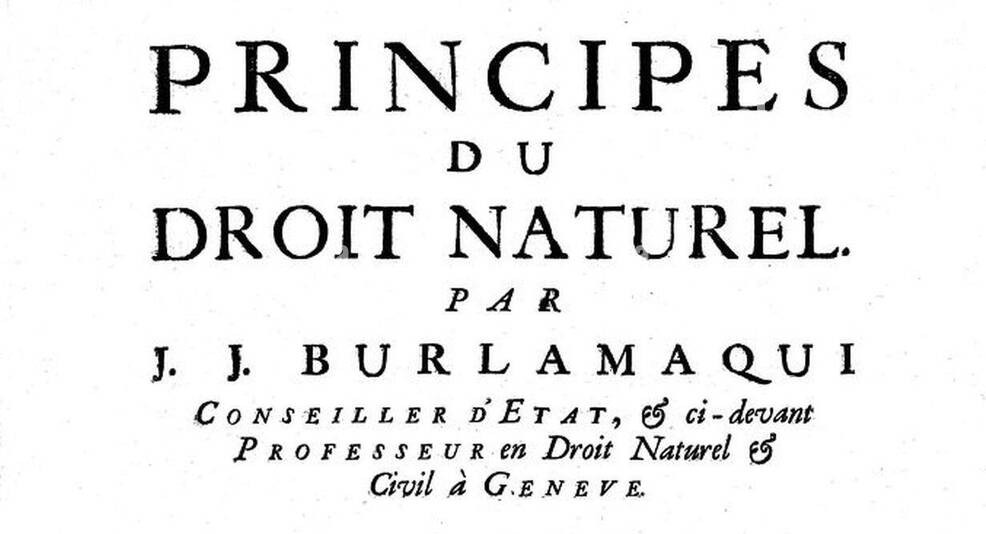
The Principles of Natural Law, J. Burlamaqui, tr. Thomas Nugent (1748, tr. 1752).
The Principles of Politic Law, J. Burlamaqui, tr. Thomas Nugent (1748, tr. Thomas Nugent 1752).
The Spirit of Laws, Charles de Montesquieu, (1748, tr. Thomas Nugent 1752).
An Inquiry into the Principles of Political Economy, James Steuart.
Remarks on the Fable of the Bees, Frances Hutcheson (1750)
A Discourse on the Origin of Inequality, Jean Jacques Rousseau (1754).
A Discourse on Political Economy, Jean Jacques Rousseau (1755).
The Social Contract, Jean Jacques Rousseau (1762).
Elements of Criticism, Lord Kaims [Henry Homes] (1762).
Treaty of Paris (1763). Blackstone’s Commentaries (1765).
“Offenses Against God and Religion,” William Blackstone (1765).
William Pitt’s Speech on the Stamp Act, January 14, 1766
On Crimes and Punishments, Cesare Beccaria (1766). Acts of Parliament concerning the American Colonies, 1763-1774
Three Major Thinkers were Especially Important
Burlamaqui and Montesquieu produced seminal works that were available in English about 20 years before America’s Revolution. And a dozen years later, Blackstone especially shaped the legal thinking of America’s Founders. Below we will provide an analysis of the first of these three men.
Burlamaqui’s The Principles of Natural Law
Jean-Jacques Burlamaqui (1694–1748), a Genevan jurist, wrote within the Reformed Protestant intellectual tradition. He is less known today than others of that time. Though he drew from classical natural law thinkers like Hugo Grotius and Samuel Pufendorf, his framework is explicitly theistic and deeply shaped by Scripture.
Here are key ways the Bible shaped his thought:
A. Natural Law Grounded in God’s Will
Burlamaqui teaches that natural law is the will of God discovered by reason.
He argues that God, as Creator, has sovereign authority over humanity.
Humans are morally bound because they are dependent creatures.
This mirrors biblical passages such as:
Romans 2:14–15 (law written on the heart)
Psalm 24:1 (God’s ownership of the earth)
Unlike secular Enlightenment rationalism, Burlamaqui does not detach morality from divine authority.
B. Human Equality from Creation
He affirms that all men are naturally equal, not by convention but by divine design.
This parallels Genesis 1:26–27 (humans made in God’s image).
Political authority must therefore respect that equality.
No one has inherent dominion over another by nature.
This theological anthropology undergirds later arguments for liberty.
C. Natural Rights as God-Given
Burlamaqui teaches that individuals possess:
A right to self-preservation
A right to liberty
A right to property
These arise from:
God’s intention for human flourishing
Humanity’s moral capacity and responsibility
This reflects:
Exodus 20 (protection of life, property, and reputation)
The biblical concept of stewardship (Genesis 2:15)
D. Government as a Moral Trust
Civil government exists:
To promote public happiness
To preserve natural rights
To act according to justice
Authority is legitimate only if exercised in accordance with natural law (i.e., God’s moral order).
This parallels:
Romans 13:1–4 (rulers are ministers of God)
1 Samuel 8 (warning against tyrannical kingship)
E. Right of Resistance to Tyranny
Burlamaqui allows that when rulers violate fundamental law and the public good:
Political authority may be forfeited.
The people retain ultimate sovereignty.
This idea reflects Reformed resistance theory seen in:
Lex, Rex
Covenantal political theology (e.g., Deuteronomy 17’s limits on kings)
Though more moderate than radical revolutionaries, Burlamaqui clearly affirms conditional government.
How Burlamaqui Influenced the American Revolution
Burlamaqui’s work became extremely influential in colonial America.
A. Widely Used in American Colleges
Future revolutionary leaders were trained in his framework of:
Natural rights
Popular sovereignty
Constitutional government
Moral limits on authority
B. Influence on the Declaration of Independence
Declaration of Independence reflects Burlamaqui’s themes:
The phrase “pursuit of happiness” particularly echoes Burlamaqui’s formulation that the purpose of law is public happiness under God.
C. Influence on American Constitutionalism
Burlamaqui’s ideas helped shape:
The concept of limited government
Written constitutions
The idea that law is superior to rulers
The moral grounding of republican government
These ideas filtered into:
State constitutions (1776–1780)
The U.S. Constitution’s structure of limited powers
Summary
The Bible shaped Burlamaqui by:
Grounding natural law in God’s will
Teaching equality from creation
Defining rights as divinely derived
Limiting government by moral law
Justifying resistance to tyranny
Burlamaqui influenced the American Revolution by:
Educating colonial elites
Shaping the language of natural rights
Supporting the right of resistance
Framing government as consent-based and morally accountable
Jean-Jacques Burlamaqui’s The Principles of Natural Law (1747) is a major Enlightenment synthesis of Protestant natural law theory, drawing deeply from Hugo Grotius, Samuel Pufendorf, John Locke, and the Reformed natural law tradition.
[A curated collection of quotations from Burlamaqui’s work is in the section below provided for paid subscribers. This list of representative quotations is from standard English translations; (wording may vary slightly by edition). Citations are given by Book and Chapter for reference.]
The content below was originally paywalled.
The Principles of Natural Law
By Jean-Jacques Burlamaqui
Jean-Jacques Burlamaqui’s The Principles of Natural Law (1747) is a major Enlightenment synthesis of Protestant natural law theory, drawing deeply from Hugo Grotius, Samuel Pufendorf, John Locke, and the Reformed natural law tradition.
Below is an extensive curated list of representative quotations (using standard English translations; wording may vary slightly by edition). Citations are given by Book and Chapter for reference.
I. On the Nature of Law
“Law is a rule prescribed by the sovereign of a society to his subjects, either in order to lay an obligation upon them, or to permit them to act in a certain manner.”
“The end of law in general is the happiness of mankind.”
“Obligation is a necessity imposed on a free agent, by a superior, to act according to his will.”
“Right is nothing else but the faculty of doing what is permitted by law.”
“The authority of laws depends entirely on the will of the superior who establishes them.”
II. On Natural Law
“Natural law is that rule which so necessarily agrees with the nature and state of man, that without observing it, society cannot subsist.”
“The rules of natural law are so many dictates of right reason.”
“God himself is the author of the law of nature.”
“The law of nature is immutable.”
“The knowledge of the law of nature is engraven in our hearts.”
“Reason is the instrument by which we discover the law of nature.”
“The first principle of natural law is, that we must do good and avoid evil.”
III. On God and Moral Obligation
“Since God is the creator and sovereign Lord of mankind, he has an absolute right to prescribe laws to them.”
“The will of God is the supreme rule of justice.”
“The sanction of the law of nature consists in the rewards and punishments annexed to it by God.”
“Without a superior capable of obliging us, there could be no moral necessity properly so called.”
IV. On Human Nature and Sociability
“Man is naturally a sociable creature.”
“Society is absolutely necessary to the happiness of mankind.”
“The desire of society is founded on the very constitution of our nature.”
“It is impossible to conceive a state in which men could live without some common rules of conduct.”
V. On Liberty
“Liberty is the power of acting as one thinks fit, within the bounds of the law.”
“Natural liberty consists in the right which nature gives to all mankind, of disposing of their persons and property, as they judge most proper for their own advantage.”
“Civil liberty is natural liberty restrained by the authority of the laws.”
VI. On Equality
“All men are by nature equal.”
“This natural equality consists in the equal right which every man has to his liberty and independence.”
“No man has by nature any authority over another.”
VII. On Property
“The right of property is founded on occupancy.”
“The earth and its fruits were originally common to all mankind.”
“It is labour which gives a man a right of property in that which before belonged to all.”
“Property is necessary to the support of society.”
VIII. On Government and Sovereignty
“Civil society is formed by the union of several persons into one body, in order to procure their mutual safety and advantage.”
“The origin of sovereignty is in the consent of the people.”
“Sovereignty is the supreme power of commanding in civil society.”
“The sovereign power is limited by the end for which it was established.”
“When the sovereign acts contrary to the fundamental laws of society, he abuses his authority.”
IX. On the Social Compact
“The establishment of civil society is the result of a covenant.”
“By this pact, each individual submits his will to that of the community.”
“The obligation of subjects arises from the engagement they have contracted.”
X. On Resistance and Tyranny
“When the sovereign power degenerates into tyranny, the fundamental end of society is destroyed.”
“If the prince violates the fundamental laws, he breaks the contract.”
“A manifest abuse of power may authorize resistance.”
(Note: Burlamaqui is more cautious than later revolutionary writers, but he clearly allows limits on sovereignty.)
XI. On Civil Laws
“Civil laws are those which the sovereign establishes for the government of the state.”
“Human laws ought to be conformable to the law of nature.”
“An unjust law is not properly a law.”
XII. On Punishment
“Punishment is an evil inflicted by public authority on him who has done wrong.”
“The end of punishment is not revenge, but the good of society.”
“Punishments ought to be proportioned to the crimes.”
XIII. On Duties Toward Others
“We are obliged to do no injury to another.”
“Every man is bound to render to others what is their due.”
“Benevolence is a duty imposed by natural law.”
XIV. On International Law
“The law of nations is nothing else but the law of nature applied to nations.”
“Nations are moral persons.”
“The society of nations is founded on the same principles as that of individuals.”
XV. On Happiness and Moral Order
“The ultimate end of man is happiness.”
“Virtue is the surest means of attaining happiness.”
“There is an essential connexion between virtue and felicity.”