with special focus on Rev. John Peter Gabriel Muhlenberg of Virginia
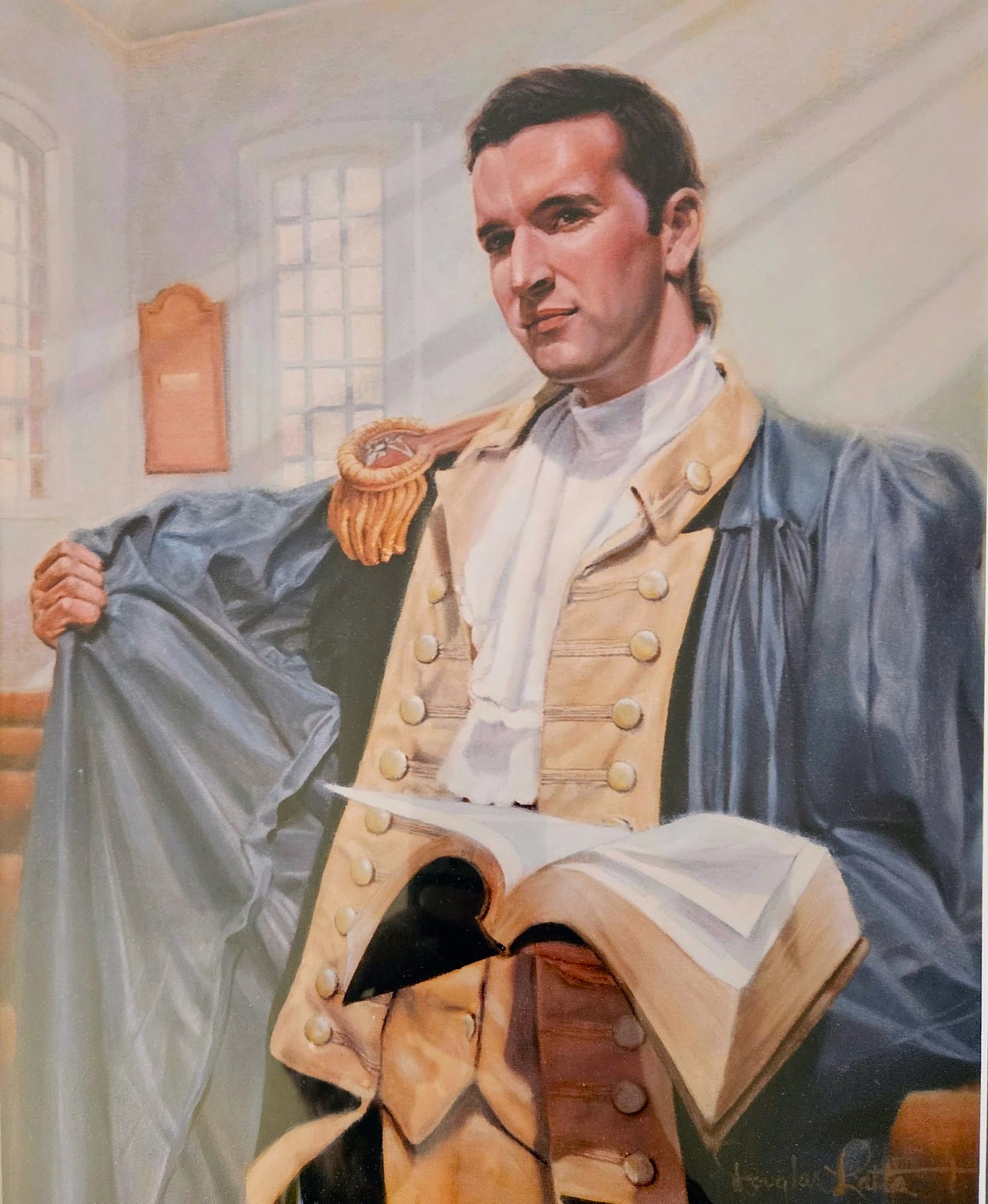
About 250 years ago this week a Lutheran pastor in Virginia shocked his congregation. He closed his sermon and took off his clerical robes to reveal the uniform of an officer in the Continental Army. (Photo above is from painting in personal collection of Mark Beliles)
Rev. Peter Muhlenberg had just finished reading a passage from Ecclesastes 3 about how everything has a season. After the verse saying there is “a time to fight” he declared that it was now the time for them in the congregation to join the fight against British tyranny. About 300 of his men signed up and joined the Continental Army as part of the 8th Virginia Regiment.
In the U. S. Capitol building today stands a statue of this preacher throwing off his robe. The American Revolution was a Christian-led movement. Several books have been published highlighting the role of the clergy at that time. One is The Chaplains and Clergy of the Revolution by J. T. Headley. Another is The New England Clergy and the American Revolution by Alice Baldwin. Also see The Pulpit of the American Revolution by J. W. Thornton. There are others.
The Leadership of Rev. John Peter Gabriel Muhlenberg
In 1776 this pastor was just thirty years old, but he already had been elected from his town of Woodstock, Virginia as a delegate in 1774 to the Virginia House of Burgesses. As conflicts with England emerged he attended the First Virginia Convention and heard Patrick Henry’s famous speech in 1775 about the need to fight. It inspired him to join the military cause and became a Colonel, but was a major-General by the end of the war. He served at Valley Forge, Brandywine, Monmouth, Germantown, Stony Point, and finally in the climatic battle at Yorktown in 1781.
After the war he moved back to Pennsylvania and was elected as a Congressman in 1789 where his brother and fellow pastor Frederick Muhlenberg also served as the first Speaker of the House of Representatives. Their father Henry was the leading figure of the Lutheran Church in America.
While in the first Congress, Peter and his brother Frederick helped pass the first ten amendments to the Constitution that now are known as The Bill of Rights. The First Amendment secured the freedom of religion by prohibiting Congress from any role that would hinder the “free exercise of religion.”
Peter went on to become vice-president of Pennsylvania, a member of it’s constitutional convention, U. S. Senator, and then held a position in the Executive Branch of the Federal government under President Thomas Jefferson (with whom he corresponded frequently for about 30 years).
In early histories of the Revolution, such men were known and their stories taught to new generations of Americans. One of these early works was in 1864 by Rev. J. T. Headley. He talks about the importance of the role of religion in his opening chapter and then specifically has a later chapter on Rev. Peter Muhlenberg.
Below is an excerpt from Headley’s The Chaplains and Clergy of the Revolution.
CHAPTER ONE
NOTWiTHSTANDiNG the numberless books that have been written on the American Revolution, there is one feature of it which has been sadly overlooked. I mean the religious element.
In this respect there is not a single history of that great struggle which is not so radically defective as to render the charge against it of incompleteness a valid one. This omission on the part of historians, seems the more remarkable from the fact that common belief, the universal impression, is against it. There has scarcely been a celebration of the day on which our independence was declared, in which this religious element is not referred to as constituting one of the chief features of the Revolution, yet it receives a subordinate place in history. One reason of this, doubtless, is, that it did not enter into the machinery of political or military life. It was not an organized force that could be numerically calculated or physically disposed of in making outward achievements.
To omit Religion in a history of the Crusades, would be like building a structure without laying a foundation, for that great movement was begun and carried forward by religious feeling alone. The banner that moved at the head of crowdino-millions was the Cross of Christ, and lie tliat bore it a priest, while the great object to bo accomplished was the rescue of the Sepulchre of the Saviour from infidel hands.
So of the English Revolution under Cromwell: no one would dream of writing its history without making religion and religious men a prominent and perpetual force. In short, a history that should ignore them, would be false and worthless. The reason is, that here, too, they formed a part of the physical machinery by which the revolution was carried on. The camp was a prayer-meeting — its passwords Scriptural phrases, and the dread slogan of the army the language of the sanctuary. Freedom and equal rights, was not the war-cry of the Invincible Ironsides ; but when they, with, their helmets on, and their eyes bent in wi-ath on their enemies, swept like a thunder-cloud to battle, the charge-cry that rolled so terribly over the field was “religion.”
In our Revolution the religious element was not paramount, and hence did not give shape and character to the whole physical structure and organization. It kept more within its appropriate sphere, and stood behind and sustained the political and military organizations of the land, rather than formed a part of tkem. But it is not on that account to be overlooked. He who forgets or under-estimates the moral forces that uphold or bear on a great struggle, lacks the chief qualities of a historian….
[The Rest of Headley’s excerpts including his account of Muhlenberg’s speech and service is in the section below for paid subscribers.]
The content below was originally paywalled.
Excerpts from Chapters 1 and 12 of J. T. Headley’s The Chaplains and Clergy of the Revolution
CHAPTER ONE
(continuing from above excerpt)
….It is unquestionably true that, if the clergy of New England had from the outset taken the decided and determined stand against the cause of the colonies, which they did for it, the result would have been totally different. Why then sluuld not they and their sermons, addresses, and prayers, have as prominent a place in the history of the Revolution, as town committees of safety, and local petitions, and resolutions, and remonstrances, which the historian thinks so necessary to the completeness of his narrative ? That omission in our histories I design in these pages as far as possible to fill up.
There is some excuse for the historian in not giving a greater prominence to the religious element of the Revolution, for its development, force, and the efforts it caused to be put forth, did not take the shape of town meetings, and form part of the political and military records of the times. It is impossible, therefore, to collect together the unreported harangues, and sermons, and unorganized efforts that lay at the bottom of its power. I have had this difficulty to contend with an every step.
It is difficult in these days, when chaplains in the army are looked upon simply as a necessary part of its methodical organization, a set of half officers, half civilians who are not allowed to fight, and often can not preach, to get a proper conception of those times when their appeals thrilled the ranks, and made each hand clutch its weapon with a firmer grasp, and when their prayers filled each heart with a lofty enthusiasm. Then the people composed the army ; and when the man of God addressed the crowding battalions, he addressed the young men and old men of his flock, who looked up to him with love and reverence, and believed him almost as they did the Bible. Could the history of each volunteer band, as it left its native valley — the enthusiasm kindled by the pastor’s address, the courage imparted by his solemn parting blessing, and assurance that God smiled on them — be given, it should have a revolutionary page that would thrill the heart.
The religious sentiment was stronger in New England than in the other colonies, from the fact that the original settlers were driven there by religious persecution. Having fled across the ocean to secure religious freedom, it was natural they should consider it to be the chief end and purpose of all government. Hence all rules, regulations, and laws for their government, were, figuratively speaking, first baptized before they were allowed to become a part of the civil system.
Hence, too, in the early wars of the colonies, chaplains became a necessary part of the army. Men who had been in the conventicles of Cromwell’s troops, and heard Baxter preach and pray, would not be apt to forget a chaplain when organizing an expedition. The office at that time was no sinecure, nor unattended with danger, and men of nerve and force, as well as piety, were sought after.
Those who were chaplains during the French and Indian war became at its close pastors of churches, and although most of those who were alive at the breaking out of the Revolution were too old to become chaplains once more, they still held to their former belief in the right of resistance, and taught it in their congregations. The same was true of the entire clergy throughout the New England Colonies, and though some were not so positive and aggressive in their action as others, yet they were equally decided, and exerted though a quiet, a deep influence on the Revolution.
They were humhle pastors, from whose flocks were drawn the numberless little companies of minute-men, who formed the first army against which the tides of British valor rolled in vain on the heights of Bunker Hill. In every quiet little ralley and sequestered nook in New England, the pastor had taught the doctrines of freedom, and preached the duty of resistance to oppression.
The farmers and mechanics listened with reverence and confidence to these teachings, and showed their faith by their works when the hour of trial came. At the battle-cry, that rolled over the land from Lexington and Concord, they shouldered their muskets, and went forth with the blessing of their pastor on their heads and his fervent prayers for their success following their footsteps. If the scenes that transpired in the countless villages and hamlets of New England, when the news of the first blood, shed by British troops, swept over the colonies, and the first uprising of the people took place, could be described, just as they occurred, in all the beauty, pathos, patriotism, and religion that characterized them, the Revolutionary struggle would possess an interest that all its thrilling battles and perilous marches, deeply as they enlist our sympathies, can never impart. The description of a single one, that took place in one of the remotest towns of Massachusetts — Old Stockbridge — must answer as an illustration of what transpired every where throughout the country.
For a long time matters had been drawing to a crisis ; the colonists refused to yield their sacred rights, and the mother country steadily increased the pressure of her power to force obedience, till she could go no farther unless she resorted to military force. Hence the whole country was in a state of the most painful suspense and expectation. But firmly resolved to meet open force with force, they had arranged relays of horses and couriers along the highways and byeways of New England, to speed the news of the first shedding of American blood. To be ready for these fearful tidings, minute-men had been enrolled in every town, prepared to march on a moment’s notice.
In Stockbridge, Berkshire County, Mass., Deacon Cleveland and another leading member of the church had been selected, for their positions in the centre of the valley and of the village, to spread the note of alarm. The son of the Deacon, a young man only seventeen years of age at the time, gave to a friend of the “writer a description of the reception of the news in that little village.
One quiet Sabbath morning, when all was still, as it ever was in that peaceful valley on that holy day, he was suddenly startled by the report of a musket. On going out to ascertain what it meant, he saw his father in the back yard with the discharged piece in his hand. Before he had time to express his wonder, another report broke the stillness of the Sabbath morning, and as the smoke curled up in the damp atmosphere, he saw in the neighboring yard one of the chief pillars of the church, standing with his musket in his hand. He paused astounded, not knowing what awful phenomenon this strange event portended. He said that he thought the judgment day had come. But in a few moments he noticed men hurrying along the hitherto deserted street, with weapons in their hands. One by one they entered his father’s gate, and gathered on the low stoop. The flashing eye and flushed cheek told that something eventful had transpired— and there had.
When the report of those two muskets echoed along the sweet valley of the Housatonic and up the adjacent slopes, the sturdy farmers knew what it meant. The father, just preparing for the duties of the sanctuary, heard it, and, flinging aside his Sabbath garments, hastily resumed his work-day dress, and taking down his musket strained his wife and children in one long farewell embrace to his bosom, then turned from the home he might never see again. The young man buckled on his knapsack, and amid sobs and tears shut the little farm gate behind him, the fire in his eye drying up the tears as fast as they welled to the surface. Although the heart heaved with emotion, the step was firm and the brow knit and resolute.
In a short time the little porch was crowded with men. A moment after, Dr. West, the pastor, was seen slowly descending the hill toward the same place of rendezvous. It was a cold, drizzly morning, and as, with his umbrella over his head, and the Bible under his arm, he entered the dooryard, his benevolent face revealed the emotion that was struggling within. He, too, knew the meaning of those shots ; they were the signals agreed upon to inform the minute-men of Stockbridge that their brethren in the East had closed with the foe in battle. He ascended the stepS, and, opening the Bible, read a few appropriate passages, and then sent up a fervent prayer to Heaven. When he ceased, the rattling of arms was heard. A short and solemn blessing closed the impressive scene, and before twelve o’clock twenty men, with knapsacks on their backs and muskets on their shoulders, had started on foot for Boston, nearly two hundred miles distant.
Oh, how deep down in the consciences of men had the principles of that struggle sunk, when they made those Puritans forget the solemn duties of the sanctuary for the higher duties of the battle-field. They had been taught from the pulpit that it was the cause of God, and they took it up in the full belief they had His blessing and His promise. Such scenes as these were enacted everywhere, and from the consecrating hand of the man of God went forth the thousand separate bands that soon after m-et and stood shoulder to shoulder on the smoking heights of Bunker Hill.
….
CHAPTER TWELVE
PETER GABRIEL MUHLENBURG.
There -was a class of clergymen in the Revolution who regarded the struggle so sacred that they felt it to be their duty to fight sometimes as well as pray. They did not, however, consider it necessary to abandon their profession to do so. That duty depended on the emergency of the case. In a perilous crisis, when one idle arm might turn the scale against the patriots, they had no hesitation in stepping into the ranks, and fighting like a common soldier. They saw nothing incongruous in this course, and hence seldom condescended to make an apology for it. Nor did it interfere with their professional duties — for, when the smoke of battle had cleared away, they were found praying with the wounded who had been struck by their side, or offering thanksgivings in front of the battalions for a victory won.
The subject of the following sketch, however, abandonecl entirely his profession, and became a distinguished military man.
John Peter Gabriel Muhlenburg was born in the village of Trapp, Montgomery Co., Pa., on the first of October, 1746. Educated partly in this country and partly in Europe, he received ordination in 1768, and commenced his labors in Western New Jersey. In 1772 he went to London to receive ordination from an English bishop, that he might take charge of a church in Virginia, to which he had been called. Returning to America, he settled at Woodstock, and entered on the duties of a country pastor.
His ministerial profession, however, did not prevent him from feeling a deep interest in the quarrel between the Colonies and the mother country — on the contrary, he took the lead in every measure of hostility to her oppressive acts.
In 1774, when the people of his county assembled to choose a committee of safety, he was unanimously elected its chairman. He was the head and soul of the opposition in that whole region, and so much did he possess the confidence of the people that they sent him to the House of Burgesses of the state. Ardent, fearless and patriotic he became so absorbed in the approaching struggle, that, when the news of the battle of Bunker Hill reached him, he resolved at once to throw up his profession, and enter the army. Having talked and preached for freedom, he determined now to strike for it. He immediately commenced to organize a Virginia regiment, and laying aside his ministerial character, became its colonel.
He took leave of his people in a farewell sermon, wliich glowed throughout with the most devoted patriotism. At the close he told them of the resolution he had taken to fight, and if need be, die for his country on the battle-field. It was a strange announcement from the pulpit, but there were few to criticize his abandonment of his profession, for he had breathed his own fervid spirit into his congregation, and the kindling eye and speaking countenance told him that his course had their hearty approval. Said he, in conclusion, “The Bible tells us ‘there is a time for all things,’ and there is a time to preach, and a time to pray, but the time for me to preach has passed away;” then, raising his voice, till it rung like the blast of a trumpet through the church, he exclaimed, “and there is a time to fight, and that time has now come.”
Closing the services he stepped into the vestry-room, and laying aside his gown, put on his colonel’s uniform, and stood before his astonished congregation in full regimentals. This sudden apparition of a Virginia colonel, in full uniform, walking down the broad aisle, in the place of their pastor, took every one by surprise. Turning neither to the right hand nor to the left, he strode sternly on to the door, and ordered the drum to beat for recruits.
The silence that had reigned, while this extraordinary scene was passing, was suddenly broken by the loud and rapid roll of the drum. The congregation rose simultaneously to their feet, and the men gathered in a mass around their former pastor — scarcely one capable of bearing arms remaining behind. The calm quiet of the Sabbath, day -was now changed into a scene of bustle and excitement. The drum was kept beating, and those who were not in the church came rushing towards it, to learn what strange event had happened. The sight of the pastor in uniform, standing at the door and calling for recruits, kindled the most unbounded enthusiasm, and before night nearly three hundred men had joined his standard. He immediately marched south, and was present with his regiment at the battle of Charleston.
The next year he was promoted by Congress to the rank of brigadier-general, and ordered to take charge of all the Continental ‘troops in Virginia. The next May he joined Washington at Middebrook, New Jersey, and marched with his brigade to the desolate encampment of Valley Forge. Among the devoted leaders who closed with unflinching resolution and courage around their great chieftain, during the trials of this terrible winter, none took a firmer and nobler’ stand than Muhlenburg, At the battle of Brandy-
wine his brigade formed a part of the division of Greene, which at the close of that disastrous day was ordered up from the rear, where he had been stationed, to cover the retreat. For three quarters of an hour these noble troops withstood the onset of the entire British army, and then steadily and in good order withdrew. At Germantown he was in the thickest of the fight, and at Monmouth, on that scorching Sabbath day, led his troops over the burning sands as steadily as if on parade. Known for his coolness, courage, and determined resolution, he was selected by Wayne to command the reserve at the assault on Stony Point. He was afterwards stationed in Virginia, and aided in the operations that finally shut up Cornwallis in Yorktown. His brigade was actively employed during the siege of that place. On one occasion he led a storming party against a redoubt, and with such desperate and deadly resolution did he carry it through the fire, that not a man returned unwounded.
At the close of the war -he was elevated to the rank of major-general. Removing to Pennsylvania, he was made chairman of the executive council of the State, and afterwards was sent to Congress, In 1801 he was elected United States Senator, and in the same year received the appointment of supervisor of the internal revenue of Pennsylvania. The next year he was made collector of the port of Philadelphia, which office he held till his death, in October 1807. He was buried close by the village church where he was baptized, and the following true epitaph placed above his grave: “He was brave in the field, faithful in the cabinet, honorable in all his transactions, a sincere friend, and an honest man.”
It is but just to the memory of this unflinching patriot to let him be heard in his own defence for his course in abandoning the pulpit for the army. In a letter to his brother Frederick, a clergyman also, who had written to another brother condemning his (Peter’s) course for laying aside the ministerial profession for that of arms, he says:
“Thus far I had written when I received brother Henry’s letter from you to him, wherein you make observations on my conduct in the present alarming crisis. You say, as a clergyman nothing can excuse my conduct. I am a clergyman, it is true, but I am a member of society as well as the poorest layman, and my liberty is as dear to me as to any man. Shall I then sit still, and enjoy myself at home, when the best blood of the continent is spilling? Heaven forbid it! You make a comparison with Struensee. The comparison is odious. Did he die in defence of his country ? Far from it. He suffered for crimes, and his life was justly forfeited to the law. But even if you was on the opposite side of the question, you must allow that in this last step I have acted for the best. You know that from the beginning of these troubles I have been compelled to have a hand in public affairs. I have been chairman to the committee of delegates from this county from the first. Do you think, if America should he conquered, I should he safe? Far from it. And would you not sooner fight like a man than die like a dog ? I am called by my country to its defence. The cause is just and noble. Were I a bishop, even a Lutheran one, I should obey without hesitation, and so far am I from thinking that I am wrong, I am convinced it is my duty so to do, a duty I owe to my God and to my country.”
This same Frederick, notwithstanding his condemnation of his brother, two or three years later, under the pressure of the Revolution, left the church for the state, and entered Congress under the Federal Constitution.