Shaping the faith and worldview of a generation of Founding Fathers
[Our primary focus in the coming months is on the influences and events that led to and shaped the birth of the United States as an independent nation in 1776. In previous blogs we listed some colonial sermons from the 1730s to 1750s that shaped the thinking of the Founders. We continue today with more from that period.]
In the 1730s the colonies continued to develop ways, thinking and policies that are important to know before focusing on the era of the American Revolution. Freedom of speech and the press was solidified with the trial of Peter Zenger in 1735. The first hospital in America was started by the Quakers in Philadelphia around 1740. The number of blacks in the South began to significantly increase. By the start of the Revolution in 1775 they grew 3-fold to almost 410,000 (about 40% of entire population in the South). Conflicts with Britain emerged on matters of self-governance, but we will address them more later.
New Immigrants and Religion
Religious developments is our focus in today’s blog. First, a review of previous periods of immigration. The first period was in Massachusetts and New England being mostly shaped by the Exodus of English Puritans between 1629-1641. The second period was in Virginia and to some degree the Carolinas and Georgia begin shaped mostly by the “Distressed” Cavaliers and Indentured Servants between 1642 and 1675. Third was in Eastern Pennsylvania, Delaware and western New Jersey being mostly shaped by the Quaker and German Pietist migration between 1675 and 1725. Lutherans also emerged with Henry Muhlenberg as the founder in 1742.
But the fourth migration period began around 1717 and lasted to the eve of the Revolution and was mostly shaped by immigrants from north Britain (Scotland, northern Ireland, northern counties of England). These settled mostly in the backcountry of Pennsylvania, Maryland, Virginia and North Carolina and eventually had a significant religious impact. They tended to be Presbyterians and Anglicans but what was unique from previous settlers is that both were inclined toward “new light” Christianity.
These new settlers were accustomed back in Britain to gather at times in field meetings and prayer societies, and they shared a hostility toward the established church and a belief in “free grace.” In America this led to interdenominational tendencies, open-air camp meetings and more emotional displays. It was the main characteristic of what became known as the Great Awakening.
The First Great Awakening in America
The Great Awakening began in early 1730s. It found expression among every major religious group: Congregationalists, Baptists, Presbyterians and Anglicans/Methodists. We listed some of the sermons of this period that shaped America in a previous post and noted the famous Congregationalist pastor Jonathan Edwards.
Harry Stout in his book The New England Soul describes how awakening began in New England: “Increasingly ministers called upon each other to concentrate on laying a foundation of personal faith and spirituality through a return to the simple gospel message of the ‘New Birth.’” Where previously their sermons were more focused on the head than the heart, it was apparent that now polished, literary discourses were less desired than more emotional styles found in the spreading frontier congregations.
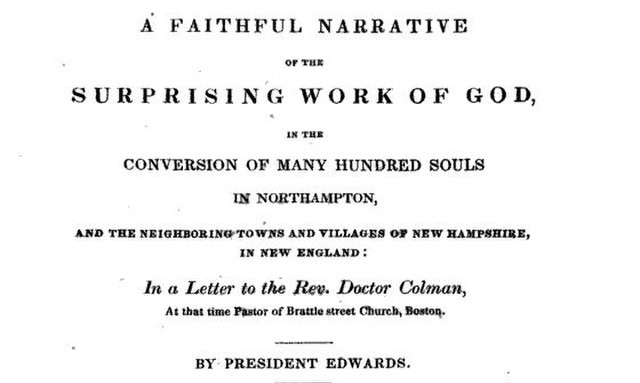
1734 brought the first rumblings of revival in Northampton, Massachusetts where Jonathan Edwards’ sermons brought in over 300 new converts. In 1738 the visiting itinerant Anglican evangelist George Whitefield impacted the middle and southern colonies, but brought major awakening again to New England in 1740 and 1741 with his constant emphasis on ‘New Birth’. New converts flocked into the churches, especially the youth. The Journal of David Brainard in 1745 expressed the passion of that generation.
Gilbert Tennent continued the itinerant work in Pennsylvania with harvests at least equal to Whitefield’s and many new graduates of Harvard and Yale began itinerating as well. Tennent’s sermon on The Danger of an Unconverted Ministry sparked huge backlash led by Charles Chauncey and faculties of Harvard and Yale (see Harvard pamphlet in 1744) and many traditional clergy who felt threatened. Chauncey emphasized “reason” while Jonathan Edwards defended the revival in his 1746 book: Treatise on the Religious Affections. The major shift in New England was the rise of the common person to take responsibility for their own soul and for the health of their congregations. Stout wrote that the laity “…discovered the power they possessed when united against authority.” In this case it was their pastors, but later it would be focused on the civil government.
Both camps were needed. The two styles of “rational” and “evangelical” ministry grew to respect each other. The Anglican and ‘Arminian’ Congregational clergy such as Chauncey, who emphasized morality and natural theology, employed their pens and Election day and artillery sermons (especially during the war against the French and Indians) most effectively to lay the foundation for later resistance to British tyranny and the cause of civil liberty. A sermon in 1747, Civil Magistrates Must be Just, Ruling in the Fear of God, by Charles Chauncy is a great example. It included other clergy such as Jonathan Mayhew (his sermon on the principle of limited submission to authority is in the section for paid subscribers.)
Continuing Awakening from 1750 to the Revolution
But while the evangelical awakening waned after 1745 among the Congregationalists of New England, it continued among dissenter congregations; Separate Baptists, Presbyterians. And even if perhaps fervor cooled in urban areas, it spread slowly into the frontier communities and in isolated regions. Sometimes historians say the revival was over by about 1750, but in fact the Presbyterians were impacted in rural areas as late as 1760. And the Baptists, Anglicans and Methodists in the south and backcountry regions did not even start being impacted by the Awakening until the 1760s. (Baptists enjoyed it up 1777, Anglicans and Methodists up 1783. And in Virginia there was a culminating multi-denominational phase between 1784 to 1789.)
One of its leaders in Virginia was Presbyterian Samuel Davies whose sermons in the 1750s were featured in a previous blog. Also important was the founding of new universities by the leaders of the Awakening, among them Princeton in 1746 (It’s first president was Presbyterian Rev. Jonathan Dickinson). The Founding Father generation began to attend these new universities and shaped their spiritual life and worldview for the eventual era of independence. Another development was new outlets for spreading news and mass communication. All of this helped build unity among the 13 separate colonies that led to the emergence on one nation.
Sermons Shaping the Colonial Mind
In an earlier post we listed some sermons of the period. Revival brought not just passion and fervor but principles of freedom. One example was a sermon by Rev. Elisha Williams of Boston who previously helped turn Yale College away from Enlightenment to more Biblical foundations. But his 1744 sermon called The Essential Rights and Liberties of Protestants was a great expression of the colonial mind. We give some excerpts below.
1744, The Essential Rights and Liberties of Protestants
1. Scripture as the Sole Rule of Faith
Williams emphasizes that every Protestant must recognize the Bible alone as the guide for belief and practice. He argues that civil authorities should never legislate religious doctrine:
“That the sacred scriptures are the alone rule of faith and practice to a Christian … and must therefore inviolably maintain, that every Christian has a right of judging for himself what he is to believe and practice in religion according to that rule.”
He warns that civil interference in spiritual matters undermines true Christian liberty and charity:
“If our Purses be Caesar’s, our Consciences are GOD’S:—and if Caesar’s Commands interfere with GOD’S, we must obey GOD rather than Men.”
2. Right of Private Judgment and Liberty of Conscience
He asserts that individuals inherently own the right to interpret Scripture and follow their conscience:
“Every man has an equal right to follow the dictates of his own conscience in the affairs of religion … he has an unalienable right to judge of the sense and meaning [of scripture], and to follow his judgment wherever it leads him; even an equal right with any rulers be they civil or ecclesiastical.”
Williams upholds this freedom even if it conflicts with popular or legal expectation:
“Should a government … make it penal to examine and search [the scriptures]; it would be a manifest usurpation upon the common rights of mankind … men would be bound by a higher authority to read them, notwithstanding any humane prohibition.”
3. Limits of Civil Authority in Religion
Drawing on Lockean principles, Williams draws a clear boundary:
“The civil authority hath no power to make or ordain articles of faith, creeds, forms of worship or church government.”
He strongly rejects any government enforcement of religious uniformity:
“The civil authority have no power to establish any religion … much less … with penalties whatsoever.”
He insists government’s rightful role is to uphold religious freedom:
“Civil authority should protect all their subjects in the enjoyment of this right of private judgment … and the liberty of worshipping GOD according to their consciences.”
4. Natural Rights & the Right to Property
Williams connects the right to religious liberty with basic human rights rooted in nature and labor:
“Reason teaches us that all Men are naturally equal … every man having a property in his own person, the labor of his body and the work of his hands are properly his own … And if every man has the right to his Person and Property; he has also a Right to defend them … and so has a Right of punishing all Insults upon his Person and Property.”
He draws analogies between defending property and defending conscience:
“A man can no more part with [private judgment] than he can his power of thinking … to attempt to strip himself of the power of reasoning … is equally reasonable as to vest another with this right.”
5. Vigilance, Charity, and the Preciousness of Religious Liberty
Williams reminds Protestants that safeguarding freedom of conscience is an ongoing duty:
“Religious liberty was so precious a jewel that it is always to be watched with a careful eye: for no people are likely to enjoy liberty long, that are not zealous to preserve it.”
He emphasizes that recognizing one’s own rights fosters compassion toward others of different beliefs:
“The more firmly this is established in our minds; the more firm shall we be against all attempts upon our Christian liberty, and better practice that Christian charity towards such as are of different sentiments from us.”
The Great Awakening shaped a generation of leaders throughout the American colonies that shared an evangelical fervor, sincere godly character and involvement in their church communities, and a common worldview about liberty, law and governance. Williams’ sermon is an exhibit of a synthesis of evangelical theology and Locke’s worldview. And another New England minister, Jonathan Mayhew, six years later articulated the principles of resistance to tyranny. It was not focused on resisting Britain but provided the theological basis for the Revolution about fifteen years later. [Rev. Jonathan Mayhew’s sermon excerpts are below in the paid subscriber section.]
The content below was originally paywalled.
A Discourse Concerning Unlimited Submission and Non-Resistance to the Higher Powers
1750 by Rev. Jonathan Mayhew
Romans 13:1-7. Let every soul be subject unto the higher powers. For there is no power but of God: the powers that be are ordained of God. 2 Whosoever therefore resisteth the power, resisteth the ordinance of God: and they that resist shall receive to themselves damnation. 3 For rulers are not a terror to good works, but to the evil. Wilt thou then not be afraid of the power? Do that which is good, and thou shalt have praise of the same: 4 for he is the minister of God to thee for good. But if thou do that which is evil, be afraid; for he beareth not the sword in vain: for he is the minister of God, a revenger to execute wrath upon him that doeth evil. 5 Wherefore ye must needs be subject, not only for wrath, but also for conscience sake. 6 For this cause pay ye tribute also: for they are God’s ministers, attending continually upon this very thing. 7 Render therefore to all their dues: tribute to whom tribute is due; custom to whom custom; fear to whom fear; honor to whom honor.
…Let us now trace the apostle’s reasoning in favor of submission to the higher powers, a little more particularly and exactly. For by this it will appear, on one hand, how good and conclusive it is, for submission to those rulers who exercise their power in a proper manner: And, on the other, how weak and trifling and unconnected it is, if it be supposed to be meant by the apostle to show the obligation and duty of obedience to tyrannical, oppressive rulers, in common with others of a different character.
The apostle enters upon his subject thus—“Let every soul be subject unto the higher powers; for there is no power but of God: the powers that be, are ordained of God.” Here he urges the duty of obedience from this topic of argument, that civil rulers, as they are supposed to fulfill the pleasure of God, are the ordinance of God. But how is this an argument for obedience to such rulers as do not perform the pleasure of God, by doing good; but the pleasure of the devil, by doing evil ; and such as are not, therefore, God’s ministers, but the devil’s! “Whosoever, therefore, resisteth the power, resisteth the ordinance of God; and they that resist, shall receive to themselves damnation.”
Here the apostle argues, that those who resist a reasonable and just authority, which is agreeable to the will of God, do really resist the will of God himself; and will, therefore, be punished by him. But how does this prove, that those who resist a lawless, unreasonable power, which is contrary to the will of God, do therein resist the will and ordinance of God? Is resisting those who resist God’s will, the same thing with resisting God? Or shall those who do so, receive to themselves damnation! “For rulers are not a terror to good works, but to the evil. Wilt thou then not be afraid of the power? Do that which is good; and thou shalt have praise of the same. For he is the minister of God to thee for good.” Here the apostle argues more explicitly than he had before done, for revering, and submitting to magistracy, from this consideration, that such as really perform the duty of magistrates, would be enemies only to the evil actions of men, and would befriend and encourage the good; and so be a common blessing to society.
But how is this an argument, that we must honor, and submit to such magistrates as are not enemies to the evil actions of men, but to the good; and such as are not a common blessing, but a common curse, to society! “But if thou do that which is evil, be afraid: For he is the minister of God, a revenger, to execute wrath upon him that doth evil.” Here the apostle argues from the nature and end of magistracy, that such as did evil, (and such only) had reason to be afraid of the higher powers; it being part of their office to punish evil doers, no less than to defend and encourage such as do well. But if magistrates are unrighteous; if they are respecters of persons; if they are partial in their administration of justice; then those who do well, have as much reason to be afraid, as those that do evil: there can be no safety for the good, nor any peculiar ground of terror to the unruly and injurious. So that in this case, the main end of civil government will be frustrated. And what reason is there for submitting to that government, which does by no means answer the design of government? “Wherefore ye must needs lie subject not only for wrath, but also for conscience sake.” Here the apostle argues the duty of a cheerful and conscientious submission to civil government, from the nature and end of magistracy as he had before laid it down, i.e. as the design of it was to punish evil doers, and to support and encourage such as do well; and as it must, if so exercised, be agreeable to the will of God. But how does what he here says, prove the duty of a cheerful and conscientious subjection to those who forfeit, the character of rulers? To those who encourage the bad, and discourage the good?
The argument here used no more proves it to be a sin to resist such rulers, than it does, to resist the devil that he may flee from us. For one is as truly the minister of God as the other. “For, for this cause pay you tribute also; for they are God’s ministers, attending continually upon this very thing.” Here the apostle argues the duty of paying taxes, from this consideration that those who perform the duty of rulers, are continually attending upon the public welfare. But how does this argument conclude for paying taxes to such princes as are continually endeavoring to ruin the public? And especially when such payment would facilitate and promote this wicked design! “Render therefore to all their dues; tribute, to whom tribute is due; custom, to whom custom; fear, to whom fear; honor, to whom honor.” Here the apostle sums up what he had been saying concerning the duty of subjects to rulers. And his argument stands thus—”Since magistrates who execute their office well, are common benefactors to society, and may, in that respect, be properly styled the ministers and ordinance of God; and since they are constantly employed in the service of the public, it becomes you to pay them tribute and custom; and to reverence, honor, and submit to them in the execution of their respective offices.” This is apparently good reasoning. But does this argument conclude for the duty of paying tribute, custom, reverence, honor and obedience to such persons as (although they bear the title of rulers) use all their power to hurt and injure the public? Such as are not God’s ministers, but Satan’s? Such as do not take care of, and attend upon the public interest, but their own, to the ruin of the public? that is, in short, to such as have no natural and just claim at all to tribute, custom, reverence, honor and obedience? It is to be hoped that those who have any regard to the apostle’s character as an inspired writer, or even as a man of common understanding, will not present him as reasoning in such a loose incoherent manner; and drawing conclusions which have not the least relation to his premises. For what can be more absurd than an argument thus framed? “Rulers are, by their office, bound to consult the public welfare and the good of society: therefore you are bound to pay them tribute, to honor, and submit to them, even when they destroy the public welfare, and are a common pest to society, by acting in direct contradiction to the nature and end of their office.”
Thus, upon a careful review of the apostle’s reasoning in this passage, it appears that his arguments to enforce submission, are of such a nature, as to conclude only in favor of submission to such rulers as he himself describes; i.e. such as rule for the good of society, which is the only end of their institution. Common tyrants, and public oppressors, are not entitled to obedience from their subjects, by virtue of anything here laid down by the inspired apostle.
I now add farther, that the apostle’s argument is so far from proving it to be the duty of people to obey, and submit to such rulers as act in contradiction to the public good, and so to the design of their office, that it proves the direct contrary. For, please to observe—that if the end of all civil government, be the good of society; if this be the thing that is aimed at in constituting civil rulers; and if the motive and argument for submission to government, be taken from the apparent usefulness of civil authority, it follows, that when no such good end can be answered by submission, there remains no argument or motive to enforce it; if instead of this good end’s being brought about by submission, a contrary end is brought about, and the ruin and misery of society effected by it; here is a plain and positive reason against submission in all such cases, should they ever happen. And therefore, in such cases, a regard to the public welfare, ought to make us withhold from our rulers that obedience and subjection which it would, otherwise, be our duty to render to them.
If it be our duty, for example, to obey our king, merely for this reason, that he rules for the public welfare, (which is the only argument the apostle makes use of) it follows, by a parity of reason, that when he turns tyrant, and makes his subjects his prey to devour and to destroy, instead of his charge to defend and cherish, we are bound to throw off our allegiance to him, and to resist; and that according to the tenor of the apostle’s argument in this passage. Not to discontinue our allegiance, in this case, would be to join with the sovereign in promoting the slavery and misery of that society, the welfare of which, we ourselves, as well as our sovereign, are indispensably obliged to secure and promote, as far as in us lies. It is true the apostle puts no case of such a tyrannical prince; but by his grounding his argument for submission wholly upon the good of civil society; it is plain he implicitly authorizes, and even requires us to make resistance, whenever this shall be necessary to the public safety and happiness. Let me make use of this easy and familiar similitude to illustrate the point in hand—Suppose God requires a family of children, to obey their father and not to resist him; and enforces his command with this argument; that the superintendence and care and authority of a just and kind parent, will contribute to the happiness of the whole family; so that they ought to obey him for their own sakes more than for his: Suppose this parent at length runs distracted, and attempts, in his mad fit, to cut all his children’s throats: Now, in this case, is not the reason before assigned, why these children should obey their parent while he continued of a sound mind, namely, their common good, a reason equally conclusive for disobeying and resisting him, since he is become delirious, and attempts their ruin? It makes no alteration in argument, whether this parent, properly speaking, loses his reason, or does while he retains his understanding, that which is as fatal in its consequences, as any thing he could do, were he really deprived of it. This similitude needs no formal application.
But it ought to be remembered, that if the duty of universal obedience and non-resistance to our king or prince, can be argued from this passage, the same unlimited submission under a republican, or any other form of government; and even to all the subordinate powers in any particular state, can be proved by it as well: which is more than those who allege it for the mentioned purpose, would be willing should be inferred from it. So that this passage does not answer their purpose; but really overthrows and confutes it. This matter deserves to be more particularly considered.—The advocates for unlimited submission and passive obedience, do, if I mistake not, always speak with reference to kingly or monarchical government, as distinguished from all other forms; and, with reference to submitting to the will of the king, in distinction from all subordinate officers, acting beyond their commission, and the authority which they have received from the crown. It is not pretended that any person besides kings, have a divine right to do what they please, so that no one may resist them, without incurring the guilt of factiousness and rebellion. If any other supreme powers oppress the people, it is generally allowed, that the people may get redress, by resistance, if other methods prove ineffectual. And if any officers in a kingly government, go beyond the limits of that power which they have derived from the crown, (the supposed original source of all power and authority in the state) and attempt, illegally, to take away the properties and lives of their fellow subjects, they may be forcibly resisted, at least till application can be made to the crown. But as to the sovereign himself, he may not be resisted in any case; nor has any of his officers, while they confine themselves within the bounds which he prescribed to them. This is, I think, a true sketch of the principles of those who defend the doctrine of passive obedience and non-resistance.
Now there is nothing in scripture which supports this scheme of political principles. As to the passage under consideration, the apostle here speaks of civil rulers in general: of all persons in common, vested with authority for the good of society, without any particular reference to one form of government, more than to another; or to the supreme power in any particular state, more than to subordinate powers. The apostle does not concern himself with the different forms of government. This he supposes left entirely to human prudence and discretion. Now the consequence of this is, that unlimited and passive obedience is no more enjoined in this passage, under monarchical government; or to the supreme power in any state, than under all other species of government, which answer the end of government; or, to all the subordinate degrees of civil authority, from the highest to the lowest. Those, therefore, who would from this passage infer the guilt of resisting kings, in all cases whatever, though acting ever so contrary to the design of their office, must, if they will be consistent, go much farther, and infer from it the guilt of resistance under all other forms of government; and of resisting any petty officer in the state though acting beyond his commission, in the most arbitrary, illegal manner possible. The argument holds equally strong in both cases.
All civil rulers, as such, are the ordinance and ministers of God; and they are all, by the nature of their office, and in their respective spheres and stations, bound to consult the public welfare. With the same reason therefore, that any deny unlimited and passive obedience to be here enjoined under a republic or aristocracy, or any other established form of civil government; or to subordinate powers, acting in an illegal and oppressive manner; (with the same reason) others may deny, that such obedience is enjoined to a king or monarch, or any civil power whatever. For the apostle says nothing that is peculiar to kings; what he says, extends equally to all other persons whatever, and vested with any civil office. They are all, in exactly the same sense, the ordinance of God; and the ministers of God; and obedience is equally enjoined to be paid to them all. For, as the apostle expresses it, “there is NO POWER but of God: And we are required to render to ALL their DUES; and not MORE than their DUES.” And what these dues are, and to whom they are to be rendered, the apostle sayeth not; but leaves to the reason and con- sciences of men to determine.
Thus it appears, that the common argument, grounded upon this passage, in favor of universal and passive obedience, really overthrows itself, by proving too much, if it proves any thing at all; namely, that no civil officer is, in any case whatever, to be resisted, though acting in express contradiction to the design of his office; which no man, in his senses, ever did, or can assert.
If we calmly consider the nature of the thing itself, nothing can well be imagined more directly contrary to common sense, than to suppose that millions of people should be subjected to the arbitrary, precarious pleasure of one single man; (who has naturally no superiority over them in point of authority) so that their estates, and every thing that is valuable in life, and even their lives also, shall be absolutely at his disposal, if he happens to be wanton and capricious enough to demand them. What unprejudiced man can think, that God made ALL to be thus subservient to the lawless pleasure and frenzy of ONE, so that it shall always be a sin to resist him! Nothing but the most plain and express revelation from heaven could make a sober, impartial man believe such a monstrous, unaccountable doctrine, and, indeed, the thing itself, appears so shocking, so out of all proportion, that it may be questioned, whether all the miracles that ever were wrought, could make it credible, that this doctrine really came from God.
At present, there is not the least syllable in scripture which gives any countenance to it. The hereditary, indefeasible, divine right of kings, and the doctrine of non-resistance, which is built upon the supposition of such a right, are altogether as fabulous and chimerical, as transubstantiation; or any of the most absurd reveries of ancient or modern visionaries. These notions are fetched neither from divine revelation, nor human reason; and if they are derived from neither of those sources, it is not much matter from whence they come, or whither they go. Only it is a pity that such doctrines should be propagated in society, to raise factions and rebellions, as we see they have, in fact, been both in the last, and in the present REIGN.
But then, if unlimited submission and passive obedience to the higher powers, in all possible cases, be not a duty, it will be asked, “how far are we obliged to submit? If we may innocently disobey and resist in some cases, why not in all? Where shall we stop? What is the measure of our duty? This doctrine tends to the total dissolution of civil government; and to introduce such scenes of wild anarchy and confusion, as are more fatal to society than the worst of tyranny.”
After this manner, some men object; and, indeed, this is the most plausible thing that can be said in favor of such an absolute submission as they plead for. But the worst (or rather the best) of it, is, that there is very little strength or solidity in it. For similar difficulties may be raised with respect to almost every duty of natural and revealed religion.—To instance only in two, both of which are near akin, and indeed exactly parallel, to the case before us. It is unquestionably the duty of children to submit to their parents; and of servants, to their masters. But no one asserts, that it is their duty to obey, and submit to them, in all supposable cases; or universally, a sin to resist them. Now does this tend to subvert the just authority of parents and masters? Or to introduce confusion and anarchy into private families? No. How then does the same principle tend to unhinge the government of that larger family, the body politic? We know, in general, that children and servants are obliged to obey their parents and masters respectively. We know also, with equal certainty, that they are not obliged to submit to them in all things, without exception; but may, in some cases, reasonably, and therefore innocently, resist them. These principles are acknowledged upon all hands, whatever difficulty there may be in fixing the exact limits of submission.
Now there is at least as much difficulty in stating the measure of duty in these two cases, as in the case of rulers and subjects. So that this is really no objection, at least no reasonable one, against resistance to the higher powers: Or, if it is one, it will hold equally against resistance in the other cases mentioned. — It is indeed true, that turbulent, vicious-minded men, may take occasion from this principle, that their rulers may, in some cases, be lawfully resisted, to raise factions and disturbances in the state; and to make resistance where resistance is needless, and therefore, sinful. But is it not equally true, that children and servants of turbulent, vicious minds, may take occasion from this principle, that parents and masters may, in some cases be lawfully resisted, to resist when resistance is unnecessary, and therefore, criminal? Is the principle in either case false in itself, merely because it may be abused; and applied to legitimate disobedience and resistance in those instances, to which it ought not to be applied? According to this way of arguing, there will be no true principles in the world; for there are none but what may be wrested and perverted to serve bad purposes, either through the weakness or wickedness of men.…
The next question which naturally arises, is, whether this resistance which was made to the king by the Parliament, was properly rebellion, or not? The answer to which is plain, that it was not; but a most righteous and glorious stand, made in defense of the natural and legal rights of the people, against the unnatural and illegal encroachments of arbitrary power. Nor was this a rash and too sudden opposition: The nation had been patient under the oppressions of the crown, even to long suffering;—for a course of many years; and there was no rational hope of redress in any other way.—Resistance was absolutely necessary, in order to preserve the nation from slavery, misery and ruin. And who so proper to make this resistance, as the Lords and Commons;—the whole representative body of the people;—guardians of the public welfare; and each of which, was, in point of legislation, vested with an equal, co-ordinate power, with that of the crown? Here were two branches of the legislature against one;—two of which, had law and equity, and the constitution on their side, against one which was impiously attempting to overturn law and equity, and the constitution; and to exercise a wanton licentious sovereignty over the properties, consciences and lives of all the people:—Such a sovereignty as some inconsiderately ascribe to the Supreme Governor of the world.—I say, inconsiderately; because God himself does not govern in an absolutely arbitrary and despotic manner. The power of this Almighty King (I speak it not without caution and reverence; the power of this Almighty King) is limited by law; not, indeed, by acts of parliament, but by the eternal law as of truth, wisdom and equity; and the everlasting tables of right reason; tables that cannot be repealed, or thrown down and broken like those of Moses.…