Sources of American Liberty and Law
On this day 250 years ago, April 19, 1775, the first shots were fired at Lexington, Massachusetts which led to American independence. On that very day the colony of Connecticut was praying and fasting due to the Proclamation of a Day of Fasting and Prayer by its Governor Jonathan Trumbull. He urged them to pray on that day that “God would graciously pour out His Holy Spirit on us to bring us to a thorough repentance and effectual reformation that our iniquities may not be our ruin; that He would restore, preserve and secure the liberties of this and all the other British American colonies, and make the land a mountain of Holiness, and habitation of righteousness forever.” The pastor of the church in Lexington, Rev. Jonas Clark, saw the men in his congregation fight that day, and some of them died. But he saw God’s providence in that moment and said: “From this day will be dated the liberty of the world.” Soon this blog will look at more of these events, but for now we are examining some of the historical influences on the political and legal reasoning back in Europe that led to American independence.
In the last blog, we reviewed important ideas that were expressed in the 1640s and 1650s in Europe, especially in the English Civil War and Commonwealth period. These were temporarily reversed or ignored for a while after the restoration of Monarchy in England in 1660. This reversal also influenced the colonies in America. New England’s original charter was revoked in 1684, the former royalist colonies such as Virginia realigned with England’s government. Beneath the surface, long-term tensions grew between local and imperial authority.
Ideologically, the brief abolition of the monarchy and earlier execution of Charles I demonstrated that a king could be held accountable by the people. The doctrine of the divine right of kings was no more, and a new awareness emerged of the ability of a parliament to successfully manage government, not just as an advisory body but as a guardian of liberties. So, although the next 3 decades seemed to reverse some of the Commonwealth ideals, the ideas gradually grew over the next 3 decades. Some key documents and writings reveal this below.
Key European documents between 1661-1690:
Declaration of Breda (1660, King Charles II)
Law of Nature and Nations (1672, Puffendorf)
Duty of Man and Citizen According to Natural Law (1673, Puffendorf)
Discourses Concerning Government (1683, Sidney – although not published until 1698)
Institutes of Elenctic Theology (1685, Turretin)
English Bill of Rights (1689)
English Act of Toleration (1689)
Two Treatises of Government (1689, Locke)
One of the things from the previous period that overtly remained in favor was more religious toleration both in England and in the colonies. In this light, a new colony began in America known as Pennsylvania, founded by Quaker William Penn, that was the foremost model of religious toleration. Another notable colony emerged under English control through the seizure of New Amsterdam from the Dutch. It was renamed as New York.
The writings [discussed below] of Puffendorf, Sidney and Locke were major developments in governmental thinking that eventually found legal expression in the Glorious Revolution of 1688 and 1689 and its Bill of Rights and Act of Toleration. England’s Glorious Revolution solidified English models of governance and religion. Parliament invited William and Mary to replace James II and take the throne under the condition that monarchical power be limited—limits enshrined in the Bill of Rights (1689). Laws, taxes and the army henceforth required approval by parliament (i.e. parliamentary supremacy). The rule of law was established with this new constitutional monarchy.
The legal precedent of the consent of the governed became fundamental to the thinking of American colonists as well. Colonists in Boston overthrew the royalist governor Andros in April 1689 and re-established colonial government (New York and Maryland colonies made similar moves). The only thing that was not restored in New England was the religious system – now toleration was required of other Protestant denominations and voting rights for non-church members.
Let us examine some key excerpts from Pufendorf, Sidney and Locke showing Christian Biblical reasoning:
Pufendorf
Samuel von Pufendorf’s The Law of Nature and Nations (De Jure Naturae et Gentium, 1672) was deeply influenced by the Bible, particularly in its moral and legal philosophy.
A. The Concept of Natural Law as Rooted in Divine Order
Pufendorf, like Hugo Grotius before him, believed that natural law was established by God and could be discerned by human reason. He saw moral law as universally binding on both rulers and citizens (e.g., Romans 2:14-15, which speaks of the law being written on the hearts of people). His emphasis on the dignity of individuals and human equality was influenced by Genesis 1:27—“God created mankind in his own image.”
B. The Biblical Foundations of Sovereignty and Governance
Pufendorf argued that civil government was necessary due to human sinfulness, echoing the biblical understanding of fallen human nature in Genesis 3. He emphasized that rulers were bound by moral law, much like the Old Testament concept of kings being accountable to divine justice (e.g., Deuteronomy 17:18-20, where Israelite kings were instructed to govern according to God’s law). He stressed the need for rulers to seek the common good rather than absolute power, paralleling Proverbs 29:2: “When the righteous are in authority, the people rejoice; but when the wicked rule, the people groan.”
C. Religious Toleration and the Role of Conscience
Pufendorf promoted religious toleration, arguing that government should not coerce individual conscience in matters of faith—an idea rooted in New Testament teachings on personal faith (e.g., Romans 14:5, “Each one should be fully convinced in his own mind”). He built upon the biblical idea that human authority was limited and that religious obligations were ultimately owed to God rather than the state (Matthew 22:21: “Render unto Caesar what is Caesar’s, and unto God what is God’s”).
A year after Pufendor’s work on the Law of Nature and Nations, he wrote On the Duty of Man and Citizen According to Natural Law (1673). It built on the natural law thinking above but also emphasized:
Justice and the Social Order:
Pufendorf emphasized the need for individuals and rulers to act justly to maintain societal harmony. Biblical Example: Proverbs 21:3 states that “to do righteousness and justice is more acceptable to the Lord than sacrifice.” This aligns with Pufendorf’s idea that justice is fundamental to a well-ordered society.
Human Dignity and Equality:
Pufendorf held that all people are equal under natural law and that rulers derive their authority not from divine right but from a social contract. Biblical Example: Genesis 1:27 states that all humans are created in the image of God, which reinforces the idea of intrinsic human dignity and equality.
The Role of Government:
He advocated for a government that protects natural rights and the common good rather than serving the selfish interests of rulers. Biblical Example: In 1 Samuel 8, when Israel demands a king, God warns them about the dangers of tyranny. This reflects Pufendorf’s belief that governments should be held accountable to the people.
Sidney
Algernon Sidney’s Discourses Concerning Government (1683, although not published for another 15 years) was a highly influential work that opposed absolute monarchy and advocated for popular sovereignty, republicanism, and the right of resistance against tyranny. The Bible played a significant role in shaping Sidney’s arguments, as he frequently used biblical examples to support his case for limited government and the legitimacy of rebellion against unjust rulers. Key ideas are as follows:
[Note: For paid subscribers today’’s extra section later below is an excerpt from Sidney’s discourses.]
Biblical Justification for Resistance to Tyranny
Sidney rejected the idea of the divine right of kings, which claimed that monarchs ruled by God’s direct appointment and were accountable only to Him. He cited biblical passages (e.g., Exodus and Judges) where God’s people resisted tyrannical rulers, such as Moses leading Israel out of Egypt and the Israelites rejecting oppressive kings. He argued that God never endorsed absolute monarchy but rather supported governance based on justice and the consent of the governed.
The Hebrew Republic as a Model
Sidney used the Old Testament to argue that the biblical government of Israel was not a monarchy but rather a system where power was distributed among judges and elders, ensuring accountability. He referenced the period before Israel demanded a king (1 Samuel 8), where governance was based on law and collective leadership, rather than hereditary rule. This was used to argue that a government accountable to the people was more aligned with divine law than absolute monarchy.
Equality and the Biblical Basis for Liberty
Sidney emphasized that all men were created equal under God, challenging the notion that some individuals were divinely ordained to rule over others. He invoked biblical principles to argue that rulers derived their authority from the people, not from birthright or arbitrary power.
Locke
John Locke’s Two Treatises of Government (1689) was profoundly shaped by biblical principles, particularly in his arguments for natural rights, government by consent, and the right of rebellion against tyranny. Locke, though influenced by Enlightenment rationalism, frequently referenced Scripture to support his political philosophy (but modern editions of his works often leave the Bible verses out). His key ideas were:
Natural Rights and Human Equality (Genesis 1:26-28)
Locke argued that all humans are born with natural rights to life, liberty, and property. He derived this idea in part from Genesis 1:26-28, where God grants dominion over the earth to mankind, implying a natural order of freedom and stewardship. Locke emphasized that since all people are created in God’s image, no one has a divine right to rule over others without their consent.
Government by Consent (Judges 8:22-23)
Locke rejected the divine right of kings and instead proposed that governments derive authority from the consent of the governed. In Judges 8:22-23, Gideon refuses kingship, declaring that only God should rule over Israel, reinforcing the idea that political power is not inherently given to a monarch but must be granted by the people.
The Right to Rebellion Against Tyranny (Exodus 1, Acts 5:29)
Locke argued that when governments violate natural rights, citizens have a right to overthrow them. He cited biblical examples, such as: Exodus 1: The Hebrew midwives defying Pharaoh’s orders to kill male Israelite children; and Acts 5:29: The apostles proclaiming, “We must obey God rather than men,” suggesting that divine law overrides unjust human law. These examples reinforced his belief that resistance against tyranny is justified when rulers act against God’s law and the people’s well-being.
Property Rights and Labor (Genesis 2:15, Exodus 20:15)
Locke’s famous assertion that property originates from labor (“mixing one’s labor” with the land) aligns with Genesis 2:15, where God commands Adam to cultivate the Garden of Eden. Exodus 20:15 (“You shall not steal”) undergirds Locke’s idea that individuals have a divine right to their property, which the government must protect.
The rich documentation and writings of Europe, especially England, reveals how universal the Christian worldview was in those nations. While grappling with development and application of public policy, they felt a necessity to approach it from the standpoint of Scripture first. They first asked: What did God already reveal about politics and patters of government?
Modern historians try to frame or describe some of these writers such as John Locke as Enlightenment rationalists or Deists, and modern editions of their writings often have the Bible verses (that people like Locke cited) edited out. This was true also for America’s Founders. They reasoned as Christians toward society and politics, but their Scriptural citations or writings are often removed.
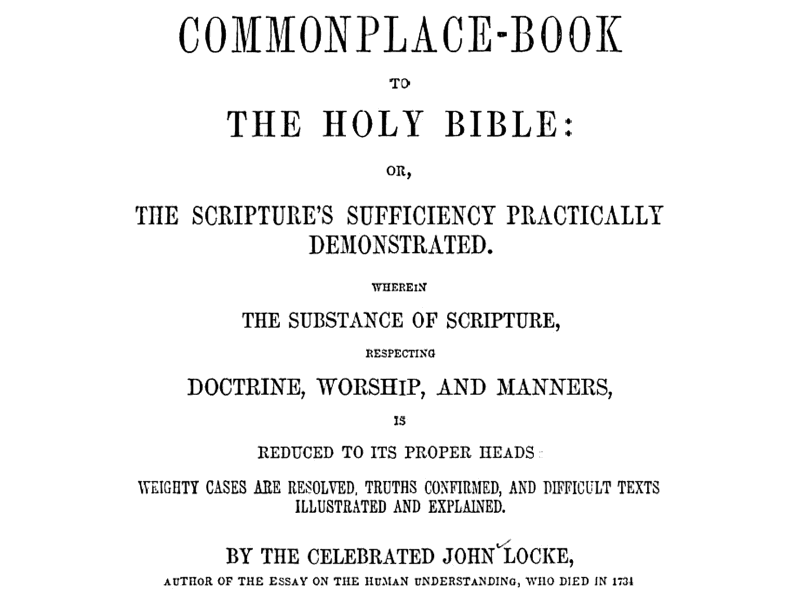
An old book in my own personal library is John Locke’s “A Commonplace Book to the Holy Bible, or the Scripture’s Sufficiency Practically Demonstrated.” [See pic at beginning of this blog.] It shows how much effort he put into organizing and analyzing the principles of Scripture for every area of life. This careful study of the Bible for all of life is what gave America the ideological foundations for indendence and liberty.
[Note: For paid subscribers today’’s extra section below is an excerpt from Sidney’s discourses.]
The content below was originally paywalled.
Excerpts from Sidney’s Discourses on Government, 1683
Abraham and the Patriarchs were not kings.
If any man say, that we are not to seek into the depth of God’s counsels; I answer, that if he had, for reasons known only to himself, affixed such a right to any one line, he would have set a mark upon those who come of it, that nations might know to whom they owe subjection; or given some testimony of his presence with Filmer and Heylyn, if he had sent them to reveal so great a mystery. Till that be done, we may safely look upon them as the worst of men, and teachers only of lies and follies. This persuades me little, to examine what would have been, if God had at once created many men, or the conclusions that can be drawn from Adam’s having been alone. For nothing can be more evident, than that if many had been created, they had been all equal, unless God had given a preference to one. All their sons had inherited the same right after their death; and no dream was ever more empty, than his whimsey of Adam’s kingdom, or that of the ensuing patriarchs. To say the truth, ’tis hard to speak seriously of Abraham’s kingdom, or to think any man to be in earnest who mentions it. He was a stranger, and a pilgrim in the land where he lived, and pretended to no authority beyond his own family, which consisted only of a wife and slaves. He lived with Lot as with his equal, and would have no contest with him, because they were brethren. His wife and servants could neither make up, nor be any part of a kingdom, in as much as the despotical government, both in practice and principle, differs from the regal. If his kingdom was to be grounded on the paternal right, it vanished away of itself; he had no child: Eliezer of Damascus, for want of a better, was to be his heir: Lot, tho his nephew, was excluded: He durst not own his own wife: He had not one foot of land, till he bought a field for a burying place: His three hundred and eighteen men were servants (bought according to the custom of those days), or their children;1 and the war he made with them, was like to Gideon’s enterprize; which shews only that God can save by a few as well as by many, but makes nothing to our author’s purpose. For if they had been as many in number as the army of Semiramis, they could have no relation to the regal, much less to the paternal power; for a father doth not buy, but beget children.
Notwithstanding this, our author bestows the proud title of lord paramount upon him, and transmits it to Isaac, who was indeed a king like his father, great, admirable, and glorious in wisdom and holiness, but utterly void of all worldly splendor or power. This spiritual kingdom was inherited by Jacob, whose title to it was not founded on prerogative of birth, but election and peculiar grace; but he never enjoyed any other worldly inheritance, than the field and cave which Abraham had bought for a burying place, and the goods he had gained in Laban’s service.
The example of Judah his sentence upon Thamar2 is yet farther from the purpose, if it be possible; for he was then a member of a private family, the fourth son of a father then living; neither in possession, nor under the promise of the privileges of primogeniture, tho Reuben, Simeon and Levi fell from it by their sins. Whatsoever therefore the right was, which belonged to the head of the family, it must have been in Jacob; but as he professed himself a keeper of sheep, as his fathers had been, the exercise of that employment was so far from regal, that it deserves no explication. If that act of Judah is to be imputed to a royal power, I have as much as I ask: He, tho living with his father, and elder brothers, when he came to be of age to have children, had the same power over such, as were of, or came into his family, as his father had over him; for none can go beyond the power of life and death: The same in the utmost extent, cannot at the same time equally belong to many. If it be divided equally, it is no more than that universal liberty which God hath given to mankind; and every man is a king till he divest himself of his right, in consideration of something that he thinks better for him.
Nimrod was the first King, during the life of Cush, Ham, Shem, and Noah.
The Creation is exactly described in the Scripture; but we know so little of what passed between the finishing of it and the Flood, that our author may say what he pleases, and I may leave him to seek his proofs where he can find them.1 In the meantime I utterly deny, that any power did remain in the heads of families after the flood, that does in the least degree resemble the regal in principle or practice. If in this I am mistaken, such power must have been in Noah, and transmitted to one of his sons. The Scripture says only, that he built an altar, sacrificed to the Lord, was a husbandman, planted a vineyard, and performed such offices as bear nothing of the image of a king, for the space of three hundred and fifty years. We have reason to believe, that his sons after his death, continued in the same manner of life, and the equality properly belonging to brethren. ’Tis not easy to determine, whether Shem or Japheth were the elder;2 but Ham is declared to be the younger; and Noah’s blessing to Shem seems to be purely prophetical and spiritual, of what should be accomplished in his posterity; with which Japheth should be persuaded to join. If it had been worldly, the whole earth must have been brought under him, and have forever continued in his race, which never was accomplished, otherwise than in the spiritual kingdom of Christ, which relates not to our author’s lord paramount.
As to earthly kings, the first of them was Nimrod, the sixth son of Cush the son of Ham, Noah’s younger and accursed son. This kingdom was set up about a hundred and thirty years after the Flood, whilst Cush, Ham, Shem and Noah were yet living; whereas if there were anything of truth in our author’s proposition, all mankind must have continued under the government of Noah whilst he lived; and that power must have been transmitted to Shem, who lived about three hundred and seventy years after the erection of Nimrod’s kingdom; and must have come to Japheth if he was the elder, but could never come to Ham, who is declared to have been certainly the younger, and condemned to be a servant to them both; much less to the younger son of his son, whilst he, and those to whom he and his posterity were to be subjects, were still living.
This rule therefore, which the partizans of absolute monarchy fancy to be universal and perpetual, falling out in its first beginning, directly contrary to what they assert; and being never known to have been recovered, were enough to silence them, if they had anything of modesty or regard to truth. But the matter may be carried farther: For the Scripture doth not only testify, that this kingdom of Nimrod was an usurpation, void of all right, proceeding from the most violent and mischievous vices, but exercised with the utmost fury, that the most wicked man of the accursed race, who set himself up against God, and all that is good, could be capable of. The progress of this kingdom was suitable to its institution: that which was begun in wickedness, was carried on with madness, and produced confusion. The mighty hunter, whom the best interpreters call a cruel tyrant, receding from the simplicity and innocence of the patriarchs, who were husbandmen or shepherds, arrogating to himself a dominion over Shem, to whom he and his fathers were to be servants, did thereby so peculiarly become the heir of God’s curse, that whatsoever hath been said to this day, of the power that did most directly set itself against God and his people, hath related literally to the Babel that he built, or figuratively to that which resembles it in pride, cruelty, injustice and madness. 3
But the shameless rage of some of these writers is such, that they rather chuse to ascribe the beginning of their idol to this odious violence, than to own it from the consent of a willing people; as if they thought, that as all action must be suitable to its principle, so that which is unjust in its practice, ought to scorn to be derived from that which is not detestable in its principle. ’Tis hardly worth our pains to examine whether the nations, that went from Babel after the confusion of languages, were more or less than seventy two, for they seem not to have gone according to families, but every one to have associated himself to those that understood his speech; and the chief of the fathers, as Noah and his sons, were not there, or were subject to Nimrod; each of which points doth destroy, even in the root, all pretence to paternal government. Besides, ’tis evident in Scripture, that Noah lived three hundred and fifty years after the Flood; Shem five hundred; Abraham was born about two hundred and ninety years after the Flood, and lived one hundred seventy five years: He was therefore born under the government of Noah, and died under that of Shem: He could not therefore exercise a regal power whilst he lived, for that was in Shem: So that in leaving his country, and setting up a family for himself, that never acknowledged any superior, and never pretending to reign over any other, he fully shewed he thought himself free, and to owe subjection to none: And being as far from arrogating to himself any power upon the title of paternity, as from acknowledging it in any other, left every one to the same liberty.
The punctual enumeration of the years, that the fathers of the holy seed lived, gives us ground of making a more than probable conjecture, that they of the collateral lines were, in number of days, not unequal to them; and if that be true, Ham and Cush were alive when Nimrod set himself up to be king. He must therefore have usurped this power over his father, grandfather, and great grandfather; or, which is more probable, he turned into violence and oppression the power given to him by a multitude; which, like a flock without a shepherd, not knowing whom to obey, set him up to be their chief. I leave to our author the liberty of chusing which of these two doth best suit with his paternal monarchy; but as far as I can understand, the first is directly against it, as well as against the laws of God and man; the other being from the consent of the multitude, cannot be extended farther than they would have it, nor turned to their prejudice, without the most abominable ingratitude and treachery, from whence no right can be derived, nor any justifiable example taken.
Nevertheless, if our author resolve that Abraham was also a king, he must presume that Shem did emancipate him, before he went to seek his fortune. This was not a kingly posture; but I will not contradict him, if I may know over whom he reigned. Paternal monarchy is exercised by the father of the family over his descendants, or such as had been under the dominion of him, whose heir he is. But Abraham had neither of these: Those of his nearest kindred continued in Mesopotamia, as appears by what is said of Bethuel and Laban. He had only Lot with him, over whom he pretended no right: He had no children till he was a hundred years old (that is to say, he was a king without a subject), and then he had but one. I have heard that sovereigns do impatiently bear competitors;4 but now I find subjection also doth admit of none. Abraham’s kingdom was too great when he had two children, and to disburthen it, Ishmael must be expelled soon after the birth of Isaac. He observed the same method after the death of Sarah: He had children by Keturah; but he gave them gifts and sent them away, leaving Isaac like a stoical king reigning in and over himself, without any other subject till the birth of Jacob and Esau. But his kingdom was not to be of a larger extent than that of his father: The two twins could not agree: Jacob was sent away by his mother; he reigned over Esau only, and ’tis not easy to determine who was the heir of his worldly kingdom; for tho Jacob had the birthright, we do not find he had any other goods, than what he had gotten in Laban’s service. If our author say true, the right of primogeniture, with the dominion perpetually annexed by the laws of God and nature, must go to the eldest: Isaac therefore, tho he had not been deceived, could not have conferred it upon the younger; for man cannot overthrow what God and nature have instituted. Jacob, in the court language, had been a double rebel, in beguiling his father, and supplanting his brother. The blessing of being lord over his brethren, could not have taken place. Or if Isaac had power, and his act was good, the prerogative of the elder is not rooted in the law of God or nature, but a matter of conveniency only, which may be changed at the will of the father, whether he know what he do or not. But if this paternal right to dominion were of any value, or dominion over men were a thing to be desired, why did Abraham, Isaac and Jacob, content themselves with such a narrow territory, when after the death of their ancestors, they ought, according to that rule, to have been lords of the world? All authors conclude that Shem was the eldest by birth, or preferred by the appointment of God, so as the right must have been in him, and from him transmitted to Abraham and Isaac; but if they were so possessed with the contemplation of a heavenly kingdom, as not to care for the greatest on earth; ’tis strange that Esau, whose modesty is not much commended, should so far forget his interest, as neither to lay claim to the empire of the world, nor dispute with his brother the possession of the field and cave bought by Abraham, but rather to fight for a dwelling on Mount Seir, that was neither possessed by, nor promised to his fathers. If he was fallen from his right, Jacob might have claimed it; but God was his inheritance, and being assured of his blessing, he contented himself with what he could gain by his industry, in a way that was not at all suitable to the pomp and majesty of a king. Which way soever therefore the business be turned, whether, according to Isaac’s blessing, Esau should serve Jacob, or our author’s opinion, Jacob must serve Esau, neither of the two was effected in their persons: And the kingdom of two being divided into two, each of them remained lord of himself.