Plus a list of other important documents and writings up to 1733
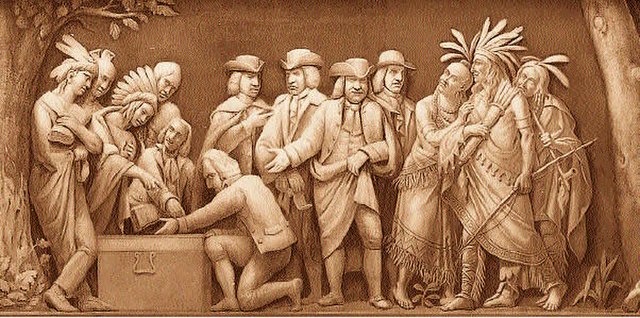
Our primary focus in the coming months is on the influences and events that led to and shaped the birth of the United States as an independent nation in 1776. [The image above is from U.S. Capitol of William Penn, Founder of Pennsylvania.]
[Note: A Great Resource for much of this is Colonial Origins of the American Revolution: A Documentary History edited by Donald Lutz and published by the Liberty Fund. I recommend to buy the book but the entire volume is also online here: https://oll.libertyfund.org/titles/lutz-colonial-origins-of-the-american-constitution-a-documentary-history]
In previous posts we provided excerpts from documents of Virginia, Massachusetts and New England in the first half of the 17th century. In the last half of the 1600s and early 1700s other colonies emerged and expressed their beliefs and worldview in their founding documents and laws. A few excerpts are below from diverse colonies planted by Roman Catholics, Moravians, Quakers, and Anglicans, yet the common Biblical worldview runs throughout the whole collection:
Maryland Toleration Act, 1649
….in a well governed and Xtian CommonWeath, matters concerning Religion and the honor of God ought in the first place to bee taken, into serious consideracion and endeavoured to bee settled. Be it therefore ordered and enacted by the Right Noble Cecilius Lord Baron of Baltemore absolute Lord and Proprietary of this Province with the advise and consent of this Generall Assembly. That whatsoever pson or psons within this Province and the Islands thereunto belonging shall from henceforth blaspheme God, that is Curse him, or deny our Saviour Jesus Christ to bee the sonne of God, or shall deny the holy Trinity the ffather sonne and holy Ghost, or the Godhead of any of the said Three psons of the Trinity or the Vnity of this Godhead, or shall use or utter any reproachfull Speeches, words or language concerning the said Holy Trinity, or any of the said three psons thereof, shalbe punished with death and confiscation or forfeiture of all his or her lands and goods…. [and] any reproachfull words or Speeches concerning the blessed Virgin Mary the Mother of our Saviour or the holy Apostles or Evangelists….
[and any] heritick, Scismatick, Idolator, Puritan, Independent, Prespiterian popish prest, Jesuite, Jesuited Papist, Lutheran, Calvenist, Anabaptist, Brownist, Antinomian, Barrowist, Roundhead, Sepatist, or any other name or terme in a reproachfull manner relating to matter of Religion…. And be it further likewise Enacted by the Authority and consent aforesaid That every person and persons within this Province that shall at any time hereafter prophane the Sabbath or Lords day called sunday by frequent swearing, drunkennes or by any uncivill or disorderly recreacion, or by working on that day when absolute necessity doth not require it shall for every such first offence forfeit 2s. 6d 4 sterling or the value thereof, ….And for the third offence and for every time after shall also bee publickly whipt. And whereas the inforceing of the conscience in matters of Religion hath frequently fallen out to be of dangerous Consequence in those commonwealthes where it hath been practised, And for the more quiett and peaceable government of this Province, and the better to preserve mutuall Love and amity amongst the Inhabitants ….noe person or psons ….professing to beleive in Jesus Christ, shall from henceforth bee any waies troubled, Molested or discountenanced for or in respect of his or her religion not in the free exercise thereof within this Province or the Islands thereunto belonging nor any way compelled to the beliefe or exercise of any other Religion against his or her consent….
Fundamental Constitutions of Carolina, 1669
….No man shall be permitted to be a freeman of Carolina, or to have any estate or habitation within it, that doth not acknowledge…that God is publicly and solemnly to be worshipped. As the country comes to be sufficiently planted and distributed into fit divisions, it shall belong to the parliament to take care for the building of churches, and the public maintenance of divines, to be employed in the exercise of religion, according to the Church of England; which being the only true and orthodox and the national religion of all the King’s dominions, is so also of Carolina; and, therefore, it alone shall be allowed to receive public maintenance, by grant of parliament.
But since the natives of that place, who will be concerned in our plantation, are utterly strangers to Christianity, whose idolatry, ignorance, or mistake gives us no right to expel or use them ill; and those who remove from other parts to plant there will unavoidably be of different opinions concerning matters of religion, the liberty whereof they will expect to have allowed them, and it will not be reasonable for us, on this account, to keep them out, that civil peace may be maintained amidst diversity of opinions, and our agreement and compact with all men may be duly and faithfully observed; the violation whereof, upon what presence soever, cannot be without great offence to Almighty God, and great scandal to the true religion which we profess; and also that Jews, heathens, and other dissenters from the purity of Christian religion may not be scared and kept at a distance from it, but, by having an opportunity of acquainting themselves with the truth and reasonableness of its doctrines, and the peaceableness and inoffensiveness of its professors, may, by good usage and persuasion, and all those convincing methods of gentleness and meekness, suitable to the rules and design of the gospel, be won ever to embrace and unfeignedly receive the truth; therefore, any seven or more persons agreeing in any religion, shall constitute a church or profession, to which they shall give some name, to distinguish it from others.
….[however:] no agreement or assembly of men, upon presence of religion, shall be accounted a church or profession within these rules: 1st. “That there is a God.”, II. “That God is publicly to be worshipped.” ….it shall be lawful for slaves, as well as others, to enter themselves, and be of what church or profession any of them shall think best, and, therefore, be as fully members as any freeman ….Assemblies, upon what presence soever of religion, not observing and performing the above said rules, shall not be esteemed as churches, but unlawful meetings, and be punished as other riots. ….No person whatsover shall disturb, molest, or persecute another for his speculative opinions in religion, or his way of worship.
Pennsylvania Charter of Privileges, 1701
William Penn Proprietary and Governour of the Province of Pennsilvania and Territories thereunto ….Do Grant and Confirme unto all the Freemen Planters and Adventurers therein Divers Liberties Franchises and properties as by the said Grant Entituled the Frame of the Government
….Because noe people can be truly happy though under the Greatest Enjoyments of Civil Liberties if Abridged of the Freedom of theire Consciences as to theire Religious Profession and Worship. And Almighty God being the only Lord of Conscience Father of Lights and Spirits and the Author as well as Object of all divine knowledge Faith and Worship who only {[can]} Enlighten the mind and perswade and Convince the understandings of people I doe hereby Grant and Declare that noe person or persons Inhabiting in this Province or Territories who shall Confesse and Acknowledge one Almighty God the Creator upholder and Ruler of the world and professe him or themselves Obliged to live quietly under the Civill Governement shall be in any case molested or prejudiced in his or theire person or Estate because of his or theire Conscientious perswasion or practice nor be compelled to frequent or mentaine any Religious Worship place or Ministry contrary to his or theire mind or doe or Suffer any other act or thing contrary to theire Religious perswasion And that all persons who also professe to beleive in Jesus Christ the Saviour of the world shall be capable (notwithstanding theire other perswasions and practices in point of Conscience and Religion) to Serve this Governement in any capacity both Legislatively and Executively….
Charter of Georgia, 1732
….there shall be a liberty of conscience allowed in the worship of God, to all persons inhabiting, or which shall inhabit or be resident within our said provinces and that all such persons, except papists, shall have a free exercise of their religion, so they be contented with the quiet and peaceable enjoyment of the same, not giving offence or scandal to the government…
Oglethorpe’s Founding Vision for Georgia, 1733
….CHRISTIANITY will be extended by the execution of this design; ….in a just, moral, and religious manner, [and thus] will contribute greatly towards the conversion of the Indians….
100 Years of documents showing Christian Influence and Leadership and other key ideas (1630-1730):
Reasons for the Plantation in New England (circa 1628).
A Short and True Description of New England, by the Rev. Francis Higginson (1629)
The Glorious Work in Maryland, Andrew White, S.J. (1633)
Account of A Maryland Jesuit (1634)
The Constitution of Plymouth Colony (1636)
John Cotton Condemns Democracy (1636)
Essay Against the Power of the Church To Sit in Judgement, John Winthrop (1637)
Sermons of Thomas Shephard
Letter of Thomas Shephard to his son at Harvard College
The New Hampshire Compact (1639)
The Wicked Capitalism of Robert Keayne, John Winthrop (1639)
The First Constitution of Rhode Island (1640)
The Bay Psalm Book (1640)
New England’s First Fruits, (c1640)
The True Constitution of a Particular Visible Church, by John Cotton (1642)
Massachusetts Bay School Laws (1642)
Harvard College Admission and Graduation Requirements (1642-1700)
Jesuit Encounters With the Indians (1642-43)
The Establishment of the United Colonies of New England (1643)
The Bloody Tenet of Persecution for the Cause of Conscience, Roger Williams
A Plea for Religious Liberty, Roger Williams (1644)
A Description of New Amsterdam by Isaac Joques (1644)
Description of the Iroquois, Rev. John Megapolensis (1644)
Massachusetts Government Vindicated, John Winthrop (1644)
On Liberty , John Winthrop (1645)
Hypocricie Unmasked (London, 1646). by Edward Winslow.
New England’s Salamander Discovered (London, 1647). by Edward Winslow.
The Old Deluder Act (1647)
The Simple Cobbler of Aggawamm in America, Nathaniel Ward (1647).
The Laws of Massachusetts (1648)
Blue Laws, New Haven
The Original Indian Deed for East-Hampton (1648)
The Cambridge Platform (1649)
The Gospel Covenant, Rev. Peter Bulkely (1651)
The Flushing Remonstrance (1657)
Forward to the Revision of the New Plymouth Laws (1658)
The Status of Religion in Virginia (1661)
Court Records Dealing with Runaway Slaves in Virginia
The Day of Doom and other Poems, Michael Wigglesworth (1662)
Death Penalties in Maryland (1664)
Fines and Punishments in Massachusetts (1664-1682)
Witchcraft Trials in New York (1665)
A Description of Carolina, Robert Horne (1666)
The Nicolls Patent (1666)
First Thanksgiving Proclamation (1676)
A Compleat Body of Divinity, Samuel Willard.
The New England Primer,
Bacon’s Declaration in the Name of the People, 30 July 1676
On Bacon’s Rebellion, Governor William Berkely, 19 May 1676
The Captivity of Mary Rowlandson (1676)
Poems for Her Husband, Anne Bradstreet (1678)
Findings of the New England Synod (1679), a “Jeremiad.”
The Pueblo Revolt (1680)
Proposals for the Carrying on the Negro’s Christianity, Morgan Goodwyn (1681).
Frame of Government of Pennsylvania, William Penn (1682)
Some Fruits of Solitude In Reflections And Maxims, William Penn (1682)
William Penn to His Family (1682)
Petition for a Democratic Government (1682)
The Original Constitution of New York (1683)
Causes of King Phillip’s War, Edward Randolph (1685)
Instructions to Sir Edmund Andros (1686)
Charter of East Hampton (1686)
Commercial Orders to Governor Andros (1686-1687)
James II Creates the Dominion of New England, April 7, 1688
Memorable Providences, Relating to Witchcrafts & Possessions, Cotton Mather (1698)
Wonders of the Invisible World (excerpts), Cotton Mather (1693)
Cases of Conscience Concerning Evil Spirits, Increase Mather (1693)
The Character of a Good Ruler, Samuel Willard (1694)
Penn’s Plan for a Union (1697)
Judge Samuel Sewall Repents His Participation in the Salem Witch Trials (1697)
Magnalia Christi Americana, by Cotton Mather (1702)
Robert Beverley on Bacon’s Rebellion (1704)
Money and Trade Considered, by John Law (1705)
Slave Laws in Virginia (1642-1705)
The Repentance of a Salem Witchcraft Accuser, Ann Putnam (1706)
Act of Union (1707) The document creating “Great Britain”
Philosophical Commentary, Pierre Bayle (1708)
William Byrd’s Diary [excerpt] (1709)
William Byrd’s Diary [excerpts regarding slave punishments] (1709)
Theopolis Americana (“God’s City: America”), Cotton Mather (1709).
Awakening Truths Tending to Conversion, Increase Mather (1710).
About the Duties of Husbands and Wives, Benjamin Wadsworth (1712)
Curriculum of the Boston Latin Grammar School (1712)
The History of the Common Law of England, Matthew Hale (1713)
Documents Concerning the Jacobite Rebellion
The North Carolina Biennal Act (1715)
Vindication of the Government of New England Churches, John Wise (1717)
The Angel of Bethesda, Cotton Mather. in favor of inoculation.
Selections from Cato’s Letters, John Trenchard and Thomas Gordon (1720-23)
Selected Works of Walter Moyle, (~1696-1721, pub. 1796).
Constitution of the Iroquois Confederacy
Statutes of the College of William and Mary (1727)
Massachusetts House of Representatives on the Governor’s Salary, 11 September 1728
Governor Burnet of Massachusetts on the Governor’s Salary, 17 September 1728
The Story of Venture Smith (1729-1809)
Plain Reasons for Presbyterians Dissenting, Andrew Clarkson (1731);
Dissertation Upon Parties, Henry St. John Bolingbroke (1733).
Founding Vision for Georgia, General James Oglethorpe (1733)
Negotiations Regarding the Settlement of the Georgia Colony, Zinzendorf (1733)
[Today’s extra material is from a sermon by Cotton Mather in 1709 on corruption in the marketplace and a call for America to be the City of God.]
The content below was originally paywalled.
Rev. Cotton Mather__1709
Theopolis Americana [God’s City: America]
AN ESSAY ON
CORRUPTIONS of the Market-Place.
With Some Good HOPES of Better Things to be yet seen in the AMERICAN World.
In a SERMON, to the GENERAL ASSEMBLY of the Massachusetts province
in NEW-ENGLAND. September 3, 1709.
—————————————————————————————————–
Rev[elation]. XXI. 21
The STREET of the City was Pure GOLD.
GLORIOUS Things are Spoken of thee, O thou City of God! The STREET be in Thee O NEWENGLAND; The Interpretation of it, be unto you, O American Colonies.
The Invitation, sounds Angelically; But my Hearers must have it now given them; Come hither, and I will show you an admirable Spectacle! ’Tis an Heavenly CITY, descending out of Heaven, from GOD. There is an Heavenly CITY, which the Great GOD, has Prepared for them, to whom He will be a God: A CITY to be inhabited by an Innumerable Company of Angels, and by the Spirits of Just Men made Perfect by a Resurrection from the Dead, with JESUS the Mediator of the New Covenant shining upon them: A CITY; where God shall dwell with men, God Himself shall be with them, and we shall Inherit all things. . . .
One incomparable Glory of the City, is now singled out for our present Meditation. The Street of the City is Pure Gold. I concur with Peganius and conceive That the Street here means, and so it may be translated, The Market-Place; the Place where the Affairs of Trade bring together a Concourse of People. The meaning is, The Business of the CITY shall be managed by the Golden Rule. The Things that use to be done in the Market-Place shall be done without Corruption. There shall be no Base Dealing in it. It is added, It is as it were Transparent Globe: That is, The Dealing shall be so Honest that it shall bear to be Look’d into; it shall be so Sincere that men shall be willing to have their very Hearts Look’d into. There shall be no False-Dealing: All shall be done with all possible Integrity. . . .
O Happy CITY! O Golden Street, nowhere, nowhere to be found but in a City of God!
The Thing which I am to Observe is That in a CITY of GOD, the Street will be Pure Gold. The Business transacted in the Market-Place of an Holy City will have a Golden, that is to say, a Gracious Character upon it. Golden Proceedings, that is to say, Godly ones, will be found in the Market-Place of a CITY, which the Son of God, has a favor for. . . .
What is to be done, that the Street of our City, may be Pure Gold? And, What have we to do in our Market-Place, that so our Great SAVIOUR may Espouse us for A City of God, and become our Saviour? . . .
Sirs, NEW-ENGLAND is a Country [colony] that has made a more than ordinary Profession of Religion. Our Profession is Weigh’d in the Balances of GOD. If there be anything Defective in the Honesty of our Dealing with one another, our Profession will have a woeful MENE TEKEL Written upon it. Let a man be never such a Professor2 and Pretender of Religion, if he be not a Fair-Dealer That Man’s Religion is Vain. A Noise about Faith & Repentance, among them that forget Moral Honesty, tis but an Empty Noise. The men are utter Strangers to Faith and Repentance; God will Reject all their Confidences, of their being. The People of God, and they shall not Prosper in them. I have a Commission that Enables me, and Emboldens me, to say among you; Woe, Woe, Woe, to you Professors, and Hypocrites, who can make a Show of this and that Piety and Purity; but can Cheat, and Cousen, and Oppress, and Wrong others. People in your Dealing with them! . . .
But I have certain MOTIONS to make; and I assure myself that all the Good Men in the Country will concur to the making of them.
The First Thing for which I move is That the Golden Rule of Charity may Operate in all the Dealings of the Market-Place. Then will the Street be Pure Gold, when everything is done in it with an Eye to the Golden Rule of Christ. I am not versed in the Niceties and Mysteries of the MarketPlace. But I am acquainted with a Golden Rule, which, I am sure, would mightily Rectify all our Dealings there. . . .
The Second Thing for which I move is That all Frauds in our Dealings of all sorts may be the Abomination of all that have anything to do in the Market-Place. All such Things as by the Irregular & Inordinate Love of Gold, men are too often betray’d into! Of the various Methods wherein men Deal Dishonestly with one another in the Market-Place, and particularly, False Weights and Measures, we read, Deut[eronomy]. 25.16. All that do such things, and all that do Unrighteously, are an abomination unto the Lord thy God. May they Likewise, and Therefore, be an Abomination unto you, O People of the LORD.
As now;
For men to Lie to one another, in Dealing with one another; Tis an Abomination! It was required; Lev[iticus]. 19. 11. Ye shall not Steal, neither deal False, neither Lie to one another.
For men to put off Adulterated or Counterfeited Wares; or, for men to work up their Wares Deceitfully; When the Fish is naught; the Tar has undue mixtures; there is Dirt & Stone instead of Turpentine; there are thick Layes of Salt instead of other things that should be there; the Cheese is not made as tis affirm’d to be; the Liquor is not for Quantity or Quality such as was agreed for; the Wood is not of the Dimensions that are promised unto the Purchaser; or perhaps, there was a Trespass in the place of Cutting it; the Hay does hold our Weight by abundance; the Lumber has a false Number upon it; or, the Bundles are not as Good Within as they are Without; Tis an Abomination!
For men to Over-reach others because they find them Ignorant, or Scrue grievously upon them only because they are Poor and Low, and in great Necessities; to keep up the Necessities of Humane Life (I say, the Necessaries, which I always distinguish from the Superfluities), at an Immediate Price, merely because other People want them, when we can more easily spare them; Tis an Abomination!
For men to Employ others and not Reward them according to Contract [A Crime, not at all the less, because the Minister is not seldom the Sufferer from it!], Or, to withhold from the Labourer his Wages, till his Cry reach up to Heaven; or break their Faith with the Creditors, and keep them out of their Dues! Tis an Abomination!
To Rob the Public Treasury by False Musters, or any other Articles of Charge falsely given in; or, to Abet [aid] the Robbers by any Assistance or Contrivance at such things in Auditing their Accounts; This also is a thing to be Repented of, where any have been Guilty of it. . . .
There is one sort of Trade, also, about which my way of Addressing you shall be by Reciting the words of the Excellent BAXTER. They are these: [His Christian Directory. Part II. Chap. 14]
To go as Pirates, and Catch up poor Negroes, or People of another Land, that have never forfeited Life or Liberty, and to make them Slaves, and Sell them, is One of the worst kinds of Thievery in the World; and such Persons are to be taken for the common Enemies of Mankind; and they that buy them and use them as Beasts for their mere Commodity, and betray or destroy or neglect their Souls, are fitter to be called Incarnate Devils than Christians, tho’ they be no Christians whom they so Abuse.
I will go on to say; When we have Slaves in our Houses, we are to treat them with Humanity, we are so to treat them that their Slavery may really be their Happiness; Yea, In our treating of them, there must be nothing but what the Law of CHRIST will Justify. Above all, we are to do all we can to Christianize them. I will again give you the Words of my Honoured BAXTER.
So use them as to preserve Christ’s Right and Interest in them. Those that keep their Negroes and Slaves from Hearing of God’s Word and from becoming Christians, because they shall then lose part of their Service,4 do openly profess Rebellion against God, and contempt of Christ the Redeemer of Souls, and a contempt of the Souls of Men, and indeed, they declare, that their Worldly profit is their Treasure and their God.
Fidelity to the cause of Righteousness obliges me to take Notice of One thing more.
If there be any English People who are concerned with our Christianized Indians, but then take advantage of their Ignorance or their Indigence or their unchristian Love of the Bottle to decoy them into their Debt, and then use Indirect and Oppressive ways to Exact an Unreasonable Satisfaction [monetary payment] from them, and Sell them for Servants, or Send them out of their own Country, This Trade will be a Reproach to our Christianity, and, I am sure, it will be Bitterness in the Latter End [i.e., Judgment Day]. Certainly, our Justices will concern themselves to Rebuke and Prevent such Doings, lest the Guilt become so Public as to provoke the Justice of Heaven to Revenge it by Indian Depredations.
The Third Thing for which I move is That there may not be so much as any Tendency to anything Oppressive or Injurious in the Dealings of the Market-Place. The Thing for which I bring a very pressing Exhortation is that, I Thes[salonians]. 5. 22: Abstain from all Appearance of Evil. If anything Approach to a thing that Appears an Evil, Sirs, Beware of it! There are Some Ill Things too frequently done among those who would count themselves greatly Wrong’d if they be not thought Good People. But they are things which anon, I am sure, prove a notorious Wrong to many others that really are Good People.
I will be free [direct] with you. There are Crooked Things that cannot be Numbered; I wish they could be Straightened.
I conceive There are some of them in certain Extortions used by some of them who let out Money upon Interest, I mean when they make People pay Interest for a Sum that really never was in their Hands; As it is, when the Usurer6 immediately takes into his own the whole first year’s Interest at the Instant of his Letting out [loaning] the Money.
I will go on to say, ’Tis a Thing of an Evil Tendency for People to Live beyond themselves, or to take it for granted that they must brave it out with such a Table, or with such an Habit [clothing], tho’ they have not wherewithal to bear the Expenses of it. They won’t take in a Reef of their Sails, tho’ they are on the point of Suffering Ship-wreck, tho’ they must borrow, and defraud, and Whistle, and hurt other People, to Support their Vanity. How contrary, How contrary is this to that Poverty of Spirit which must be found in all that would have a claim to a part in the Golden City!
’Tis a thing of Evil Tendency for People to Run into Debt when they know they can’t Run out of it, as well and as fast as they Run into it; so they Spend what is none of their Own; They Forget that Precept: Owe nothing to any man, but to Love one another.
’Tis a thing of Evil Tendency for People to go from year to year without Settling their Accounts; to Jog on in a blind Confusion and not know how much they may be gone backward, or whether they have anything, they may call Their Own or no. If they would have done like Honest Men, their Insolvency should have been ingenuously Confessed some years ago!
And then, sometimes People that Break deal not so fairly, so truly, so justly with their Injured Creditors as they ought to do. Perhaps there are Indirect Ways taken to Cover from other Men what justly belongs unto them.
No man that understands the Gospel will Justify such things. The Street is not Pure Gold where such things are Practiced. On behalf of our Holy RELIGION, I do this day Testify against them! You that Fear GOD will do so too, and will come forth of them all.
I must make a Fourth Motion. ’Tis that They who have Command of the Street would look upon themselves as concerned Above others to keep all Dishonesty out of it.
It is the Action of a JUDGE, Job 29. 7. I prepared my Seat in the Street. And May your Seat always be upon Pure Gold: But then, your Hand, a Stranger to it!
We are to Pray for our Honourable RULERS. We should make that Prayer That they may be always Able Men such as Fear God, Men of Truth, and hating of Covetousness. — It was once the Unhappiness of Israel; Hos[ea]. 4. 18. Her Rulers with Shame do Love, Give ye. — . . .
PEOPLE of GOD, May these be your Cares. Then there will be fulfilled unto us that Word: Isa[iah]. 1.26. Thou shalt be called The City of Righteousness, The Faithful City. A CITY of such a Golden Street will be a Strong City. God will appoint Salvation for Walls and bulwarks unto it, while none but a Righteous Nation which keeps the Truth inhabits it. O NEW ENGLAND, Keep such a Street, and Sweep it where it wants to be better kept. Then there will be no breaking in or going out; there will be no Complaining in our Street. No, we shall be an Happy People, I say, an Happy People; for the LORD will be OUR GOD