Plus excerpts from Winthrop’s “A Model of Christian Charity”
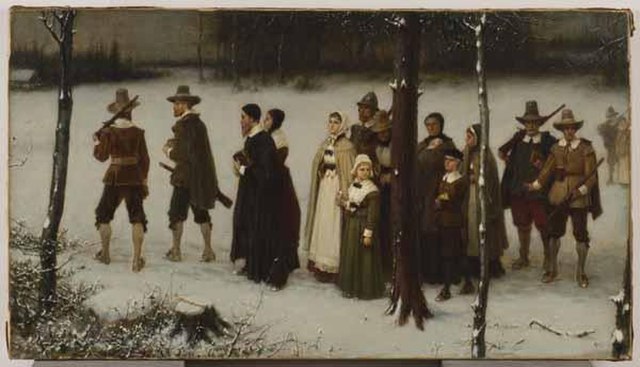
Our primary focus in the coming months is on the influences and events that led to and shaped the birth of the United States as an independent nation in 1776. In the previous post we provided excerpts from Bradford and Winslow’s early history of Plymouth and the famous Mayflower Covenant of 1620.
The Christian motivation and leadership of all the early colonies of New England are well known. Below are several other covenants from nearby settlements over the next two decades after Plymouth. The Puritans of New England provided some of the greatest examples of Christian transformation of society that the world has ever seen.
At some point I hope to provide excerpts from Cotton Mather’s Magnalia Christi Americana which described the entire 17th century New England story. And a modern book I recommend for understanding their theology is The Mission of God: A Manifesto of Hope for Society by Joseph Boot. It is a great source for modern reformers as well.
Covenants of New England
The Salem Covenant of 1629
We Covenant with the Lord and one with another; and doe bynd our selves in the presence of God, to walke together in all his waies, according as he is pleased to reveale himselfe unto us in his Blessed word of truth.
The Enlarged Salem Covenant of 1636
We covenant with our Lord, and one with another; and we do bind our selves in the presence of God, to walk together in all his ways, according as he is pleased to reveal himself unto us in his blessed word of truth; and do explicitly, in the name and fear of God, profess and protest to walk as followeth, through the power and grace of our Lord, Jesus Christ.
We avouch the Lord to be our God, and our selves to be his people, in the truth and simplicity of our spirits.
We give our selves to the Lord Jesus Christ, and the word of his grace for the teaching, ruling and sanctifying of us in matters of worship and conversion, resolving to cleave unto him alone for life and glory, and to reject all contrary ways, canons, and constitutions of men in his worship.
We promise to walk with our brethren, with all watchfulness and tenderness, avoiding jealousies and suspicions, back-bitings, censurings, provokings, secret risings of spirit against them; but in all offences to follow the rule of our Lord Jesus, and to bear and forbear, give and forgive, as he hath taught us.
In public or private, we will willingly do nothing to the offence of the church; but willing to take advice for our selves and ours, as occasion shall be presented.
We will not in the congregation be forward either to show our own gifts and parts in speaking or scrupling, or there discover the weakness or failings of our brethren; but attend an orderly call thereunto, knowing how much the Lord may be dishonoured, and his gospel, and the profession of it, slighted by our distempers and weaknesses in public.
We bind our selves to study the advancement of the gospel in all truth and peace; both in regard of those that are within or without; no way slighting our sister churches, but using their counsel, as need shall be; not laying a stumbling-block before any, no, not the Indians, whose good we desire to promote; and so to converse, as we may avoid the very appearance of evil.
We do hereby promise to carry our selves in all lawful obedience to those that are over us, in Church or Commonwealth, knowing how well pleasing it will be to the Lord, that they should have encouragement in their places, by our not grieving their spirits through our irregularities.
We resolve to approve our selves to the Lord in our particular callings; shunning idleness as the bane of any stake; nor will we deal hardly or oppressingly with any, wherein we are the Lord’s stewards.
Promising also unto our best ability to teach our children and servants the knowledge of God, and of His Will, that they may serve Him also; and all this not by any strength of our own, but by the Lord Jesus Christ; whose blood we desire may sprinkle this our Covenant made in his name.
The Covenant of the Charles-Boston Church (1630)
In the Name of our Lord Jesus Christ, and in Obedience to his holy Will and Divine Ordinance, We whose Names are here under written, being by his most wise and good providence brought together into this part of America in the Bay of Massachusetts, and desirous to unite ourselves into one Congregation or Church under the Lord Jesus Christ our Head, in such sort as becometh all those whom he hath redeemed, and sanctified to himself, DO hereby solemnly and religiously (as in his most holy Presence) promise and bind ourselves, to walk in all our ways according to the Rule of the Gospel, and in all sincere Conformity to his holy Ordinances, and in mutual Love and Respect each to other, so near as God shall give us Grace.
John Winthrop | Thomas Dudley | Isaac Johnson | John Wilson | &c | &c
In: Donald Lutz: A Covenanted People. Religious Tradition and the Origin of American Constitutionalism(The John Carter Brown Library: Providence, RI, 1987), p. 12.
The Watertown Covenant
July 30, 1630
We whose Names are hereto subscribed, having through God’s Mercy escaped out of Pollutions of the World, and been taken into the Societe of his People, with all Thankfulness do hereby both with Heart and Hand acknowledge, That his Gracious Goodness, and Fatherly Care, towards us: And for further and more full Declaration thereof, to the present and future Ages, have undertaken (for the promoting of his Glory and the Churches Good, and the Honour of our Blessed Jesus, in our more full and free subjecting of our selves and ours, under his Gracious Government, in the practice of, and Obedience unto all his Holy Ordinances and Orders, which he Hath pleased to Prescribe and impose upon us) a long and hazardous Voyage from East to West, from Old England in Europe, to New England in America that we may walk before him, and serve him, without Fear in Holiness and Righteousness, all the Days of our Lives: And being safely arrived here, and thus far onwards peaceably preserved by his special Providence, that we bring forth our Intentions into Actions, and perfect our Resolutions, in the Beginnings of some Just and Meet Executions; We have separated the Day above written from all other Services, and Dedicated it wholly to the Lord in Divine employments, for a Day of Afflicting our Souls, and humbling our selves before the Lord, to seek him, and at his Hands, a Way to walk in, by Fasting and Prayer, that we might know what was Good in his Sight: And the Lord was intreated of us.
For in the End of the Day, after the finishing of our Publick Duties, we do all, before we depart, solemnly and with all our Hearts, personally, Man by Man for our selves and others (charging them before Christ and his Elect Angels, even them that are not here with us this Day, or are yet unborn, That they keep the Promise unblameably and faithfully unto the coming of our Lord Jesus) Promise, and enter into a sure Covenant with the Lord our God, and before him with one another, by Oath and serious Protestation made, to renounce all Idolatry and Superstition, Will-Worship, all Humane Traditions and Inventions whatsoever, in the Worship of God; and forsaking all Evil Ways, do give ourselves wholly unto the Lord Jesus, to do him faithful Service, observing and keeping all his Statutes, Commands, and Ordinances, in all Matters concerning our Reformation; his Worship, Administrations, Ministry, and Government; and in the Carriage of our selves among our selves, and one another towards another, as he hath prescribed in his Holy Word. Further swearing to cleave unto that alone, and the true Sense and meaning thereof to the utmost of our Power, as unto the most clear Light and infallible Rule, and All-sufficient Canon, in all things that concern us in this our Way. In Witness of all, we do ex Animo, and in the presence of God, hereto set our Names, or Marks, in the Day and Year above written.
The Dedham Covenant
1636
One: We whose names are here unto subscribed do, in the fear and reverence of our Almighty God, mutually and severally promise amongst ourselves and each to profess and practice one truth according to that most perfect rule, the foundation whereof is ever lasting love.
Two: That we shall by all means labor to keep off from us all such as are contrary minded, and receive only such unto us as may be probably of one heart with us, [and such] as that we either know or may well and truly be informed to walk in a peacable conversation with all meekness of spirit, [this] for the edification of each other in the knowledge and faith of the Lord Jesus, and the mutual encouragement unto all temporal comforts in all things, seeking the good of each other out of which may be derived true peace.
Three: That if at any time differences shall rise between parties of our said town, that then such party or parties shall presently refer all such differences unto some one, two, or three others of our said society to be fully accorded and determined without any further delay, if it possibly may be.
Four: That every man that… shall have lots [and]* in our said town shall pay his share in all such… charges as shall be imposed on him…, as also become freely subject unto all such orders and constitutions as shall be… made now or at any time hereafter from this day forward, as well for loving and comfortable society in our said town as also for the prosperous and thriving condition of our said fellowship, especially respecting the fear of God, in which we desire to begin and continue whatsoever we shall by his loving favor take into hand.
Five: And for the better manifestation of our true resolution herein, every man so received into the town is to subscribe hereunto his name, thereby obliging both himself and his successors after him forever, as we have done.
Covenant of Exeter, New Hampshire
July 5, 1639
Whereas it hath pleased the Lord to Moue the heart of our Dread Soveraigne Charles, by the grace of God, King of England, Scotland, France & Ireland, to grant license & liberty to sundry of his subjects to plant themselves in the westerne partes of America: Wee, his loyall subjects, brethren of the church of Exeter, situate & lying upon Piscataquacke, wth other inhabitants there, considering wth ourselves the holy will of god and our owne necessity, that we should not live whout wholesome lawes & government amongst us, of wch we are altogether destitute; doe in the name of Christ & in the sight of God combine ourselves together, to erect & set up amongst us such government as shall be to our best discerning, agreeable to the will of god, professing ourselves subjects to our Sovereign Lord King Charles, according to the Libertys of our English Colony of the Massachusetts & binding ouselves solemnly by the grace & helpe of Christ & in his name & fear to submit ourselves to such godly & christian laws as are established in the realme of England to our best knowledge, & to all other such lawes wch shall upon good grounds, be made & inacted amongst us according to God, yt we may live quietly & peaceablely together, in all godliness and honesty.
Mon., 5th d., 4th, 1639.
[Signed by John Whelewright and thirty-four others.]
THE ELDERS OR RULERS OATH
You shall swear by the great and dreadful Name of the High God, Maker and Governor of Heaven and earth and by the Lord Jesus Christ, the Prince of the Kings and rulers of the earth, that in his Name and fear you will rule and govern his people according to the righteous will of God, ministering justice and judgement on the workers of iniquite, and ministering due incouragement and countenance to well doers, protecting of the people so far as in you lieth, by the help of God from foreigne annoyance and inward desturbance, that they may live a quiet and peacabble life in all godliness and honesty. So God be helpful and gracious to you and yours in Christ Jesus.
THE OATH OF THE PEOPLE
We do swear by the Great and dreadful Name of the High God, Maker and Governor of heaven and earth, and by the Lord Jesus Christ, the King and Saviour of his people, that in his Name and fear, we will submit ourselves to be ruled and governed according to the will and word of God, and such wholsome laws and ordinances as shall be derived there from by our honored Rulers and the lawful assistants, with the consent of the people, and that we will be ready to assist them by the help of God, in the administration of justice and preservation of the peace, with our bodies and goods and best endeavours according to God. So God protect and save us and ours in Jesus Christ.
Other Founding Colonial Documents
It is also worth reading the other founding charters and documents from the first colonies. Below is a description of them with links for you to find and read.
Charter of Massachusetts Bay (1629) – The royal charter issued by King Charles I to the Massachusetts Bay Company, authorizing the Puritan settlement of New England. The charter allowed the company to establish a colony and, by bringing the charter to America, the colonists used it as a de facto constitution, giving them broad self-governance powers (Commonwealth Museum – Virtual Tour – 1629 Charter). Full text: Avalon Project (transcript of the 1629 Charter) (Commonwealth Museum – Virtual Tour – 1629 Charter).
Charter of Maryland (1632) – The proprietary charter granted by King Charles I to Cecilius Calvert (Second Lord Baltimore), creating the Province of Maryland. This was one of the first proprietary colony charters, making Lord Baltimore essentially the “overlord” of Maryland with feudal-like authority over its land and government (Ch. 3.3. Primary Source: Charter to Lord Baltimore, for Maryland, King Charles I, 1632 – American Legal History to the 1860s). Full text: Avalon Project (Maryland’s History).
Fundamental Orders of Connecticut (1639) – Often considered the first written constitution in America, it established a representative government for the Connecticut River towns. The Fundamental Orders set out the powers and limits of government and introduced rule by the “consent of the governed,” serving as a model for later colonial and state constitutions (The Fundamental Orders: Connecticut’s Role in Early Constitutional Government – Connecticut History | a CTHumanities Project). Full text: Avalon Project (Avalon Project – Fundamental Orders of 1639).
Massachusetts Body of Liberties (1641) – The first legal code of Massachusetts Bay Colony, enumerating the rights and duties of the colonists. It was an early attempt to restrain governmental power by a fundamental document, listing protections for individuals (including rights for women, servants, and even animals) and serving as a precursor to later bills of rights (The Massachusetts Body of Liberties | Teaching American History). Full text: (Teaching American History) (The Massachusetts Body of Liberties | Teaching American History).
New England Confederation – Articles of Confederation of the United Colonies of New England (1643) – An alliance between four colonies (Massachusetts Bay, Plymouth, Connecticut, and New Haven) formed for mutual defense and cooperation. This federation, though limited in power, was the first significant effort by English colonists to form an intercolonial union for their common benefit (New England Confederation | Colonial Era, Puritans & Quakers | Britannica). Full text: Avalon Project (New England Confederation | Colonial Era, Puritans & Quakers | Britannica).
Maryland Toleration Act (1649) – Also known as the Act Concerning Religion, passed by Maryland’s assembly. It mandated religious tolerance for all Trinitarian Christians, providing the broadest definition of religious freedom in the colonies at the time and marking an important step toward the principle of freedom of religion in America (1649: Maryland Toleration Act | Online Library of Liberty). Full text: Avalon Project (Avalon Project – Maryland Toleration Act; September 21, 1649).
Charter of Connecticut (1662) – The royal charter from King Charles II that united the Connecticut settlements into one colony with extensive self-governing rights. This “liberal” charter combined Connecticut and New Haven and provided for virtual self-government by the colony’s freemen, serving Connecticut well until it was replaced by a state constitution in 1818 (Connecticut – Revolution, Constitution, Slavery | Britannica). Full text: Avalon Project (The Avalon Project : Charter of Connecticut – 1662).
Charter of Rhode Island and Providence Plantations (1663) – King Charles II’s charter uniting Rhode Island’s towns and guaranteeing unprecedented religious freedom and self-government. It gave the colonists the power to elect their own governor and legislature and stipulated that no person in Rhode Island could be “molested, punished, disquieted, or called in question” for differences in religious opinion (Rhode Island Royal Charter – Wikipedia). This charter was so progressive it remained Rhode Island’s governing document for nearly 180 years (not replaced until 1843) (Rhode Island Royal Charter – Wikipedia). Full text: Rhode Island State Archives (PDF) ().
Fundamental Constitutions of Carolina (1669) – A grand plan of government for the Province of Carolina, drawn up by the Lords Proprietors (with input from philosopher John Locke). Part constitution and part promotional tract, it outlined a feudal-style society based on hereditary property and religious toleration, creating a nobility of landgraves and caciques (July, 1669: First Draft of the Fundamental Constitutions of Carolina is Completed – South Carolina Historical Society). While innovative (it provided for a written constitution and freedom of worship), the scheme’s feudal elements proved impractical; it was never fully implemented and was largely abandoned by the early 18th century (July, 1669: First Draft of the Fundamental Constitutions of Carolina is Completed – South Carolina Historical Society). Full text: Avalon Project (The Avalon Project : The Fundamental Constitutions of Carolina : March 1, 1669).
Pennsylvania Charter of Privileges (1701) – The final Frame of Government issued by William Penn for his colony. This charter gave the elected assembly in Pennsylvania full legislative powers (transforming the council into a purely advisory body) and continued Penn’s policy of religious toleration (Charter of Privileges | American colonial history | Britannica). The Charter of Privileges established an unusually democratic form of government for its time, and it remained the constitution of Pennsylvania until the Revolutionary period (Charter of Privileges | American colonial history | Britannica). Full text: Avalon Project (The Avalon Project : Charter of Privileges Granted by William Penn, esq. to the Inhabitants of Pennsylvania and Territories, October 28, 1701).
In today’s section for paid subscribers we provide excerpts from the famous sermon by the Massachusetts Bay governor John Winthrop dated December 31, 1630 and titled A Model of Christian Charity.
The content below was originally paywalled.
Excerpts from CHRISTIAN CHARITY. A Model hereof.
[Governor John Winthrop, December 31, 1630]
GOD ALMIGHTY in his most holy and wise providence, hath so disposed of the condition of’ mankind, as in all times some must be rich, some poor, some high and eminent in power and dignity; others mean and in submission.
The Reason hereof.
1 Reason. First, to hold conformity with the rest of his works, being delighted to show forth the glory of his wisdom in the variety and difference of the creatures, and the glory of his power in ordering all these differences for the preservation and good of the whole; and the glory of his greatness, that as it is the glory of princes to have many officers, so this great king will have many stewards, counting himself more honored in dispensing his gifts to man by man, than if he did it by his own immediate hands.
2 Reason. Secondly, that he might have the more occasion to manifest the work of his Spirit: first upon the wicked in moderating and restraining them: so that the rich and mighty should not eat up the poor, nor the poor and despised rise up against their superiors and shake off their yoke. Secondly, in the regenerate, in exercising his graces in them, as in the great ones, their love, mercy, gentleness, temperance etc., in the poor and inferior sort, their faith, patience, obedience, etc.
3 Reason. Thirdly, that every man might have need of others, and from hence they might be all knit more nearly together in the bonds of brotherly affection. From hence it appears plainly that no man is made more honorable than another or more wealthy etc., out of any particular and singular respect to himself, but for the glory of his creator and the common good of the creature, man. Therefore, God still reserves the property of these gifts to himself as Ezek. 16:17—he there calls wealth, his gold and his silver, and Prov. 3:9—he claims their service as his due, honor the Lord with thy riches, etc. All men being thus (by divine providence) ranked into two sorts, rich and poor; under the first are comprehended all such as are able to live comfortably by their own means duly improved; and all others are poor according to the former distribution.
…There is a time when a Christian must sell all and give to the poor, as they did in the Apostles’ times. There is a time also when Christians (though they give not all yet) must give beyond their ability…. Likewise, a community of peril calls for extraordinary liberality, and so doth community in some special service for the church. Lastly, when there is no other means whereby our Christian brother may be relieved in his distress, we must help him beyond our ability rather than tempt God in putting him upon help by miraculous or extraordinary means.
This duty of mercy is exercised in three kinds: giving, lending and forgiving.
Quest[ion]. What rule shall a man observe in giving in respect of the measure?
Ans[wer]. If the time and occasion be ordinary, he is to give out of his abundance. Let him lay aside as God hath blessed him. If the time and occasion be extraordinary, he must be ruled by them: taking this withal, that then a man cannot likely do too much, especially if he may leave himself and his family under probable means of comfortable subsistence.
Object[ion]. A man must lay up for posterity, the fathers lay up for posterity and children, and he is worse than an infidel that provideth not for his own.
Ans[wer]. For the first, it is plain that it being spoken by way of comparison, it must be meant of the ordinary and usual course of fathers, and cannot extend to times and occasions extraordinary. For the other place, the Apostle speaks against such as walked inordinately, and it is without question that he is worse than an infidel who through his own sloth and voluptuousness shall neglect to provide for his family….
Quest[ion]. What rule must we observe in lending?
Ans[wer]. Thou must observe whether thy brother hath present or probable or possible means of repaying thee, if there be none of those, thou must give him according to his necessity, rather than lend him as he requires; if he hath present means of repaying thee, thou art to look at him not as an act of mercy, but by way of Commerce, wherein thou art to walk by the rule of justice; but if his means of repaying thee be only probable or possible, then is he an object of thy mercy, thou must lend him, though there be danger of losing it, Deut. 15:7. If any of thy brethren be poor etc., thou shalt lend him sufficient….
Quest[ion]. What rule must we observe and walk by in cause of community of peril?
Ans[wer]. The same as before, but with more enlargement towards others and less respect towards ourselves and our own right. Hence it was that in the primitive Church they sold all, had all things in common, neither did any man say that which he possessed was his own. Likewise in their return out of the captivity, because the work was great for the restoring of the church and the danger of enemies was common to all, Nehemiah directs the Jews to liberality and readiness in remitting their debts to their brethren, and disposing liberally to such as wanted, and stand not upon their own dues which they might have demanded of them. Thus did some of our Forefathers in times of persecution in England, and so did many of the faithful of other churches, whereof we keep an honorable remembrance of them; and it is to be observed that both in Scriptures and latter stories of the churches that such as have been most bountiful to the poor saints, especially in those extraordinary times and occasions, God hath left them highly commended to posterity….
…The definition which the Scripture gives us of love is this: Love is the bond of perfection. First it is a bond or ligament. Secondly it makes the work perfect. There is no body but consists of parts, and that which knits these parts together, gives the body its perfection, because it makes each part so contiguous to others as thereby they do mutually participate with each other, both in strength and infirmity, in pleasure and pain. To instance in the most perfect of all bodies; Christ and his Church make one body; the several parts of this body considered apart before they were united, were as disproportionate and as much disordering as so many contrary qualities or elements, but when Christ comes, and by his spirit and love knits all these parts to himself and each to other, it is become the most perfect and best proportioned body in the world, Eph. 4:16: Christ, by whom all the body being knit together by every joint for the furniture thereof, according to the effectual power which is in the measure of every perfection of parts, a glorious body without spot or wrinkle; the ligaments hereof being Christ, or his love, for Christ is love, 1 John 4:8. So this definition is right. Love is the bond of perfection.
…The next consideration is how this love comes to be wrought. Adam in his first estate was a perfect model of mankind in all their generations, and in him this love was perfected in regard of the habit. But Adam rent himself from his Creator, rent all his posterity also one from another; whence it comes that every man is borne with this principle in him: to love and seek himself only, and thus a man continueth till Christ comes and takes possession of the soul and infuseth another principle, love to God and our brother, and this latter having continual supply from Christ, as the head and root by which he is united, gets the predomining in the soul, so by little and little expels the former. 1 John 4:7: love cometh of God and every one that loveth is borne of God, so that this love is the fruit of the new birth, and none can have it but the new creature.
…From the former Considerations arise these conclusions. First, this love among Christians is a real thing, not imaginary. Secondly, this love is as absolutely necessary to the being of the body of Christ, as the sinews and other ligaments of a natural body are to the being of that body. Thirdly, this love is a divine, spiritual, nature; free, active, strong, courageous, and permanent; undervaluing all things beneath its proper object and of all the graces, this makes us nearer to resemble the virtues of our heavenly father….
It rests now to make some application of this discourse, by the present design, which gave the occasion of writing of it. Herein are four things to be propounded; first the persons, secondly the work, thirdly the end, fourthly the means.
For the persons. We are a company professing ourselves fellow members of Christ, in which respect only though we were absent from each other many miles, and had our employments as far distant, yet we ought to account ourselves knit together by this bond of love, and, live in the exercise of it, if we would have comfort of our being in Christ….
For the work we have in hand. It is by a mutual consent, through a special overvaluing providence and a more than an ordinary approbation of the churches of Christ, to seek out a place of cohabitation and consortship under a due form of Government both civil and ecclesiastical. In such cases as this, the care of the public must over sway all private respects, by which, not only conscience, but mere civil policy, doth bind us. For it is a true rule that particular estates cannot subsist in the ruin of the public.
The end is to improve our lives to do more service to the Lord; the comfort and increase of the body of Christ, whereof we are members; that ourselves and posterity may be the better preserved from the common corruptions of this evil world, to serve the Lord and work out our Salvation under the power and purity of his holy ordinances.
For the means whereby this must be effected: they are twofold, a conformity with the work and end we aim at. These we see are extraordinary, therefore we must not content ourselves with usual ordinary means. Whatsoever we did, or ought to have, done, when we lived in England, the same must we do, and more also, where we go. That which the most in their churches maintain as truth in profession only, we must bring into familiar and constant practice; as in this duty of love, we must love brotherly without dissimulation, we must love one another with a pure heart fervently. We must bear one another’s burdens. We must not look only on our own things, but also on the things of our brethren. Neither must we think that the Lord will bear with such failings at our hands as he dothe from those among whom we have lived….
…Thus stands the cause between God and us. We are entered into covenant with Him for this work. We have taken out a commission. The Lord hath given us leave to draw our own articles. We have professed to enterprise these and those accounts, upon these and those ends. We have hereupon besought Him of favor and blessing. Now if the Lord shall please to hear us, and bring us in peace to the place we desire, then hath he ratified this covenant and sealed our Commission, and will expect a strict performance of the articles contained in it; but if we shall neglect the observation of these articles which are the ends we have propounded, and, dissembling with our God, shall fall to embrace this present world and prosecute our carnal intentions, seeking great things for ourselves and our posterity, the Lord will surely break out in wrath against us; be revenged of such a [sinful] people and make us know the price of the breaches of such a covenant.
Now the only way to avoid this shipwreck, and to provide for our posterity, is to follow the counsel of Micah, to do justly, to love mercy, to walk humbly with our God. For this end, we must be knit together, in this work, as one man. We must entertain each other in brotherly affection. We must be willing to abridge ourselves of our superfluities, for the supply of other’s necessities. We must uphold a familiar commerce together in all meekness, gentleness, patience and liberality. We must delight in each other; make other’s conditions our own; rejoice together, mourn together, labor and suffer together, always having before our eyes our commission and community in the work, as members of the same body. So shall we keep the unity of the spirit in the bond of peace. The Lord will be our God, and delight to dwell among us, as his own people, and will command a blessing upon us in all our ways. So that we shall see much more of his wisdom, power, goodness and truth, than formerly we have been acquainted with. We shall find that the God of Israel is among us, when ten of us shall be able to resist a thousand of our enemies; when he shall make us a praise and glory that men shall say of succeeding plantations, “the Lord make it likely that of New England.” For we must consider that we shall be as a city upon a hill. The eyes of all people are upon us. So that if we shall deal falsely with our God in this work we have undertaken, and so cause him to withdraw his present help from us, we shall be made a story and a by-word through the world. We shall open the mouths of enemies to speak evil of the ways of God, and all professors for God’s sake. We shall shame the faces of many of God’s worthy servants, and cause their prayers to be turned into curses upon us till wee be consumed out of the good land whither we are a going.
I shall shut up this discourse with that exhortation of Moses, that faithful servant of the Lord, in his last farewell to Israel, Deut. 30: Beloved there is now set before us life and good, Death and evil, in that we are commanded this day to love the Lord our God, and to love one another, to walk in his ways and to keep his Commandments and his Ordinance and his laws, and the articles of our Covenant with him, that we may live and be multiplied, and that the Lord our God may blesse us in the land whither we go to possess it. But if our hearts shall turn away, so that we will not obey, but shall be seduced, and worship and serve other Gods, our pleasure and profits, and serve them; it is propounded unto us this day, we shall surely perish out of the good land whither we pass over this vast sea to possess it;
Therefore let us choose life—that we, and our seed may live, by obeying His voice and cleaving to Him, for He is our life and our prosperity.