2000 years since the Resurrected Jesus said to go Disciple the Nations
Nicky Gumbel, Director of Alpha International in the UK says: “On 17th April 2033 (Easter Day) we will celebrate the 2000th anniversary of the resurrection of Jesus.” Olivier Fleury, former YWAM director Switzerland and now organizer of JC2033 calls people worldwide to “Imagine… the greatest celebration in all of history: 2000 years since Jesus Christ’s resurrection…This will undoubtedly be the biggest celebration ever organized in history.”
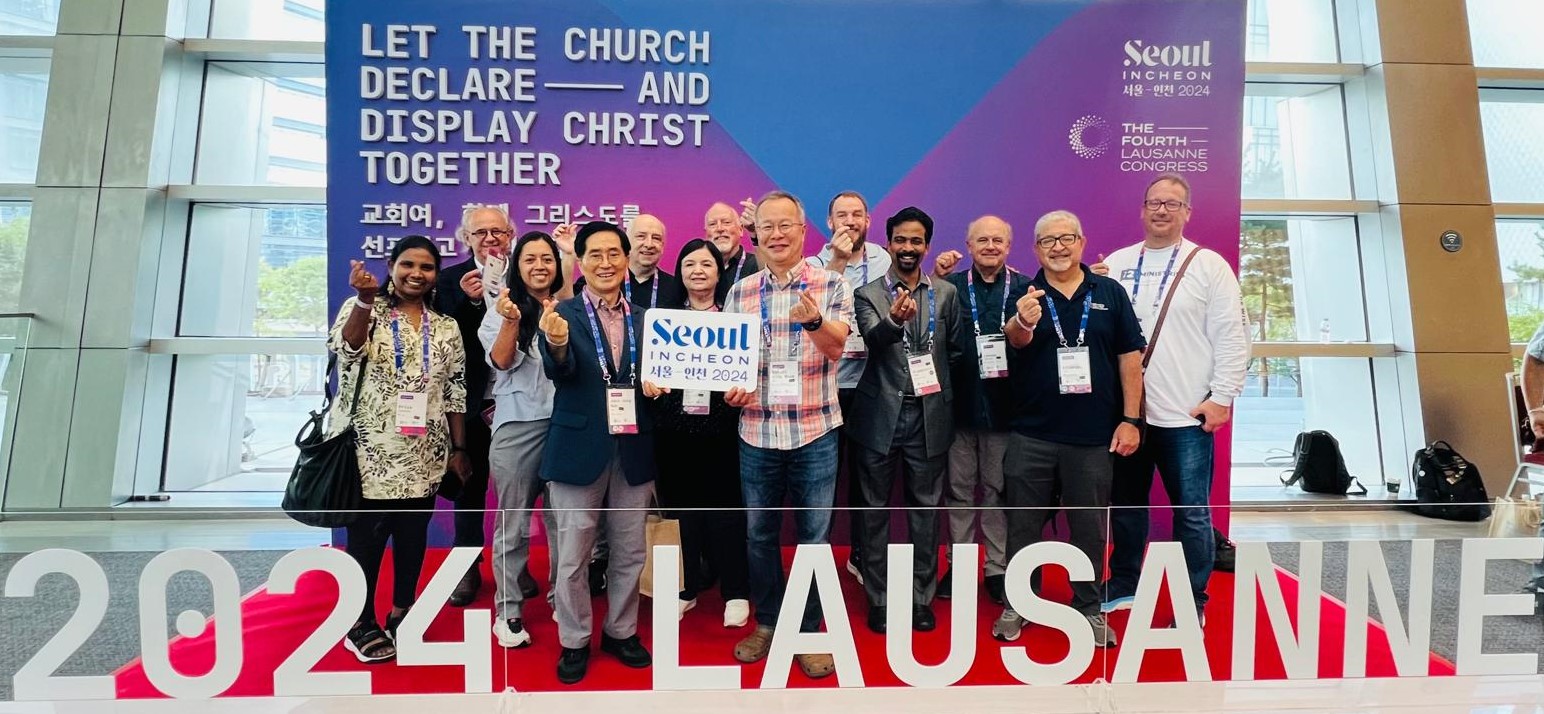
Many others from every branch of Christianity are beginning to focus on this coming anniversary: Orthodox, Roman Catholic, Armenian, Protestants, and Pentecostals. I personally was blessed to attend the recent Lausanne Congress in Seoul [see pic above with friends from Transform World group], and the Global Harvest Summit (Lausanne was founded by Billy Graham, John Stott and others in the 1970s; Global Harvest is founded by James Hwang of Korea). At these events I heard leaders of almost every global missionary agency speak on this next nine years leading up to 2033. Rick Warren, Billy Wilson, and a plethora of Evangelical names of major leaders with a common focus was impressive.
Most of the global church will be emphasizing the resurrection of Jesus which is recognized by most traditions as April 17, 2033. As important as that is, I want to focus on another date about 40 days later. That was the moment when Jesus gathered His followers one last time before He ascended into heaven. In His final message He spoke what we often call the Great Commission.
This final command to the church included of course the importance of preaching to every person in the world the salvation message, and to win souls for heaven. But it also included a task relevant to this present world: “make disciples of all nations.” The complete final message is understood fully by reading the end of all the synoptic gospels: Matthew 28, Mark 16 and Luke 24. Mark remembered Christ’s emphasis on preaching, but Matthew remembered the focus on transforming nations. Luke also added Christ’s exhortation to receive the Holy Spirit in order to restore God’s kingdom on earth to the uttermost parts of the earth.
Pagan Global Agendas
Jesus said that the wheat and the tares will both both grow to fruition before Christ returns. Indeed pagan man today is busy developing a strategy for discipling the nations in the ways of the world. Most have probably heard of the United Nation’s 2030 Agenda and 17 sustainable development goals. Others have heard of the World Economic Forum’s Great Reset. Other global organizations and multi-national corporations are working in concert to promote and establish public policies and international agreements that undermine the sovereignty of nations, but more importantly, attack the morals, values and worldview of church around the world.
Many of these worldly agendas sound good on the surface. Language has been used very intentionally to deceive and unify on common goals, but in the various agreements and in documents that agencies try to implement in most nations, we find details that are disturbing. They often are destructive, and dangerous to individual rights, and end up intending the very opposite of what most people have understood the goals to mean.
I was honored to attend a meeting at the United Nations last November to mark the 75th anniversary of the Declaration of Human Rights adopted by the UN long ago. It was for the most part consistent with Christian values and worldview. But key words in the document have been redefined by the UN agencies and leaders to now mean the exact opposite of what the original document affirmed.
In many nations of the world today there are large percentages of Christians in the populations, certainly larger than the percentages of LGBTQ, abortion or woke ideology advocates. Yet at this moment, those movements have a united strategy and are winning the battles for control of policies in the nations. Although much smaller than the numbers of Christians, they have been working gradually and consistently for decades to get people into high influence in every sphere of society: Arts/Media/Entertainment, Businesses and Banks, Church hierarchies, Health Care agencies, Universities and Research institutions, Family policy organizations, and of course national governments and global governing bodies. Now, having gained ascendancy in these institutions, they simply align their highly-placed leaders to work in common strategy.
By 2033, there is a good chance that the global elites will have achieved hegemony with their pagan philosophies around the world.
Unless.
But what If God’s people – Christian leaders in every nation and in every sphere of influence – began to unify and work together for transforming the nations? There have already been missionary and church leaders uniting and working together to evangelize many more people by 2033. This is a wonderful goal. And there have been some organizations that have gathered specific spheres such as Christian business leaders, or journalists, or educators, or doctors, etc. This is good but most of these networks have primarily simply to offer fellowship and religious support for those leaders.
What if the highest level of Christian leaders in all the spheres of society were to be connected together not for only fellowship but for developing a common agenda for transforming society in alignment with a Biblical worldview and values? If they came together and did what the Global elite pagans have already been doing when they meet at Davos, or New York or Geneva, what perhaps would the future look like? Would it be different than what the pagan agendas envision? If we do nothing to unite, then 2033 may be what the pagan globalists dream of.
Hopefully many more people will be converted by 2033 but while hearts may be changed, the nations may still be in the control of evil men. Even if there are huge numbers of believers, they may no longer have the freedom to guide their families, their schools, their churches, and their small businesses as they believe God expects of them.
Occupy Until He Comes
Of course, some Christians hold an eschatology that requires most of the nations to turn away from God before Christ returns. I do NOT believe that all must do so. One’s belief about the millennium or the rapture or the nation of Israel, etc, can vary, but whether we agree on those matters or not, I believe that there is one clear command of Jesus that applies until He appears: disciple the nations! Occupy until He comes!
Maybe some nations will be in greater darkness and rebellion to God. But maybe great light will have come in other nations and more alignment with God’s ways of governance than before. There will never be perfect nations, but some nations could be far closer to godly policies even in pluralistic democratic societies. If so, these would be great examples for the world.
How can we define a great nation? Deut 4: 7,8 says that a “…great nation…has God so near to it,…[that] for whatever reason [citizens] may call upon Him” and adds that “…a great nation has righteous statutes and judgments…” [And just to be clear, to create Theocracies is not part of the mission; nor to promote “Christian Nationalism” in the way that some imagine it to be.]
Having said that, I do not think Christians in power and influence in society should only work for religious goals. God loves all people and wishes to bless them and their nations if they will obey and align with His principles. We need to articulate God’s principles for nations without using religious language and quoting Scripture. We should turn policy proposals into language that anyone can understand, just as Jesus used parables to teach the masses. We should seek to serve human needs, that transcend what pagan globalism offers.
A 2033 Agenda for Great Nations
I believe that it is imperative for Christians to come together around the world and develop a strategic agenda for the nations. We need a plan of collaborative partnership for action by individuals, families, faith communities, businesses and governments in all countries. We can take what may be good in the existing agendas from worldly global organizations and improve them or add to them, while also clearly rejecting some parts of them. There are also good initiatives that some groups of believers are already working on (such as the 2040 Agenda of the Latin America Coalition for Human Rights, etc). We need collaboration with all of them.
But I propose five major National Development Areas and 15 goals that are rooted in Scripture and proven historically and empirically to bring blessing and progress without undermining the shared consensus of the natural family, religious values, national sovereignty and individual rights. The five major areas for national development would be spiritual, intellectual, political, economic, and social. More details of this will be explained in future posts.
I propose that between now and 2030 we convene regional and national gatherings of leaders in all sectors of society that will help define measurable goals and targets. Then from 2030 through 2032 we will convene them on a worldwide scale to collect and synthesize these national and regional goals and targets into a shared consensus.
Finally, by 2033 perhaps on the very day of the anniversary of Christ’s Great Commission saying to go “disciple all nations,” we may hold a world gathering in Israel to finalize and officially adopt the agenda. And with it would be dates for reviewing progress with perhaps most goals being implemented by 2040.
Where will you be on the 2000th anniversary of Jesus’ Great Commission?
In 2033, if God allows me, I will be 77 years old, and I hope (if God wills) to be there with you on that mountain top where Jesus gave us the mission for transforming the nations. And hopefully with me will be half of the world’s nations who have sent their highest leaders in government, business, education, journalism, health care, family, and church. I pray for at least the highest leader in 7 spheres from at least 100 nations to gather.
Those 7000 leaders “whose knees have not bowed” (1 Kgs 19:18) will humbly in the presence of God and by the power of the Holy Spirit dedicate an agenda for the nations for Christ’s glory. It will have real potential to disciple the nations because a global church will be working in concert together for it’s fulfillment. It will not be a coup or a coercive agenda, but a service agenda using democratic processes for the nations to be blessed. If this proposal is fulfilled, perhaps it will be part of the plan of God the Father who declared to Jesus that “I am giving You the nations as Your inheritance (Psa 2).” We know for certain that agenda of the Father will come to pass. If we are some small part of that, it would be an honor and a privilege.
For paid subscribers I have posted a portion of a statement issued at the recent Lausanne Congress. Although I would not agree with everything here as it is expressed, it is worth hearing what the global Evangelical world thinks at this time. Overall I find the Lausanne movement does not really have a theology formed for discipling nations. It generally limits the Great Commission to evangelization. But I include it below for your awareness.
The content below was originally paywalled.
See below section six of what Lausanne calls the Seoul Statement:
VI. The Family of Nations: The Peoples in Conflicts We See and Serve for Peace
The people of Christ must be known as a people of peace, because the gospel we proclaim brings peace between God and individuals, between individuals, and between peoples. God’s purpose is to see diverse peoples flourish as they share their gifts and the earth’s resources in just and generous ways. We thank God for many examples of Christian communities and individuals who have embodied the Bible’s consistent call to be at peace and to make peace in a world ridden with conflict. We honour them as those who champion the peace of Christ even at the risk to their own reputations and lives. And yet the church has not always honoured the peace of Christ as a defining quality of its existence in the world. There are historical examples of the church’s involvement, whether explicit or tacit, in activities and enterprises that espouse violence and promote war. These amount to the scandalising of the gospel it proclaims. What does Christ desire from his church, a people made up of all peoples, called to declare and display Christ in a world torn by conflict?
We affirm God’s purpose in Christ to reconcile all peoples through the gospel in a world full of conflict.
The Lausanne Movement has played a key role in encouraging mission to “unreached peoples” in recognition of the need for individuals of every culturally distinct people to hear the good news of God’s saving rule over all peoples and, hence, over all people. We pray for the day when states (“nations” in the modern sense) that actively seek to prevent those they govern from hearing the good news and that persecute those who hear and believe will cease doing so. We pray this not only for the sake of the individuals but of the peoples of which they are a part. Central to God’s purposes through the gospel is the reconciliation of all peoples in Christ in a relationship marked by mutual blessing. We affirm that this purpose of God can only be achieved as the hearts of individuals are transformed and filled with love for those whose cultural identity differs from their own.
We rejoice together over the many situations in the world where severe conflict has waned and estranged communities have received the opportunity for reconciliation and restoration of harmony. Some examples are the conflict in Northern Ireland, apartheid in South Africa, the Rwandan genocide, and the Sri Lankan civil war, among other conflicts around the world. We celebrate that in some of these settings God used churches, Christian organisations, and individual Christians to champion the cause of peace, whether as frontline peacemakers between conflicting parties or through negotiation, influence, and intercession in the background of the conflict.
We are deeply saddened to note that several new armed conflicts and wars—inter-ethnic, inter-religious, and international—have erupted in every region of the world. From over one hundred current armed conflicts in the world, the regions of the Middle East and Africa have seen the highest concentration. At this point in time, the Russia-Ukraine war and the war in Gaza have received the most media attention, yet severe conflicts, such as those in Syria, Myanmar, Sudan, and Ethiopia, are hardly mentioned. We also acknowledge the “forgotten wars” around the world, especially the one on the Korean peninsula. Though they remain out of public view, they are seen by God. We grieve the tragic loss of life these wars exact and the massive destruction to societies, which deny future generations their opportunity to flourish.
We repent of our failures to condemn and restrain violence by remaining silent, by promoting nationalism, or by unjustly supporting conflicts through deficient theological justification.
We condemn those who use their influence in world affairs to promote avoidable conflicts and wars, merely to further their economic and political interests. We are saddened by the immense suffering their actions have caused. We believe that they will be held accountable before God on the day of judgement.
We call all Christians to serve the vulnerable in contexts of war by pooling our resources and supporting the relief efforts of churches and humanitarian organisations that are situated near conflict zones. We also commit to serve as peacemakers, by supporting negotiations aimed at ending conflicts and by calling for justice and reparation for the innocent victims of violence.
Christians at various times in history have not only promoted violence and war but also remained silent in the face of such atrocities rather than speaking with prophetic integrity and courage. This is captured in the Cape Town Commitment:
We acknowledge with grief and shame the complicity of Christians in some of the most destructive contexts of ethnic violence and oppression, and the lamentable silence of large parts of the church when such conflicts take place. Such contexts include the history and legacy of racism and black slavery; the holocaust against Jews; apartheid; ‘ethnic cleansing’; inter-Christian sectarian violence; decimation of indigenous populations; political and ethnic violence; Palestinian suffering; caste oppression and tribal genocide.
We echo the Cape Town Commitment in calling “for repentance for the many times Christians have been complicit in such evils by silence, apathy or presumed neutrality, or by providing defective theological justification for these.” Much of this defective theological justification arises from a failure to distinguish between the “nations” of Scripture and modern “nation-states” and from a failure to think biblically about nationality. In Scripture, nations were culturally distinct peoples whose identities were shaped by historical attachment to loosely defined territory, the worship of a god (or gods) whose rule over a people was exercised through a king. By contrast, “nation-states” (or “nations” in the modern sense) are governments that administer internationally recognized political sovereignty by means of constitutionally ordered institutions and laws, over territories with clearly demarcated borders and the individuals and peoples who live within them. Most modern nation-states govern multiple peoples, that is, groups within their borders who do not derive their collective identity from nationality alone but from ethnicity, race, country of origin, and the many other forms of collective identity that enrich the modern world. In terms of identity, these culturally distinct groups are often closer to the peoples that formed the “nations” of Scripture than to modern states. We affirm that every modern state is accountable to the divine demand for the just and merciful treatment of both the individuals and peoples over whom it exercises sovereignty as well as those of its neighbours.
It is critically important that Christians think clearly about biblical peoples when they (e.g. Israelites, Egyptians, Syrians) are associated by name, history, geography, or ancestry with modern nation-states (e.g. Israel, Egypt, Syria) and the peoples who live under the political sovereignty of these states (Jews, Palestinians, Arabs, Copts, Druze, Armenians, Kurds, and many more). God is fulfilling his promises to all these peoples—both Jews and Gentiles—through the good news of Jesus, the Messiah. In the Middle East, and elsewhere, Christian leaders must work to correct theological errors that provide ideological justification for unjust violence against innocent civilians or seek to legitimise violations of international humanitarian law.
We lament that some Christians have looked to the state rather than the gospel as the key means for bringing about God’s intentions for the world. This takes an especially regrettable form when wed to nationalism—here defined as the belief that every state should have a single, national culture and no other—or ethnonationalism—which is the belief that every ethnic group should have its own state. This is a great evil in our world. We lament that many Christians have been sadly complicit in it, as well as in the claims of ethnic and racial supremacy it fosters. Against this, we assert that no modern state is able to claim or will ever be able to claim to be the special agent of God’s saving rule.
We commit to pray and serve peoples in conflict in the world so that the gospel of Jesus Christ might bring true peace to all peoples.
As we gather for this historic congress in Incheon, South Korea, we commit to pray for the peace and light of Christ to reign over the Korean peninsula and its people, who were forcibly divided into the politically separated countries of North Korea and South Korea. This wrongful separation and the death and trauma of millions of civilians is known as the Forgotten War. Despite the ceasefire of 1953, the conflict remains unresolved and instability continues to this day in a vicious cycle of rapprochement followed by escalating tensions. Nonetheless, we continue to pray that one day Korea and the Korean people will be one. We remember the great Pyongyang Revival of 1907 that took place among Koreans in the north and call for an end to the persecution of our Christian brothers and sisters by the government of North Korea. We call the global church to pray that God may open a door for the restoration of long-separated families, communities, and churches, and for the gospel of Jesus Christ to be boldly proclaimed and displayed without hindrance or fear in North Korea once more so that the whole peninsula might know the Lord.
We call all Christians everywhere to intercede on behalf of those who face the horrors of war and conflict, to pray for the persecuted church, and to labour for peace among the peoples and nations of the world. As Christ’s peacemakers, we must build Christian communities that exemplify the peace of Christ and promote a culture of peace as a crucial outworking of our faith in and proclamation of the gospel. In this way, we declare and display Christ together in a world deeply wounded by conflicts.