Part 14 of a Political Narrative of the New Testament
In the previous post we examined the main political principles and ideas in Peter’s Letter to the Provinces of Turkey, and Paul’s letters to Timothy, Titus. We saw Peter discuss the purpose go government and mention social strategists and senior statesmen. Paul tells Timothy and Titus similar things concerning requirements for leaders in the citizen assemblies, and of the importance of strategic insights and godly conduct in both family and business spheres.
[Note: This series of posts does not assert that politics is primary in the New Testament, however, there are often overlooked principles and ideas that are worthy of attention. For context we paraphrase certain Bible terms by how it was understood at the time. We ask ourselves: ‘What did this word or phrase mean to those first-century hearers or readers? Then we paraphrase the scripture to reflect that understanding. A simple example is the word ekklesia which today is translated church and means a religious meeting to most people, but in New Testament times it was understood by everyone to be a citizen assembly focused on solving community problems. Modern readers of Scripture focus only on the religious activities and teachings in Acts and the Epistles. But Christians were active in politics from the beginning. Failure to understand this and to believe Christianity only belongs in the religious sphere leads some people today to wrongly judge Christian social activism as seeking improper religious imposition of beliefs using state coercion, i.e. ‘Christian Nationalism’ or Theocracy or Dominionism. Christian activism historically is mostly in the context of democratic pluralism.]
Peter’s Second Letter, cAD65
It is thought that Peter writes this letter from Rome.
In chapter one Peter says to seek “self-government” among other virtues, and also uses democratic language to state that God’s vote for them already secured their place in the everlasting government of Jesus the Sovereign (i.e. “…your…election…into everlasting Kingdom of our Lord”).
Then, as in his first epistle, Peter emphasizes that they heed the “…strategic worldview message” and explains that “no strategic worldview of Scripture is of any private interpretation, for Strategic insights for society…came…by Spirit.” Peter speaks of the prophets or social strategists, but he is arguing not based on the Old Testament prophetic messages, but those among them in the present.
Continuing with the social strategist focus in chapter two he warns of “false Social strategists.” Peter brings up the example of Balaam who was a social strategist who was corrupted. People like him promise “liberty” but are “slaves of corruption.” The standard for determining true from false prophets or non-biblical social strategists Peter says is if they deviate from the transcendent political priorities (i.e. Commandments).
Peter however speaks of God’s faithfulness, just as He did not spare the angels who sinned nor the violent people of Noah’s time, to bring His policy decisions and punishment on the present ungodly and “unjust” people and their lawless deeds (one of which is speaking evil of dignitaries).
And in chapter three Peter again says to “be mindful of the words… spoken before by holy social strategists…” Perhaps the diaspora was already aware of the First Jewish-Roman War that in AD66 began in the land of Israel. If not, they were about to learn of it and would find Peter’s words helpful to analyze current events.
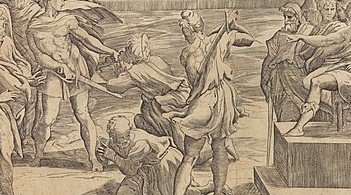
Shortly after this Peter was probably arrested and killed in Rome (see pic above of martyrdom of Peter and Paul). Paul was also arrested again and writes his last letter from prison in Rome.
Paul’s second letter to Timothy, cAD66
Paul informs them in chapter one of being a prisoner once again and the disturbing news that all believers in Turkey had “turned away from me…ashamed of my chains.” Why would they be ashamed? Perhaps it was because they did not support his resistance to tyranny. They thought he should be quiet and just focus on evangelism. This is true today for many Christians as well who think they should never speak up about political things and will not give support to believers who do so.
But in chapter two Paul argues using militant language saying we must “endure hardship as a good soldier of Jesus pre-chosen world Ruler. No one engaged in warfare entangles himself with the affairs of this life, that he may please him who enlisted him as a soldier.” Paul says “I suffer trouble as an evildoer, even to the point of chains.” This is how believers who resist tyranny are perceived. We are portrayed as the evildoers and punished. But Paul declares that there is no loss in being imprisoned because when we proclaim the truth, “the word of God is not chained…” The only thing that can “chain” the word of God is our own silence and cowardice. But Paul says he did it for the same of those voted in (i.e. the elect) by God. Paul’s confident counsel is “If we endure, We shall also govern with Him…”
In chapter three Paul speaks of things we must endure in “perilous times” as we face: “…slanderers, …brutal, despisers of good, traitors….evil men and impostors…” Paul specifically mentions persecutions he faced at Antioch, at Iconium, at Lystra. But “out of them all the Lord delivered me.” Paul says these were “the last days” but this seems not to be a reference to human history, but only the end of the first covenant era that God established with the Temple and sacrificial system in Israel.
Paul’s thoughts in the fourth chapter seem to indicate his awareness of his imminent martyrdom as he boldly proclaims that “…Jesus the pre-chosen world Ruler…will govern…at His appearing and His government…” This may refer to the final coming of Jesus or it may also be a reference to the continuous “appearings” or interventions in human affairs.
Paul says it is the time “of my departure” but he is glad that he “fought the good fight.” If Christians do not feel they are in a fight in their culture, it is likely due to avoiding conflict by their silence and excusing it with narrow personal pietistic goals. Paul expresses confidence that “the Sovereign, the righteous Governor, will give to me [a crown]…[The] Sovereign will… preserve me for His supreme government.” He understood the goal is not about eternal vacation in heaven, but about governance with God in heaven and on earth, in both time and eternity.
One of the last news updates says that “…Erastus stayed in Corinth…” Again this person was one of Paul’s apostolic team members who had run for elected office in Greece and won. He was likely still serving as an elected government official in Corinth – a New Testament example of Christians who engaged in politics in the first century with the Apostolic approval in the context of democratic pluralism.
Paul was killed shortly after writing this epistle.
Jude’s letter, c67/68AD
At about this time a letter was written by a person named Jude. It is not certain if he was a brother of James the Just, or one of the Twelve Apostles.
Jude warns of God’s policy decisions as sure as He had done for Sodom and Gomorrah in the past. So also it will come on “…[those who] reject authority” and he gives examples such as fallen angels, Cain, Balaam and Korah.
Then Jude cites Enoch as an example of one who “…saw/spoke Strategic insights for society.” He quotes Enoch as saying: “the Sovereign comes…to execute policy decisions on all.” Then Jude declares to God “…Be…majesty, Dominion and power, Both now and forever.” Note that it is not only future dominion, but now also.
Letters from Jesus to Citizen Assemblies in Turkey, cAD68
Although some scholars think that the book of Revelation was written at a later date, it is plausible that it was composed about 68AD while Jerusalem was under siege and about to be destroyed by the Romans. The emissary John was arrested and from exile was told by Jesus to write personalized letters from Him to seven citizen assemblies of present-day Turkey. We will note below only the political ideas in these seven letters found in Revelation chapters two and three.
Each of these messages mentions situations that seem to have governmental or political connotation or situations as follows:
– To the citizen assembly of Ephesus Jesus commends them for hating “…the deeds of the Nicolaitans.” This term meant “those who oppress people” and may refer to political oppression.
– To the citizen assembly of Smyrna Jesus says that ‘…the devil is about to throw some of you into prison” which may mean political persecution was coming.
– To the citizen assembly of Pergamos Jesus told them that they dwell where “Satan’s place of governance is” and he commends Antipas “My faithful martyr.” Jesus also promises them that “…To him who overcomes I will give…a white stone.” This meant a ballot for using in a democratic election. It signified their empowerment in matters of governance.
– To the citizen assembly in Thyatira Jesus rebuked them for tolerating a woman identified as “…Jezebel, who calls herself a Social strategist.” It seems likely that this was symbolic of a person in government who God associated with an evil political leader in Old Testament history. Jesus promises to those who overcome He “will give power over the nations.” And a verse is quoted saying God “shall rule them…’”
– To Sardis and Philadelphia there are no obvious political comments, but to the citizen assembly in Laodicea Jesus promises ‘…To him who overcomes I will grant to sit with Me on My place of governance…” just as Jesus sits in His Father’s place.
The End of an Era
By this point the persecution of Christians under Nero had occurred and the land of Israel was in war with the Roman Empire. The Temple was destroyed in 70AD. Most likely around this time most of the original Twelve Apostles had been martyred. Below in the paid subscriber section is from the Jewish historian Josephus about the last days in Israel leading to the fall of Jerusalem and the Temple.
The content below was originally paywalled.
Josephus: The Fall of Jerusalem and the Temple
(Josephus’ words are drawn from his writings as indicated in italics.)
Assassins in the Temple (Antiquities 20.8.5 164-166)
Certain of these robbers went up to the city, as if they were going to worship God, while they had daggers under their garments; and, by thus mingling themselves among the multitude, they slew Jonathan [the high priest]; and as this murder was never avenged, the robbers went up with the greatest security at the festivals after this time; and having weapons concealed in like manner as before, and mingling themselves among the multitude, they slew certain of their own enemies, and were subservient to other men for money; and slew others not only in remote parts of the city, but in the Temple itself also; for they had the boldness to murder men there, without thinking of the impiety of which they were guilty.
And this seems to me to have been the reason why God, out of his hatred to these men’s wickedness, rejected our city; and as for the Temple, he no longer esteemed it sufficiently pure for him to inhabit therein, but brought the Romans upon us, and threw a fire upon the city to purge it; and brought upon us, our wives, and children, slavery – as desirous to make us wiser by our calamities.
The Slaughter of the Guards (War 4.5.1 305-313)
The Idumaeans ascended through the city to the Temple. The Zealots were also in great expectation of their coming, and earnestly waited for them. When therefore these were entering, they also came boldly out of the inner Temple, and mixing themselves with the Idumaeans, they attacked the guards; and those that were upon the watch, but were fallen asleep, they killed as they were asleep; but as those that were now awakened made a cry, the whole multitude arose, and in the amazement they were in, caught hold of their arms immediately, and betook themselves to their own defence. So long as they thought they were only the Zealots that attacked them, they went on boldly, as hoping to overpower them by their number; but when they saw others pressing in upon them also, they perceived the Idumaeans were got in; and the greater part of them laid aside their arms, together with their courage, and betook themselves to lamentations. But some few of the younger guards covered themselves with their armor and valiantly received the Idumaeans, and for a while protected the weaker people. Others, indeed, gave a signal to those that were in the city of the calamities they were in; but when these were also made sensible that the Idumaeans were come in, none of them durst come to their assistance; only they returned the terrible echo of wailing, and lamenting their misfortunes. A great howling of the women was excited also, every one having a relative in the guards who was in danger of being killed.
The Zealots also joined the the shouts raised by the Idumaeans; and the storm itself rendered the cry more terrible; nor did the Idumaeans spare anybody…and acted in the same manner as to those that supplicated for their lives, as to those that fought them, insomuch that they ran those through with their swords who desired them to remember the kinship there was between them and begged of them to have regard to their common Temple. There was no place for flight nor any hope for preservation; they were driven one upon another in heaps, so were they slain. Thus the greater part were driven together by force, as there was now no place of retreat, and the murderers were upon them, and having no other way, they threw themselves down headlong into the city, undergoing a more miserable destruction, in my opinion, than that which they avoided, because it was voluntary. And now the outer Temple was all of it overflowed with blood; and that day, as it dawned, saw eight thousand five hundred dead there.
The Murder of Zacharias (War 4.5.4 335-344)
And now these Zealots and Idumaeans were quite weary of simple massacre, so they had the audacity to set up mock trials and courts of justice for that purpose. They intended to have Zacharias, the son of Baris, one of the most eminent of the citizens, slain. What provoked them against him was that hatred of wickedness and love of liberty which were so eminent in him; he was also a rich man, so that by taking him off, they did not only hope to seize his effects, but also to get rid of a man that had great power to destroy them.
So they called together, by a public proclamation, seventy of the principal men of the populace, for a show trial, as if they were real judges, although they had no proper authority. In front of these citizens Zacharias was accused of a design to betray their city to the Romans and to have traitorously sent to Vespasian for that purpose. Now there appeared no proof or sign of what he was accused; but they affirmed themselves that they were well persuaded that so it was, and desired that such their affirmation might be taken for sufficient evidence.
Now when Zacharias clearly saw that there was no way remaining for his escape from them, as having been treacherously called before them and imprisoned, but with no intention of a legal trial, he took great liberty of speech in that despair of life he was under. Accordingly he stood up, and laughed at their pretended accusation, and in a few words confuted the crimes laid to his charge; after which he turned his speech to his accusers, and went over distinctly all their transgressions of the Law, and made heavy lamentations upon the confusion they had brought public affairs into.
In the meantime the Zealots grew tumultuous, and could scarce refrain from drawing their swords, although they designed to preserve the appearance and show of judicature to the end. They were also desirous, on other accounts, to try the judges, whether they would be mindful of what was just at their own peril.
Now the seventy judges brought in their verdict, that the person accused was not guilty — choosing rather to die themselves with him, than to have his death laid at their doors.
Hereupon there arose a great clamor by the Zealots upon his acquittal, and they were all indignant at the judges for not having understood that the authority that was given them was but in jest. So two of the boldest of them fell upon Zacharias in the middle of the Temple, and slew him. And as he fell down dead they bantered him, and said, “Now you have our verdict also, and a surer release.” They then threw him down out of the Temple into the valley beneath it.
The Lamentation of Josephus (War 5.1.4 19-20)
The darts that were thrown by the engines [of the seditious factions] came with that force, that they went over all the buildings and the Temple itself, and fell upon the priests and those that were about the sacred offices; insomuch that many persons who came thither with great zeal from the ends of the earth to offer sacrifices at this celebrated place, which was esteemed holy by all mankind, fell down before their own sacrifices themselves, and sprinkled that altar which was venerable among all men, both Greeks and barbarians, with their own blood. The dead bodies of strangers were mingled together with those of their own country, and those of profane persons with those of the priests, and the blood of all sorts of dead carcasses stood in lakes in the holy courts themselves.
Oh most wretched city, what misery so great as this didst thou suffer from the Romans, when they came to purify thee from thy internal pollutions! For thou couldst be no longer a place fit for God, nor couldst thou longer survive, after thou hadst been a sepulchre for the bodies of thine own people, and hast made the Holy House itself a burying-place in this civil war of thine. Yet mayst thou again grow better, if perchance thou wilt hereafter appease the anger of that God who is the author of thy destruction.
But I must restrain myself from these passions by the rules of History, since this is not a proper time for domestic lamentation, but for historical narrations.
The Fulfillment of Ancient Prophecies (War 4.6.3 381-388)
But these Zealots came at last to that degree of barbarity as not to bestow a burial either on those slain in the city, or on those that lay along the roads; but as if they had made an agreement to cancel both the laws of their country and the laws of nature, an, at the same time that they defiled men with their wicked action, they would pollute the Divinity itself also, they left the dead bodies to putrify under the sun.
…These men, therefore, trampled upon all the laws of man, and laughed at the Laws of God; and for the oracles of the prophets, they ridiculed them as the tricks of jugglers. Yet did these prophets foretell many things concerning virtue and vice, by the transgression of which these Zealots occasioned the fulfilling of those very prophecies belonging to their country.
For there was a certain ancient oracle of those men, that the city should then be taken and the sanctuary burnt, by right of war, when a sedition should invade the Jews and their own hands should pollute the Temple of God. Now, while these Zealots did not disbelieve these predictions, they made themselves the instruments of their accomplishment.
The Temple is Set on Fire (War 6.4.5 249-253)
So Titus retired into the tower of Antonia, and resolved to storm the Temple the next day, early in the morning, with his whole army, and to encamp round about the Holy House; but, as for that House, God had for certain long ago doomed it to the fire; and now that fatal day was come, according to the revolution of the ages: it was the tenth day of the month Lous, [Av,] upon which it was formerly burnt by the king of Babylon; although these flames took their rise from the Jews themselves, and were occasioned by them; for upon Titus’s retiring, the seditious lay still for a little while, and then attacked the Romans again, when those that guarded the Holy House fought with those that quenched the fire that was burning in the inner court of the Temple; but these Romans put the Jews to flight, and proceeded as far as the Holy House itself.
At which time one of the soldiers, without staying for any orders, and without any concern or dread upon him at so great an undertaking, and being hurried on by a certain divine fury, snatched somewhat out of the materials that were on fire, and being lifted up by another soldier, he set fire to a golden window, through which there was a passage to the rooms that were round about the Holy House, on the north side of it. As the flames went upward the Jews made a great clamour, such as so mighty an affliction required, and ran together to prevent it; and now they spared not their lives any longer, nor suffered anything to restrain their force, since that Holy House was perishing, for whose sake it was that they kept such a guard upon it.
A Comforting Thought (War 6.4.8 267-268)
Now, although any one would lament the destruction of such a work as this was, since it was the most admirable of all the works that we have seen or heard of, both for its curious structure and its magnitude, and also for the glorious reputation it had for its holiness; yet might such a one comfort himself with this thought, that it was fate that decreed it so to be, which is inevitable, both as to living creatures and as to works and places also.
However, one cannot but wonder at the accuracy of this period thereto relating; for the same month and day were not observed, as I said before, wherein the Holy House was burnt formerly by the Babylonians.
Omens of Destruction (War 6.5.3 288-309)
Thus were the miserable people persuaded by these deceivers, and such as belied God himself; while they did not attend nor give credit to the signs that were so evident, and did so plainly foretell their future desolation, but, like men infatuated, without either eyes to see or minds to consider, did not regard the denunciations that God made to them.
Star and Comet
Thus there was a star resembling a sword, which stood over the city, and a comet, that continued a whole year.
Light Around the Altar
Thus also before the Jews’ rebellion, and before those commotions which preceded the war, when the people were come in great crowds to the feast of unleavened bread, on the eighth day of the month Xanthicus, [Nisan, April, about a week before Passover] and at the ninth hour of the night, so great a light shone round the altar and the holy house, that it appeared to be bright day time; which lasted for half an hour. This light seemed to be a good sign to the unskillful, but was so interpreted by the sacred scribes, as to portend those events that followed immediately upon it.
Cow Gives Birth to Lamb
At the same festival also, a heifer, as she was led by the high priest to be sacrificed, brought forth a lamb in the midst of the temple.
The Eastern Gate
Moreover, the eastern gate of the inner temple, which was of brass, and vastly heavy, and had been with difficulty shut by twenty men, and rested upon a basis armed with iron, and had bolts fastened very deep into the firm floor, which was there made of one entire stone, was seen to be opened of its own accord about the sixth hour of the night. Now those that kept watch in the temple came hereupon running to the captain of the temple, and told him of it; who then came up thither, and not without great difficulty was able to shut the gate again.
This also appeared to the vulgar to be a very happy prodigy, as if God did thereby open them the gate of happiness. But the men of learning understood it, that the security of their holy house was dissolved of its own accord, and that the gate was opened for the advantage of their enemies. So these publicly declared that the signal foreshowed the desolation that was coming upon them.
Miraculous Phenomenon of Chariots in the Air
Besides these, a few days after that feast, on the one and twentieth day of the month Artemisius, [Iyar, May or June] a certain prodigious and incredible phenomenon appeared: I suppose the account of it would seem to be a fable, were it not related by those that saw it, and were not the events that followed it of so considerable a nature as to deserve such signals; for, before sun-setting, chariots and troops of soldiers in their armor were seen running about among the clouds, and surrounding of cities.
Sound of a Great Multitude
Moreover, at that feast which we call Pentecost, as the priests were going by night into the inner [court of the temple,] as their custom was, to perform their sacred ministrations, they said that, in the first place, they felt a quaking, and heard a great noise, and after that they heard a sound as of a great multitude, saying, “Let us remove hence.”
Jesus son of Ananias: A Voice from the East
But, what is still more terrible, there was one Jesus, the son of Ananus, a plebeian and a husbandman, who, four years before the war began, and at a time when the city was in very great peace and prosperity, came to that feast whereon it is our custom for every one to make tabernacles to God in the temple [Sukkot, autumn, 62 CE], began on a sudden to cry aloud,
“A voice from the east,
a voice from the west,
a voice from the four winds,
a voice against Jerusalem and the Holy House,
a voice against the bridegrooms and the brides,
and a voice against this whole people!”
This was his cry, as he went about by day and by night, in all the lanes of the city.
However, certain of the most eminent among the populace had great indignation at this dire cry of his, and took up the man, and gave him a great number of severe stripes; yet did not he either say any thing for himself, or any thing peculiar to those that chastised him, but still went on with the same words which he cried before.
Hereupon the magistrates, supposing, as the case proved to be, that this was a sort of divine fury in the man, brought him to the Roman procurator, where he was whipped till his bones were laid bare; yet he did not make any supplication for himself, nor shed any tears, but turning his voice to the most lamentable tone possible, at every stroke of the whip his answer was,
“Woe, woe to Jerusalem!”
And when Albinus (for he was then our procurator) asked him, Who he was? and whence he came? and why he uttered such words? he made no manner of reply to what he said, but still did not leave off his melancholy ditty, till Albinus took him to be a madman, and dismissed him.
Now, during all the time that passed before the war began, this man did not go near any of the citizens, nor was seen by them while he said so; but he every day uttered these lamentable words, as if it were his premeditated vow,
“Woe, woe to Jerusalem!”
Nor did he give ill words to any of those that beat him every day, nor good words to those that gave him food; but this was his reply to all men, and indeed no other than a melancholy presage of what was to come.
This cry of his was the loudest at the festivals; and he continued this ditty for seven years and five months, without growing hoarse, or being tired therewith, until the very time that he saw his presage in earnest fulfilled in our siege, when it ceased; for as he was going round upon the wall, he cried out with his utmost force,
“Woe, woe to the city again, and to the people, and to the Holy House!”
And just as he added at the last,
“Woe, woe to myself also!”
there came a stone out of one of the engines, and smote him, and killed him immediately; and as he was uttering the very same presages he gave up the ghost.
Prophecy of the Square Temple (War 6.5.4 310-311)
Now if any one consider these things, he will find that God takes care of mankind, and by all ways possible foreshows to our race what is for their preservation; but that men perish by those miseries which they madly and voluntarily bring upon themselves; for the Jews, by demolishing the tower of Antonia, had made their Temple four-square, while at the same time they had it written in their sacred oracles, — “That then should their city be taken, as well as their Holy House, when once their Temple should become four-square.”