Part 12 of a Political Narrative of the New Testament
In the previous post we examined the main political principles and ideas in Paul’s letters to Philippians and Ephesians. We saw Paul speak of being citizens in the highest government and of the fact that some believers were now in Caesar’s household. And that they all were “fellow citizens…[with the] Emissaries and Social strategists, Jesus pre-chosen Ruler Himself being the chief corner stone.” He repeatedly emphasized the citizen assembly, the social strategists and emissaries as being given insight and responsibility for enforcing Christ’s authority over all dominions in the present age and to ultimately “fill all things.” Examples were given for the family, the marketplace, etc.
[Note: This series of posts does not assert that politics is primary in the New Testament, however, there are often overlooked principles and ideas that are worthy of attention. For context we paraphrase certain Bible terms by how it was understood at the time. We ask ourselves: ‘What did this word or phrase mean to those first-century hearers or readers? Then we paraphrase the scripture to reflect that understanding. A simple example is the word ekklesia which today is translated church and means a religious meeting to most people, but in New Testament times it was understood by everyone to be a citizen assembly focused on solving community problems. Modern readers of Scripture focus only on the religious activities and teachings in Acts and the Epistles. But Christians were active in politics from the beginning. Failure to understand this and to believe Christianity only belongs in the religious sphere leads some people today to wrongly judge modern Christian social activism as seeking improper religious imposition of beliefs using state coercion, i.e. ‘Christian Nationalism’ or Theocracy or Dominionism. Christian activism historically is mostly in the context of democratic pluralism.]
Apparently, Paul was released from prison in Rome and had opportunity to travel another 2 or 3 years or so before his final arrest and execution. Meanwhile, other emissaries produced historical accounts or wrote letters crucial to the period. Mark is thought to have written his history of Jesus in Greek sometime in the decade prior to this, mainly for non-Jewish readers. Luke did so about this time, as did Matthew, with Matthew especially providing the Jewish understanding of the history of Jesus. This was important because the first Jewish-Roman war began in 62AD and James the Just was killed by the Sanhedrin in 63AD. The understanding of Jesus’ Jewish history was vital. And it was also crucial to understand the relationship of Christ’s work to God’s purposes for the Jewish people.
Letter to the Hebrews
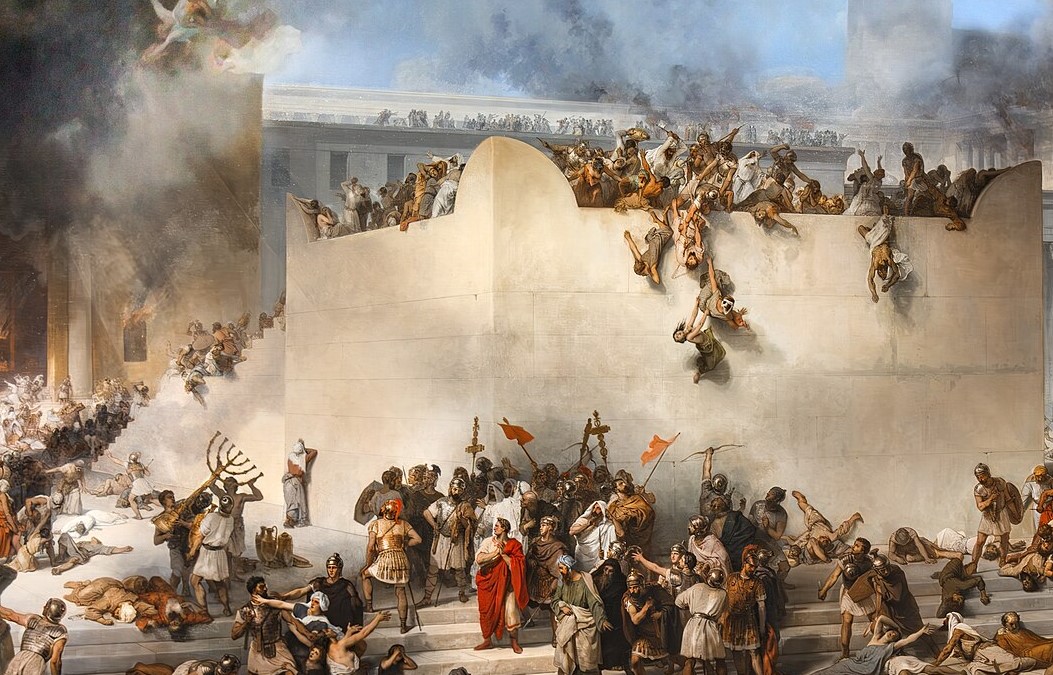
My belief is that the letter to the Hebrews was written probably around 64AD by an uncertain author before the destruction of the Temple in AD70 [see pic above]. The writer opens in Chapter one by connecting everything to the prophets, i.e. the social strategists of Israel. “God…spoke in time past to the fathers by the Social strategists…” This statement was to orient this whole letter to the context of national affairs, not just to religion. He explains that now He “has in these last days spoken to us by His Son, whom He has appointed heir of all things,….[He] sat down at the right hand of the Majesty on high…(in) Your government (i.e. kingdom).”
Christ’s Government is Secure
With government as the focus, the writer then quotes from Psalms 45. “….to the Son He says: “Your place of governance, O God, is forever and ever; A scepter of righteousness is the scepter of Your Government. You have loved righteousness and hated lawlessness; Therefore God, Your God, has endorsed You…” As we have explained in earlier posts, the idea of anointing comes from the action of the prophets whenever a new election for their king was about to take place. Anointing gave go civil power. That came through the votes of the citizens. But the act of anointing was the way that the best candidate for their votes was publicly recognized or endorsed by their most respected social strategists in the nation (i.e. their prophets). In effect was the same as modern voter education. So here the writer strategically says that Jesus had been endorsed by the Father to become the supreme Ruler of Israel and all nations.
Although Jesus’ position was secure, the writer then quotes Psalm 110: “….Sit at My right hand, Till I make Your enemies Your footstool…” To be elected is one thing, but for all opponents to concede is another. Often there is a fight to secure the authority of the winner. Jesus won the election when He died and rose again. Indeed in chapter two the writer says: “‘You have put all things in subjection under his feet [Ps 8]“…He left nothing that is not put under him. But now we do not yet see all things put under him.” His throne is secure but there are “election deniers” in this present world and they refuse to accept the results. So the rebels are still being subdued in this era. The enforcement of the victory is the present responsibility of God’s people.
Remember: Study a Biblical Worldview for all nations
Chapters 3 and 4 focus much on the idea of the Sabbath. The Sabbath Day was not just about ceasing from labor but doing something specific with the free time. As Deut 5:12,15 explained that day was to: “… do no work [and]…Remember that you were a slave…and the Lord brought you out.” This commandment required the government of Israel to give time for families and churches to assemble and teach the causes of national slavery and the way to enjoy national liberty. Understanding a Biblical Worldview is essential for citizens to live in freedom. That is why in Chapter five the writer of Hebrews then emphasizes that knowing “…the first principles of the oracles [transcendent political priorities] of God;….[they] have their senses exercised to discern both good and evil.” If citizens lack this, a nation cannot survive. This was exactly the current problem in the nation of Israel at the time this letter was written, and the same problem in many modern nations also.
In chapter seven the writer goes back to before the nation of Israel was founded. He explains that God used a person named “…Melchizedek…”king of righteousness,” and…”king of peace,” to bless Abraham. Yes God brought the full system of law through Moses, but the writer explains that God is now “…annulling of the former transcendent political priorities because of its weakness.” But we need not fear because “….Jesus has become a surety of a better constitution…” Although the nation of Israel and its temple was about to disappear in AD70, it would not be the end of God’s purposes.
Then the writer of Hebrews explains more about this national transition. In Chapter eight he affirms that “[Jesus, who is] seated at the right hand of the place of governance of the Majesty in the highest,… is also Mediator of a better constitution,,“…I will make a new constitution… not according to the constitution…with their fathers…the constitution that I will make: I will put My laws in their mind and write them on their hearts….[Ex 25 & Jer 31]“ [When] He says, “A new constitution,” He has made the first obsolete...” This new system of governance is better because it works from the inside out. Jesus governs from within the hearts of His citizens, but it’s ultimate proof is in outward transformation.
The Time of Reformation needs Faith-filled Statesmen and Social Strategists
In chapter nine he explains that “…the first constitution had….ordinances imposed until the time of reformation….” At the resurrection a reformation began that marks the end of the previous age and began a new constitutional age. In chapter ten He explains that ” “[Jesus] sat down at the right hand of God, from that time waiting till His enemies are made His footstool….” This is the constitution that I will make…I will put My laws into their hearts, and in their minds I will write them [Jer 31].” But the standards are not any lower in this new system. “….Anyone who has rejected Moses’ law dies without mercy on the testimony of two or three witnesses. Of how much worse punishment,[for he] who has trampled…the [new] constitution …For…”Vengeance is Mine, I will repay,“ [Dt 32] says the Sovereign. And again, “The Sovereign will govern His people. [Dt 32]”
But the key difference as the social strategist Habakkuk said was that “…the just shall live by faith. [Hab 2].” In chapter eleven the writer gives examples of faith that resists tyranny and impacts societies: “…[by faith] the senior statesmen obtained a good testimony …By faith Abraham…[separated from his pagan culture] …By faith [the] parents [of Moses disobeyed] …the king’s command. By faith Moses…forsook Egypt,…[and its] king;….By faith…Rahab …received the spies;…David…Samuel and the Social strategists…subdued governments…became valiant in battle…others were tortured, not accepting deliverance,…had trial of mockings and scourgings, yes, and of chains and imprisonment. They were stoned, they were sawn in two, were tempted, were slain with the sword…of whom the world was not worthy.”
Notice that in almost all of these examples, the writer is speaking not of personal righteousness or religious redemption, but of leadership in society; resisting governing tyrants and fighting for justice. This is what the book of Hebrews is mostly about – the keys for God’s people to be victorious in the nations going forward (especially after the nation of Israel is destroyed by the Romans in AD70). He is arguing that God’s people will need godly statesmen and social strategists like Israel had but now more than ever for all the nations as they pursue the Great Commission.
The reality of a new general congress and citizen council and its rulers
In chapter twelve the writer pictures the new reality. He says “Jesus…sat down at the right hand of the place of governance of God…[and likewise] you have come to…the heavenly Jerusalem,…to the general congress and citizen council of the firstborn…to God the Governor of all, to the spirits of just men made perfect, to Jesus the Mediator of the new constitution….” It’s a real kingdom that transcends all others. Indeed now “…we are receiving a government which cannot be shaken…” Notice here that it is centered in the citizen council, not the old temple. Don’t be looking for an earthly temple in just one place.
The practical reality is that “…fornicators and adulterers God will govern….” But this truth does not give license to ignore human governance. The writer says we have to actively: “Remember those who rule over you….[always with the mindset in this imperfect world that] we seek the [city] to come….Obey those who rule over you, and be submissive…have a good conscience….” Then the writer gives a closing prayer: “…may …that great Shepherd…through…the everlasting constitution, make you complete…” “Greet all those who rule over you…” Again it’s not about religious activity, but about governance and rule.
Reflection
If indeed the letter to the Hebrews was written before Jerusalem and the temple was destroyed in AD70 then it must have been helpful to God’s New Covenant people to remain calm and determined as they faced the future. In modern nations today such as the United States, God’s kingdom is not dependent on one nation for His purposes. He can raise up entirely new excellent (but not perfect) representative models of His governance in any part of the world, if the citizen assembly fulfills its mission properly to help disciple these earthly nations.