While Also Seeking to Bring More Transformation
As I write this, a terrible war is happening between the Israelis and the radical Palestinians. While praying for the situation, it is worth pondering what should we think of these things?
Often Christians around the world support the nation of Israel no matter what it does. That is not a Biblical thing to do. However, there are many legitimate reasons to usually show support for Israel. Rational processes can be difficult when we see or hear very emotional effects of war, but let us try.
There are many Christians who blindly support Israel due to their views of endtime prophecy. The interpretation of many verses is often lacking context of history and of historic Biblical hermeneutics. I remember hearing a pastor say that Israel should just wipe out the Palestinians (ignoring the reality that some are Christians), destroy the mosque on the temple mount, and attack surrounding nations in order to reclaim land in those other countries that they were promised in the Bible. Some Christians seem eager for war because they think it has to come for Jesus to return. Although sincerely held, such views are dangerous and wrong.
I generally reject the idea that the nation of Israel today is a key to the endtimes. I have lived long enough to watch the predictions and dates of popular prophecy books fail again and again. Focusing on current events related to Israel for interpreting endtimes can be misleading.
My primary view of the endtimes is based on the Great Commission of Jesus, telling us to go and make disciples of all nations before he returns. In my view, we are far from fulfilling that task. (Although not agreeing with every point, a book on endtimes by Dr. Finley addresses this with historical and scriptural reasoning that is worthy of consideration. It is available for purchase from my ministry. Click here to find out more.)
It may very well be that every people group will have heard the gospel by 2033. Many of my friends are working hard for that goal. Many mission-minded believers around the world believe that the Middle East and especially Israel will be the last place of evangelistic breakthrough and then Christ will return. It is a worthy goal, because that part of the world (the 10/40 window) is the least evangelized today.
But making disciples of all nations is another matter. I am working hard for that goal. Discipling nations is more than just evangelizing them. It means doing everything we can to help bring them into alignment with the Creator’s guidelines for nations, including governance, economics, education, health care etc.
But is supporting the nation of Israel no matter what necessary for God’s purposes? No. All nations have various levels of alignment with Biblical standards of freedom and justice. America is still lacking in many ways and we must pray and work for transformation in our own land. The same is true for Israel. There are many things that are not good in Israel. It is wrong for Christians to hide that reality.
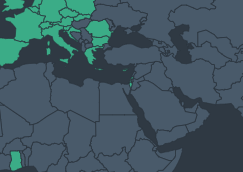
But by almost any measurement, there is a huge difference between the nation of Israel and most other nations of the Middle East and North Africa (MENA). One measurement tool is done by Freedom House. Look closely at the map at the beginning of this blog. Do you see it? There is a tiny light blue dot in the MENA region that signifies nations that are considered realy free. That dot is Israel.
On a scale of 1 to 100, it gives Israel a score of 77 when it comes to political rights and civil liberties. That is better than two thirds of all nations on earth, and better than ALL OTHER nations of MENA. All of them. [FYI: USA gets a score of 83]
(The paid subscriber section today has more statistical information in 25 categories that explains Israel’s ranking by Freedom House. It can be useful in secular settings to explain your comparative support of Israel.)
Despite failures of its government and people at times, there is without question a strong reason for us to support Israel, in light of the region and the world at large. Israel can still improve of course and we must try to help it become better. But all of the nations around are much worse. God loves both Israelis and Arabs and wants us to reach them all with the gospel and with the transforming principles of the Creator for every sphere of life, including the political problems we see.
Wars create terrible situations for innocent people. Besides the obvious lives that are lost, homes are destroyed, people are displaced and much suffering follows for many years. Rights and freedom, normally recognized and protected, are temporarily lost and often restricted for a long time.
Israel was legally granted its homeland by the international community in 1948 and has been attacked by its neighbors repeatedly since then. Over a thousand innocent Israeli civilians, even babies were murdered in cold blood this very week. There is no excuse.
I don’t support war for the sake of prophecy, but Israel has a right to defend its people from barbaric deadly attacks. Let us pray for them to be successful and bring full judgement upon the murderers. But let also pray for innocent Palestinians, many of them Christians, who have nothing to do with the barbaric terrorist activity. Let us not be affected by the emotional propaganda that the anti-semitic elements around the world will use against Israel.
We have the hard data that transcends emotion. The facts are that Israel’s government (although still needing more improvement) is far more just and free than most of those critics we will hear in coming days, especially in the other governments of the Middle East. While supporting Israel in this time, let us also pray for God to move in the region for His kingdom purposes for all people and nations.
The content below was originally paywalled.
[Everything below is edited information from FreedomHouse.org. All scores are in the range of 1 to 4, 4 being the best. In some of the items, I included some explanation of why Freedom House gave a certain score to Israel.]
Overview
Israel is a parliamentary democracy with a multiparty system and independent institutions that guarantee political rights and civil liberties for most of the population. Although the judiciary is comparatively active in protecting minority rights, the political leadership and many in society have discriminated against Arab and other ethnic or religious minority populations, resulting in systemic disparities in areas including infrastructure, criminal justice, education, and economic opportunity.
Political Rights
A Electoral Process
Was the current head of government or other chief national authority elected through free and fair elections?
4 out of 4
Were the current national legislative representatives elected through free and fair elections?
4 out of 4
Are the electoral laws and framework fair, and are they implemented impartially by the relevant election management bodies?
4 out of 4
The Central Elections Committee (CEC), is responsible for ensuring the fairness of elections. It is composed of delegations representing the various political groups in the Knesset, supported by a professional staff, and chaired by a Supreme Court judge. Elections are generally conducted in a peaceful and orderly manner, and all parties usually accept the results.
B Political Pluralism and Participation
Do the people have the right to organize in different political parties or other competitive political groupings of their choice, and is the system free of undue obstacles to the rise and fall of these competing parties or groupings?
3 out of 4
Israel hosts a diverse and competitive multiparty system. However, parties or candidates that deny Israel’s Jewish character, oppose democracy, or incite racism are prohibited. This has occasionally been invoked against both far-right Jewish candidates and Arab candidates. After agreeing to join the coalition government in December 2022, the far-right Religious Zionist party announced plans to pursue legal amendments that would remove the prohibition on “racial incitement” in the Knesset.
Is there a realistic opportunity for the opposition to increase its support or gain power through elections?
4 out of 4
Israel has undergone multiple, peaceful rotations of power among rival political groups during its history, and the 2022 elections resulted in the replacement of the incumbent prime minister. Opposition parties have typically controlled many local governments, and Arab-majority towns are mostly run by independents or mayors from the Joint List.
Are the people’s political choices free from domination by forces that are external to the political sphere, or by political forces that employ extrapolitical means?
4 out of 4
Israeli voters are generally free from coercion or undue influence by interest groups outside the political sphere. Political parties rely mostly on public subsidies for their financing.
Do various segments of the population have full political rights and electoral opportunities?
2 out of 4
Political rights are unevenly upheld….Women generally enjoy full political rights in law and in practice, though they remain underrepresented in leadership positions….
In 2018, the Knesset adopted a new “basic law” known as the nation-state law, which introduced the principle that the right to exercise self-determination in the State of Israel belongs uniquely to the Jewish people, among other discriminatory provisions. The basic laws of Israel are considered equivalent to a constitution, and critics of the nation-state law said it created a framework for the erosion of non-Jewish citizens’ political and civil rights, though any such effects have been limited to date.
Arab citizens of Israel, who often identify as Palestinian, already faced some discrimination in practice, both legal and informal….The roughly 670,000 Jewish settlers in the West Bank and East Jerusalem are Israeli citizens and can participate in Israeli elections. Arab residents of East Jerusalem have the option of obtaining Israeli citizenship, though most decline for political reasons….While these noncitizens are entitled to vote in municipal as well as Palestinian Authority (PA) elections, most have traditionally boycotted Israeli municipal balloting, and Israel has restricted PA election activity in the city. A Palestinian Jerusalem resident who is not a citizen cannot become mayor under current Israeli law….Citizenship and residency status are overwhelmingly denied to Palestinian residents of the West Bank or Gaza Strip who are married to Israeli citizens.
C Functioning of Government
Do the freely elected head of government and national legislative representatives determine the policies of the government?
4 out of 4
The government and parliament are free to set and implement policies and laws without undue interference from unelected entities.
Are safeguards against official corruption strong and effective?
2 out of 4
Corruption scandals are common in all levels of government, and high-level corruption investigations are relatively frequent, with senior officials implicated in several scandals and criminal cases in recent years.
Does the government operate with openness and transparency?
3 out of 4
Israel’s laws, political practices, civil society groups, and independent media generally ensure a substantial level of governmental transparency, though recent corruption cases have illustrated persistent shortcomings. The Freedom of Information Law grants every citizen and resident of Israel the right to receive information from a public authority. However, the law includes blanket exemptions that allow officials to withhold information on the armed forces, intelligence services, the Atomic Energy Agency, and the prison system, potentially enabling the concealment of abuses. Additionally, authorities often fail to respond to freedom of information requests in a timely manner, leading individuals and civil society organizations to turn to the courts to compel the government to respond.
Civil Liberties
D Freedom of Expression and Belief
Are there free and independent media?
3 out of 4
The Israeli media sector is vibrant and free to criticize government policy. While the scope of permissible reporting is generally broad, print articles on security matters are subject to a military censor….
Most Israeli media outlets are not financially independent, and are affected by the commercial interest of their owners, sometimes resulting in coverage biased toward the owners’ business and political interests.
Are individuals free to practice and express their religious faith or nonbelief in public and private?
3 out of 4
While Israel defines itself as a Jewish state, freedom of religion is largely respected. Christian, Muslim, Druze, and Baha’i communities have jurisdiction over their own members in matters of marriage, divorce, and burial. The Orthodox establishment governs personal status matters among Jews, drawing objections from many non-Orthodox Israelis….
Although the law protects the religious sites of non-Jewish groups, they face discrimination in the allocation of state resources as well as persistent cases of vandalism or harassment, which usually go unsolved.
Is there academic freedom, and is the educational system free from extensive political indoctrination?
3 out of 4
Primary and secondary education is universal, though divided into multiple public school systems (state, state-religious, independent religious, Arabic-Christian, Arabic-Druze, and Arabic-Muslim) as well as private schools. School quality and resources are generally lower in mostly non-Jewish communities….Attempts to influence or restrict academic freedom at universities are generally blocked.
Are individuals free to express their personal views on political or other sensitive topics without fear of surveillance or retribution?
3 out of 4
While private discussion in Israel is generally open and free, there are some restrictions on political expression. For example, the 2011 Boycott Law exposes Israeli individuals and groups to civil lawsuits if they advocate an economic, cultural, or academic boycott of the state of Israel or West Bank settlements.
The Haaretz newspaper has reported that police have targeted current and former government officials, businesspeople, and others with the Pegasus spyware, which was developed by an Israeli company.
E Associational and Organizational Rights
Is there freedom of assembly?
3 out of 4
Protests and demonstrations are widely permitted and typically peaceful. However, some protest activities—such as desecration of the flag of Israel—can draw criminal penalties, and police have sometimes attempted to restrict peaceful demonstrations….
Is there freedom for nongovernmental organizations, particularly those that are engaged in human rights– and governance-related work?
2 out of 4
The environment for nongovernmental organizations (NGOs) has deteriorated in recent years. A law enacted in 2012 requires NGOs to submit financial reports four times a year on support received from foreign government sources. Under a 2016 law, NGOs that receive more than half of their funding from foreign governments must disclose this fact publicly and in any written or oral communications with elected officials. The measure mainly affects groups associated with the political left that oppose Israel’s policies toward Palestinians; foreign funding for right-leaning groups that support Jewish settlements in the West Bank, for example, more often comes from private sources….
Is there freedom for trade unions and similar professional or labor organizations?
4 out of 4
Workers may join unions and have the right to strike and bargain collectively, although employers often attempt to prevent such moves….
F Rule of Law
Is there an independent judiciary?
4 out of 4
The judiciary is independent and regularly rules against the government. The Supreme Court has historically played a crucial role in protecting minority groups and overturning decisions by the government and the parliament when they threaten human rights. The court hears direct petitions from citizens and other individuals in Israel as well as Palestinian residents of the West Bank and Gaza Strip, and the state generally adheres to court rulings….
Does due process prevail in civil and criminal matters?
3 out of 4
Although due process is largely guaranteed in ordinary cases, those suspected of security-related offenses are subject to special legal provisions. Individuals can be held in administrative detention without trial for renewable six-month terms. According to human rights groups, at the end of 2022, more than 4,600 Palestinians from the occupied territories were being held in Israeli facilities on security grounds, including over 860 in administrative detention—the greatest number of administrative detainees since 2008. As of August 2022, all administrative detainees were Palestinians, 11 of whom held Israeli citizenship. The Supreme Court almost never grants attorneys’ requests to void administrative detention orders. Under criminal law, individuals suspected of security offenses can be held for up to 96 hours without judicial review under certain circumstances, and be denied access to an attorney for up to 21 days….
Is there protection from the illegitimate use of physical force and freedom from war and insurgencies?
2 out of 4
Israeli border communities receive occasional rocket and artillery fire from militant groups in the Gaza Strip, and more rarely from Lebanon and Syria. In August 2022, several Israeli communities were targeted with rockets fired from Gaza by the militant group Palestinian Islamic Jihad (PIJ), which is designated as a terrorist group by the United States, after Israeli forces assassinated a number of the group’s top commanders….
.The Supreme Court banned torture in a 1999 ruling, but said physical coercion might be permissible during interrogations in cases involving an imminent threat….
Do laws, policies, and practices guarantee equal treatment of various segments of the population?
2 out of 4
Jewish citizens of Israel, particularly those of Ashkenazi descent, typically enjoy practical advantages relative to the rest of the population on matters including legal treatment and socioeconomic conditions. Arab or Palestinian citizens of Israel face de facto discrimination in education, social services, personal security, and access to housing and related permits….Israelis of Ethiopian origin suffer from discrimination—including in the criminal justice system—and lag behind the general population economically despite government integration efforts.
Women are treated equally in criminal and civil courts and have achieved substantial parity within Israeli society, though economic and other forms of discrimination persist, particularly among Arab and religious Jewish communities. Religious courts that rule on family law cases systematically discriminate against women….
G Personal Autonomy and Individual Rights
Do individuals enjoy freedom of movement, including the ability to change their place of residence, employment, or education?
3 out of 4
Security measures can sometimes present obstacles to freedom of movement, though military checkpoints are restricted to the West Bank. Informal local rules that prevent driving on the Sabbath and Jewish holidays can also hamper free movement.
Are individuals able to exercise the right to own property and establish private businesses without undue interference from state or nonstate actors?
3 out of 4
Property rights within Israel are effectively protected, and business activity is generally free of undue interference. Businesses face a low risk of expropriation or criminal activity, and corruption is not a major obstacle for private investors….
Do individuals enjoy personal social freedoms, including choice of marriage partner and size of family, protection from domestic violence, and control over appearance?
3 out of 4
Personal social freedoms are generally guaranteed. However, since religious courts oversee personal status issues, women face some disadvantages in divorce and other matters. Many ultra-Orthodox Jewish communities attempt to enforce unofficial rules on gender separation and personal attire in the public sphere. Marriages between Jews and non-Jews are not recognized by the state unless conducted abroad, nor are marriages involving a Muslim woman and a non-Muslim man. Israel recognizes same-sex marriages conducted abroad….
Do individuals enjoy equality of opportunity and freedom from economic exploitation?
2 out of 4
Israel remains a destination for human-trafficking victims, and African students, migrant workers, and asylum seekers residing in the country are especially vulnerable to forced labor and other forms of exploitation. In 2021, the US State Department’s Trafficking in Persons Report demoted Israel to Tier 2, citing the government’s insufficient efforts to combat human trafficking….