Besides the primary meaning, secondary application is useful for all citizens and believers
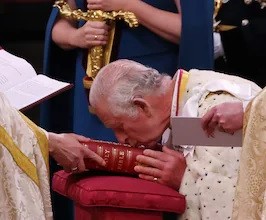
The image above of King Charles kissing the Bible at his coronation seems shocking to many modern minds. It hearkens to a view from history that in the Bible was found how to govern nations rightly. We are looking at these forgotten truths.
In previous posts we have explained indepth the primary purpose of the Ten Commandments. A Simple Summary is below as citizens in Moses’ time would have understood it:
1: Israel’s Government shall not recognize contrary sources of law
2-3: Israel’s Government shall not use or misuse religion, sex & marketplace
4-5: Israel’s Government shall empower schools & families
6-9: Israel’s Government shall not violate life, marriage, property, justice
10: Israel’s Government shall not infringe citizen liberty in everything else
Let us then restate each of these more fully:
The primary focus is on the government’s responsibility. Both before and after the commandments and laws are given, it clarifies to whom:
Ex 19:7 Moses came and called for the elders of the people, and laid before their faces all these words which the LORD commanded him. Ex 24:1 …Come up to the Lord, you and Aaron, Nadab and Abihu, and seventy of the elders….
So let us look at each one:
Word 1: Government shall not recognize contrary sources of law
1. Exod 20:3— “You [i.e. the governing elders or government] shall have no other gods before me”
Restated: Your government shall have no other sources of law [i.e. worldviews] above Jehovah.
Words 2-3: Government shall not use or misuse religion, sex & marketplace
2. Exod 20:4— “You [the governing elders] shall not make for yourself a carved image; ….nor serve them”
Restated: Your government shall not mix religious or sexual activity for political purposes.
3. Exod 20:7— “You [the governing elders] shall not take the name of the Lord your God in vain”
Restated: Your government shall not corrupt nor control social or economic contracts or marketplace activity.
Words 4-5: Government shall empower schools & families
4. Exod 20:8 “[the governing elders shall] Remember the Sabbath day to keep it holy. . .You [the elders] shall do no work… within your gates. [Deut 5:15] Remember that you were a slave….and…God brought you out“
Restated: Your government shall not work 1day/wk & provide opportunity for citizens’ education and rest
5. Exod 20:12— “[the governing elders shall] Honor your father and your mother that your days may be long upon the land” . . .
Restated: Your government shall give priority to parental rights and responsibilities to strengthen the family institution and thus bring long-term blessing and stability to the nation.
Words 6-9: Government shall not violate life, marriage, property, justice
6. Exod 20:13— “You [the governing elders] shall not murder”
Restated: Your government shall not take the life of innocent citizens.
7. Exod 20:14— “You [the governing elders] shall not commit adultery”
Restated: Your government shall not use marriages for political purposes.
8. Exod 20:15— “You [the governing elders] shall not steal”
Restated: Your government shall not own or seize land and property.
9. Exod 20:16— “You [the governing elders] shall not bear false witness against your neighbor”
Restated: Your government shall not use false witnesses.
Word 10: Government shall not infringe citizen liberty in everything else
10. Exod 20:17— “You [the governing elders] shall not covet your neighbor’s house,…wife, nor his male servant, nor his female servant, nor his ox, nor his donkey, nor anything that is your neighbor’s.
Restated: Your government shall not violate individual sovereignty/liberty of its citizens.
Secondary application of the Commandments for all:
Although the first purpose of the Decalogue was to define duties and limits of Israel’s governors (i.e. Elders and Judges), the legal principles carried over to all citizens in Israel as well. The shift from personal pronouns in Ex 20 to non-personal laws in Ex 21,22, and 23 is the natural application of the principles of the Decalogue.
The content below was originally paywalled.
Most commentaries and catechisms interpret the Decalogue for personal pietistic purposes. They will present the first four commandments as dealing with personal worship of God, and sometimes suggest that government should require a national religion. This is not a Biblical idea. The first four commandments do uphold in a broad sense, private sector cultural foundations of freedom connected to four words in these commandments: “gods” = Worldview, “image” = Religion, “name” = Morality, and “day” = Knowledge. Government cannot produce worldview, religion, morality, and knowledge, so the state’s role in those cultural institutions that do, is simply to protect and arbitrate, not regulate.
The Ten Words can be applied more generally to all citizens in the following restatement:
Word 1: citizens must not undermine the one source of law
1. Exod 20:3— “You shall have no other gods before me”
Restated: Your government shall punish citizens who violate the one official source of law (i.e. worldview of Jehovah). Citizens shall also uphold and respect the higher law acknowledged in the constitution.
Only the God that brought them freedom is where they must get right and wrong for their laws. Pagan connections of gods with the state, i.e. any other political system, is prohibited. No syncretism. Maintain strict constitutional government. Government leaders must follow the fundamental constitutional law given by God and not mix it with other worldviews that have contradictory standards of right and wrong. This has nothing to do with worship. Israel was never to use state power to require belief or worship of God.
Words 2-3: citizens must not violate religion, public morality & marketplace
2. Exod 20:4— “You shall not make for yourself a carved image; ….nor serve them”
Restated: Your government shall punish citizens who violate religion or public morality or integrity in the marketplace. Citizens shall also uphold public morality and separation of church and state.
Images in the ancient world were adopted by pagan kings to centralize power and wealth by mixing the state with religion and sacrifice and/or sexual activity (i.e., pornographic idols and temple prostitution). Here God is telling Israel that government leaders must maintain separation of functions of church [Aaron] and state [Moses], and maintain public morality. They must not use physical drives and emotions of citizens for political purposes (example: golden calf in Ex 32); keep church & sexuality independent of state favors. Government could punish citizens that used idols or anything (coins, art, speech) in public that was pornographic or deified political leaders, but it did not require punishment of private idolatry or religion or artistic expression otherwise.
3. Exod 20:7— “You shall not take the name of the Lord your God in vain”
Restated: Your government shall punish citizens who violate oaths and contracts in the marketplace. Citizens shall also uphold social and economic contracts by using God’s name honorably.
The names of gods in the ancient world were used to validate all manner of agreements or legal contracts, and their names were taken “in vain” when people broke their agreements. To maintain a free and honest marketplace, government must referee or arbitrate but not regulate private activity. This has nothing to do with religion, cursing, or blasphemy, except in the sense of preventing God’s name from being misused for dishonest or even evil activity. Citizens must maintain an honor system for free enterprise using private agreements (oaths) instead of government interference or regulation. Private individuals (such as priests in Israel) may serve as the evaluators of contract disputes.
Words 4-5: citizens must take responsibility for schools & families
4. Exod 20:8 “Remember the Sabbath day to keep it holy. . .You shall do no work… within your gates. [Deut 5:15] Remember that you were a slave….and…God brought you out“
Restated: Your government shall punish citizens who violate opportunity for education and rest. Citizens should not work one day a week and instead use the extra time for education and community service.
Pagan governments almost never gave their citizens a break; treating them in effect like slaves. Here God is telling Israel that government leaders must allow dedicated (i.e. holy) time for laborers to get rest and families to have time for private education in liberty (i.e. “remember you were slaves”), and social service (“doing good” & “deliver captives” – Isa 58:13,14; Lk 4). It did not require worship, but the free time could also be used in that manner. The state can empower education of its citizens (through the institution of the extended family). Pagan governments rarely provided education for citizens, and if it did, asserted its power to control it.
5. Exod 20:12— “Honor your father and your mother that your days may be long upon the land” . . .
Restated: Your government shall punish citizens who violate parental rights and responsibilities. Citizens shall give priority to support parental rights and responsibilities and thus bring long-term blessing and stability to the nation.
Pagan governments interfered and undermined the family institution and usurped its roles in society, but here God tells Israel that government leaders must make their highest goal to not just protect, but empower the family institution. All other commandments put limits on state power, but here there is no limit. The state can “honor” (meaning to give extra weight or favor to) the family institution. This is the only commandment with a promise: The “land” (i.e. the nation) will be blessed if families are healthy and doing their job. In Israel God gave to both fathers and mothers (equally; Lev 19:3) authority over education, marriage, labor, care of the elderly and needy, and even police power within their estate boundaries [tribe=county]. Parents, not kings, have a place in Israel’s constitution, and to curse a parent was punished like treason, as it undermined local legal authority (the highest level in Israel). Jesus rebuked the economic shift of authority from parents to the national government (Mk 7:10,12).
Commandments 6-9 are more well-understood than the others in how it applies to all citizens. Here the state role is to protect four inalienable human rights by punishing murder, theft, adultery, and perjury, but what is lesser understood is how it limited state abuse of power.
Words 6-9: citizens must not violate life, marriage, property, justice
6. Exod 20:13— “You shall not murder”
Restated: Your government shall punish citizens who take the life of other innocent citizens. Citizens may not take the life of innocent people. Killing is only allowed at times and in ways prescribed in law.
Ancient pagan governments (and many throughout world history) have used their power and position to eliminate opponents or citizens for almost any reason. They have also allowed human sacrifice (especially babies) and conducted unjust wars that caused the needless death of many. Here God tells Israel that government leaders must not take the lives of innocent people; they must follow due process of law in recognition of the inalienable right to life. Human sacrifice, especially of babies, is prohibited. Of course, the death penalty may be applied by government in legitimate cases (as case laws in Exodus confirm), and wars may be conducted following certain rules (must be approved by legislative branch and only citizens, not the state, own the weapons).
7. Exod 20:14— “You shall not commit adultery”
Restated: Your government shall punish citizens who violate marriage laws. Citizens may not undermine marriage relations between a man and a woman and may not easily dissolve a marriage.
Ancient pagan governments routinely used marriage as a political tool for maintaining dynastic power. Rulers would take the wives of others by force for lustful reasons and commit incest and polygamy to make political alliances with powerful families and foreign governments. Here God tells Israel that government leaders must not make political marriages, commit incest or polygamy in recognition of the inalienable right to natural marriage. Of course, divorce is permitted for limited reasons. Citizens also may not have sexual relations with family or near relatives, and may not have easy divorce.
8. Exod 20:15— “You shall not steal”
Restated: Your government shall punish citizens who seize land and property. Citizens may not take the property of another; they must respect the inalienable right to private property not treat humans as property.
Ancient pagan governments (and many throughout history) routinely acquired land and property at will, sometimes forcefully seizing it from citizens. Here God tells Israel that government leaders must not use government authority to centralize power by acquiring property for the state, nor for personal use. Of course, government may tax citizens for constitutional reasons approved by the legislature, and may keep prisoners of war, but may not tax and spend the public treasury arbitrarily, and may not move landmarks, or seize land. Citizens may not kidnap or practice human trafficking or hold slaves as permanent property. Bankruptcy protection is required.
9. Exod 20:16— “You shall not bear false witness against your neighbor”
Restated: Your government shall punish citizens who make false legal or defamatory statements. Citizens may not corrupt the system of justice with bribes nor spread lies about other citizens in other venues.
Ancient pagan governments (and many throughout history) corrupted the legal system for political purposes. Here God tells Israel that government leaders must not use bribes, false witnesses and other means in the courts, nor political propaganda against its citizens. There shall be a proper system of justice, due process, reputable witnesses at trial, multiple eye-witnesses, and cities of refuge for the accused until trial. False prophecy, i.e. political propaganda is not permitted (Dt 18), nor is malignant conversation about neighbors.
Word 10: citizens must not violate other citizen’s liberty in everything else
10. Exod 20:17— “You shall not covet your neighbor’s house,…wife, nor his male servant, nor his female servant, nor his ox, nor his donkey, nor anything that is your neighbor’s.
Restated: Your government shall punish citizens who violate sovereignty/liberty of other citizens. Citizens may not defraud or interfere in the liberty or sovereign private decisions of their neighbors, but must actively love their neighbor and defend their rights.
Ancient pagan governments (and many throughout history) claimed authority to control all spheres of life and were totalitarian over the private sectors of society. This commandment regarding coveting has nothing to do with individual emotions. Rather it prohibits the state from infringing on internal property, i.e. on the liberty of the citizen to make decisions about everything else as long as they do not violate an inalienable right such as life, property, marriage, or justice). Jesus rephrased it (Mk 10:19) as meaning to deprive or defraud your neighbor; i.e. an action. Rights of conscience are to be protected. The goal of the state here is to provide maximum freedom for citizens on the local level. To love your neighbor is the main point, as Jesus explained in Mt 19:19; i.e. be a an active responsible citizen, standing up for each other’s rights, and welfare, instead of the state doing it, including protection of the health of the many and treatment of all naturalized citizens as equals under the law.