The purpose of the Fourth and Fifth Commandments
The previous article explained that the purpose of the Second and Third Commandments was to keep the state separate from religion, sex and the marketplace. An earlier article explained that the Decalogue was addressed to the elders; i.e. governing officials and understood as being primarily concerning their authority and responsibility, and had only secondary applications for all citizens of Israel (and even less for all humans). In that light let us examine the principles for good governance in the Fourth and Fifth Commandments. The later list of commandments from Deut 5 adds an important fact to the Exodus 20 version. See below:
Exod 20:8 “[governing elders shall] Remember the Sabbath day to keep it holy. . .do no work… within your gates.” [Deut 5:15] Remember that you were a slave….and…God brought you out“
Exod 20:12— “[governing elders shall] Honor your father and your mother that your days may be long upon the land” . . . [Deut 5:16] “and that it may be well with you in the land…”
Both are completely different from all other commandments in that instead of limiting the authority of the state, it authorizes unlimited action by the state in specific areas.
The Fourth
Although the Fourth Commandment may seem related to worship, it is not. It applies to the governing elders primarily and to citizens only secondarily. In effect it means the following. Your government shall set apart (i.e. keep holy or dedicated) one day from the others each week by not doing state-related work. The gates were the seat of government and thus this is the main activity to be closed one day a week. And as Deut 5 explained more fully, in place of such work, the governing elders were to devote themselves to self-education (i.e. “Remember”) in the causes of slavery and the way God brings nations into liberty. Rest is also a benefit of the day, but the goal is to use the free time in active education in a Biblical worldview – an extremely important continuing education requirement for those working in governance.
Of course, as with all the commandments, secondary application is possible. In this case it would mean the state may legislate that all non-essential labor must cease for one day a week for all its residents and this would provide time for families to also meet and engage in self-education in liberty. The Jubilee Sabbath emphasized the proclamation of “liberty throughout all the land” (Lev 25:10). As Jesus said, the Sabbath was made to benefit man most of all (Mark 2:27). To prevent work by all people was not the main purpose (especially true of the New Moon Sabbaths, Num 28:11-15. Also note that no penalty for working on the sabbath was in the original constitution; See Num 15:33,34).
The reference to God resting from His work is intended to say to Israel’s governors that they are not more important than God who rules the universe. Those working in government need humility and thus called to cease operations once a week. For the state to keep working non-stop is to make it an idol, higher in authority than God Himself. This is why its violation by government leaders was the death penalty (Ex 31:14; some commentators mistakenly apply this penalty to all citizens), as an attempt to replace God as highest authority with the state. Statism is in effect the same as treason and thus draws the same serious punishment. For God’s people there is no longer a requirement to cease labor, but the idea of the future being in God’s control, not the state, remains a great comfort for us (Heb 4:9).
Most Bible commentators, writing on this commandment through the lens of religion, turn it into a requirement to worship. This is of course is a good thing to do on that day, but nothing is mentioned about worship in the commandment. And the reference to God’s rest after six days is not for worship purposes but for the state to have humility as to its importance.
The primary purpose of the government’s day off is clearly stated in the Deuteronomy version: to “Remember” or learn from the past as to causes of oppression and the way to freedom. There is no basis for state mandated worship. In fact, the Jerusalem Council in Acts 15 especially released Gentiles from Sabbath observance – returning the Noahic standard of international law for non-Jewish nations. Unfortunately, after church and state became integrated in the Middle Ages, Sabbath day worship became required. Although good to use the day for worship, it was not proper for the state to coerce it.
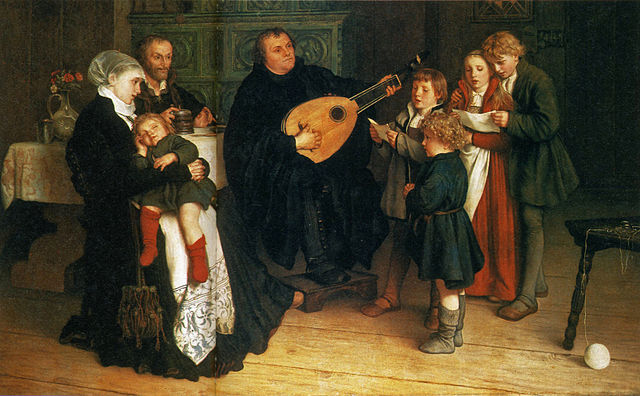
Although the government of Israel was to use the day for self-education, and it was commendable for it to urge all citizens to do so, nothing in Scripture ever gave to the state the authority to control educational institutions. Rather, it is still left to the private citizens gathered in their families to do it [see pic above of Martin Luther with his family]. And it is worth noting that those in the extended family, including enslaved laborers, were to be included in this education and rest.
C. D. Ginsburg in Leviticus points out that these two commandments are connected in Leviticus 19:1-3 in one of only two times that God tells Moses to speak to the entire “congregation”, i.e. governing assembly of citizens in the whole. Ginsburg says: “Joined with this fifth commandment is the fourth of the Decalogue. The education of the children, which…devolved upon the parents, was more especially carried on by them on Sabbath days.”
This leads to the related Fifth commandment.
The content below was originally paywalled.
The Fifth
When it says to “Honor [i.e. give extra weight to] your father and your mother” it is again addressed to the governing elders, not primarily to general individuals. In effect it means the following. Your government shall give priority to parental rights and responsibilities. It should be noted that both father and mother are mentioned so that the role of both was protected. This was not the case in pagan nations at that time.
And note that the promise of “days being long on the land” is not given to individuals. Some people honor their families yet die young. It is not about individual length of life. Rather it is a promise to the national civilization. It is about the “land” or country being blessed. Deut 5:16 added “that it may be well with you in the land.” If government empowers the family institution, then the nation will flourish and endure for many generations as a stable and prosperous society.
This is an important principle. The family in a nation is more important than the government. Empowering and protecting it should be the state’s most important priority. The state has a legitimate interest in maintaining parental authority and thus laws were passed to punish incorrigible adult children (Even Jesus affirmed capital punishment in such cases in Mark 7:10, but usually lesser penalties were applied in practice. It is also of note that although pagan nations, such as Rome and China, allowed fathers authority to kill their children, Israel did not.). The point is that the family institution is the most vital sphere of a nation and must be protected strongly the same as for treason. Highest punishments are for that which threatens the nation’s survival as a whole.
To honor parents included providing for them when elderly (Mark 7:9-13 and 1 Tim 5:8; both Jesus and Paul strongly condemned it.). When the state interferes with this duty by coercively taking the family’s resources for so-called “Social Security” and also steals from the inheritance by post-death taxation, it violates this commandment.
The extended family was commanded by God to provide the education of its members. Deut 6:6,7 declared the family house was the school house; there were no others. Levites would supplement education in God’s law beginning around age 10 or 11, but all other academic subjects were the responsibility of parents and grandparents in the household. The state had no controlling role whatsoever except to require families to do their educational job. There is a legitimate basis for government to empower parents in their educational work with financial means, if it does not usurp the control of education.
Pagan nations went further and controlled all schools. Modern nations usurp most of the responsibilities of the family or over-regulate it. In Israel never was the state empowered to control schools, health care, services for the elderly and poor, etc. These were all commanded by God as family responsibilities. Modern Christians around the world today accept the state’s role in these areas because they lack a Biblical worldview.
Even worse today is that modern nations are now directly interfering in very personal matters of the family by using schools to teach about sex, gender and even forcing health-related decisions that should be left to the parents. State school-teachers and counselors are actively teaching morals and behavior that they know is against the parent’s morals and religious values. They are grooming kids in sexually immoral thought and behavior, not to speak of political and economic ideologies.
Conclusion
In conclusion, the Fourth and Fifth commandments gave the governing elders of Israel the responsibility to take time for continuing self-education in principles of liberty, and to empower parents to do their responsibilities in society, which transcended in importance any other national institution. In contrast to pagan cultures, children belonged to the parents in Israel, not to the state. These two commandments especially exalt the family and puts the state in a secondary role. To apply these principles to all citizens, not just the state, is good and valid, but not the main purpose of these Decalogue statements.